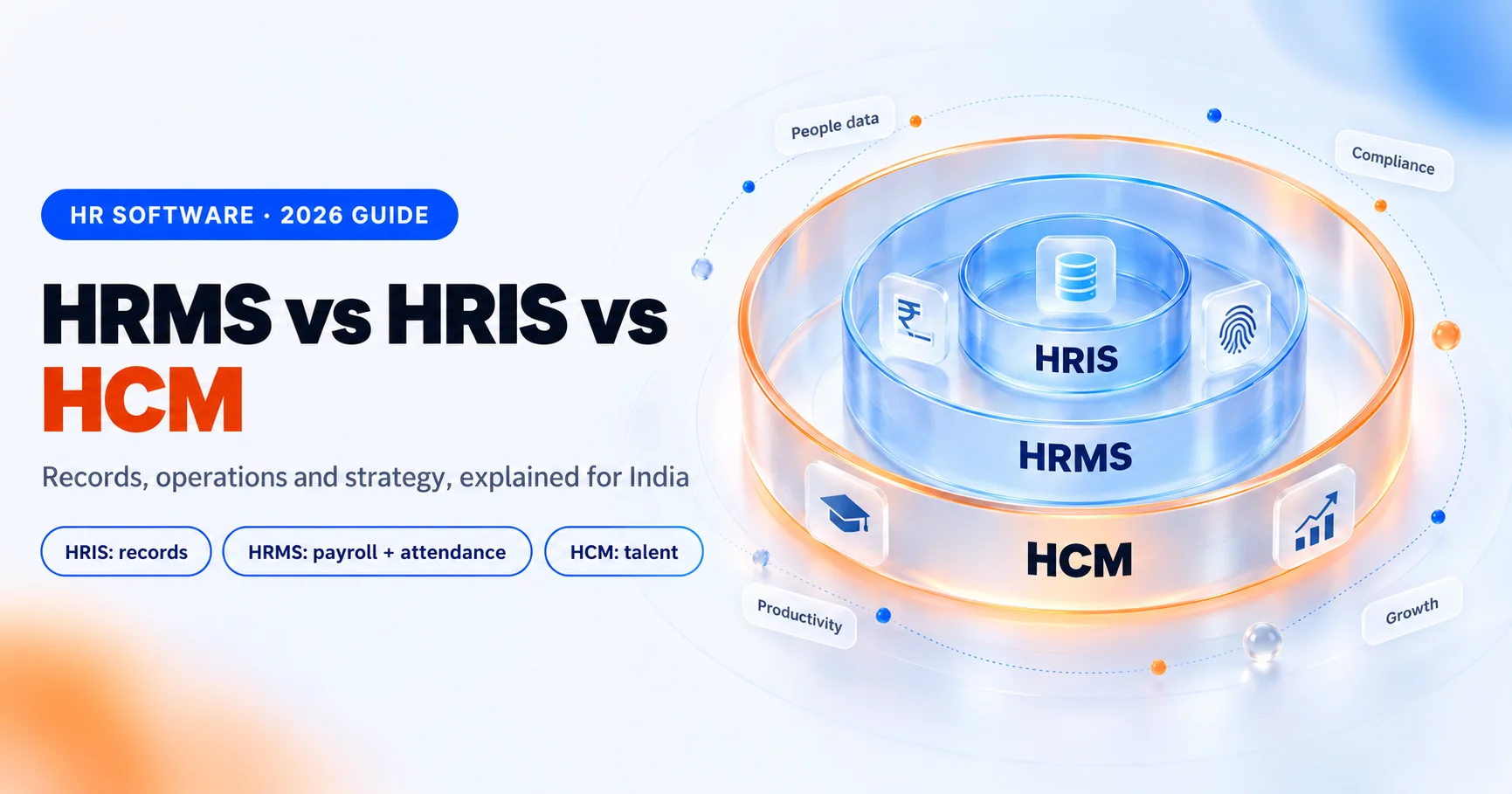
HRIS, HRMS and HCM are three overlapping names for HR software. An HRIS stores employee records, an HRMS adds operations such as payroll and attendance, and an HCM adds strategic talent management. Each one builds on the one before it, so the real difference is scope, not three separate products. Here is what each term means and how to pick the right fit for an Indian business.
Key Takeaways
- HRIS stores employee data and records; HRMS adds day-to-day operations like payroll and attendance; HCM adds strategic talent management on top.
- Each one contains the previous: every HRMS includes an HRIS, and every HCM includes an HRMS.
- For most Indian SMBs and mid-market companies, an HRMS is the right fit, since it runs payroll, attendance, leave and compliance in one place.
- HRIS alone suits very small teams that only need records; HCM suits large enterprises needing learning, succession and workforce planning.
- The labels overlap in marketing, so judge a tool by the modules it actually includes, not by its category name.
- In India, check that whichever you pick handles PF, ESI, PT and TDS, because many global HRIS and HCM tools do not.
What is an HRIS?
An HRIS (Human Resource Information System) is the system of record for your people. It stores employee data, documents, job and pay details, and leave balances. Think of it as the organised digital filing cabinet that every other HR process reads from.
Typical HRIS scope: employee database, document storage, basic leave and core HR records, and simple reports. It answers who works here and on what terms, but it does not run payroll or operations on its own.
What is an HRMS?
An HRMS (Human Resource Management System) takes those records and runs the daily machinery on top. Alongside the HRIS database, it operates payroll, attendance, leave, onboarding and compliance inside one platform instead of bolted-on tools.
So an HRMS includes everything an HRIS does, plus payroll software, an attendance management system, leave workflows and an employee self-service portal. For most Indian companies, this is the practical sweet spot.
What is an HCM?
An HCM (Human Capital Management) suite treats employees as a strategic investment rather than only an administrative record. On top of the HRMS operations, it adds recruitment, learning and development, performance, succession planning, compensation planning and workforce analytics.
HCM is aimed at large enterprises that plan talent years ahead. It includes the HRMS and the HRIS within it, which is why one platform can honestly be marketed as all three.
HRIS vs HRMS vs HCM: comparison
| Aspect | HRIS | HRMS | HCM |
|---|---|---|---|
| Core focus | Employee records and data | Day-to-day HR operations | Strategic talent management |
| Typical modules | Database, documents, leave balances, reports | HRIS + payroll, attendance, leave, onboarding, compliance, ESS | HRMS + recruitment, L&D, performance, succession, comp planning, analytics |
| Best for | Very small teams needing records | SMB to mid-market running payroll in-house | Large enterprises planning talent |
| Relationship | The base layer | Contains an HRIS | Contains an HRMS |
How the three relate
They are nested, not rival, categories. Every HRMS contains an HRIS, and every true HCM contains an HRMS. That is why the same product is often labelled HRIS, HRMS or HCM depending on who is marketing it. The useful question is not which label a vendor uses, but which modules the tool actually ships.
Which one does your business need?
- Under ~20 employees, records only: an HRIS, or the free tier of a full HRMS, is enough.
- SMB to mid-market running payroll in-house: an HRMS is the right fit, because payroll, attendance, leave and statutory compliance live in one system.
- Large enterprise with L&D, succession and workforce planning: an HCM suite earns its cost.
One India-specific caution: many global HRIS and HCM platforms do not handle PF, ESI, professional tax and TDS natively. Whatever category you choose, confirm the statutory payroll is built in, not an add-on. Our payroll compliance calendar lists every PF, ESI, PT and TDS deadline for the year.
Frequently asked questions
Is HRMS the same as HRIS?
No. An HRIS stores employee data and records, while an HRMS does that and also runs operations such as payroll, attendance, leave and onboarding. Every HRMS includes an HRIS, but not every HRIS is a full HRMS.
Is HCM bigger than HRMS?
Yes. HCM includes everything an HRMS does, plus strategic functions like recruitment, learning and development, succession planning and workforce analytics. HCM suits large enterprises, while an HRMS fits most SMB and mid-market firms.
Which is best for an Indian SMB?
An HRMS. It runs payroll with PF, ESI, professional tax and TDS, plus attendance and leave, in one platform, which is what most Indian SMBs and mid-market companies actually need.
Do HRIS and HCM tools handle Indian payroll?
Not always. Many global HRIS and HCM products need a separate payroll add-on for India. Confirm that PF, ESI, professional tax and TDS are built in before you buy.
Final word
HRIS, HRMS and HCM describe widening circles of the same HR software, records, then operations, then strategy. Most Indian businesses land on an HRMS, because it runs payroll and compliance alongside the employee record without the cost of a full HCM. Match the modules to your size, confirm Indian statutory payroll is native, and the label stops mattering. Want to see a full India-ready HRMS on your own data? Book a free factoHR demo.