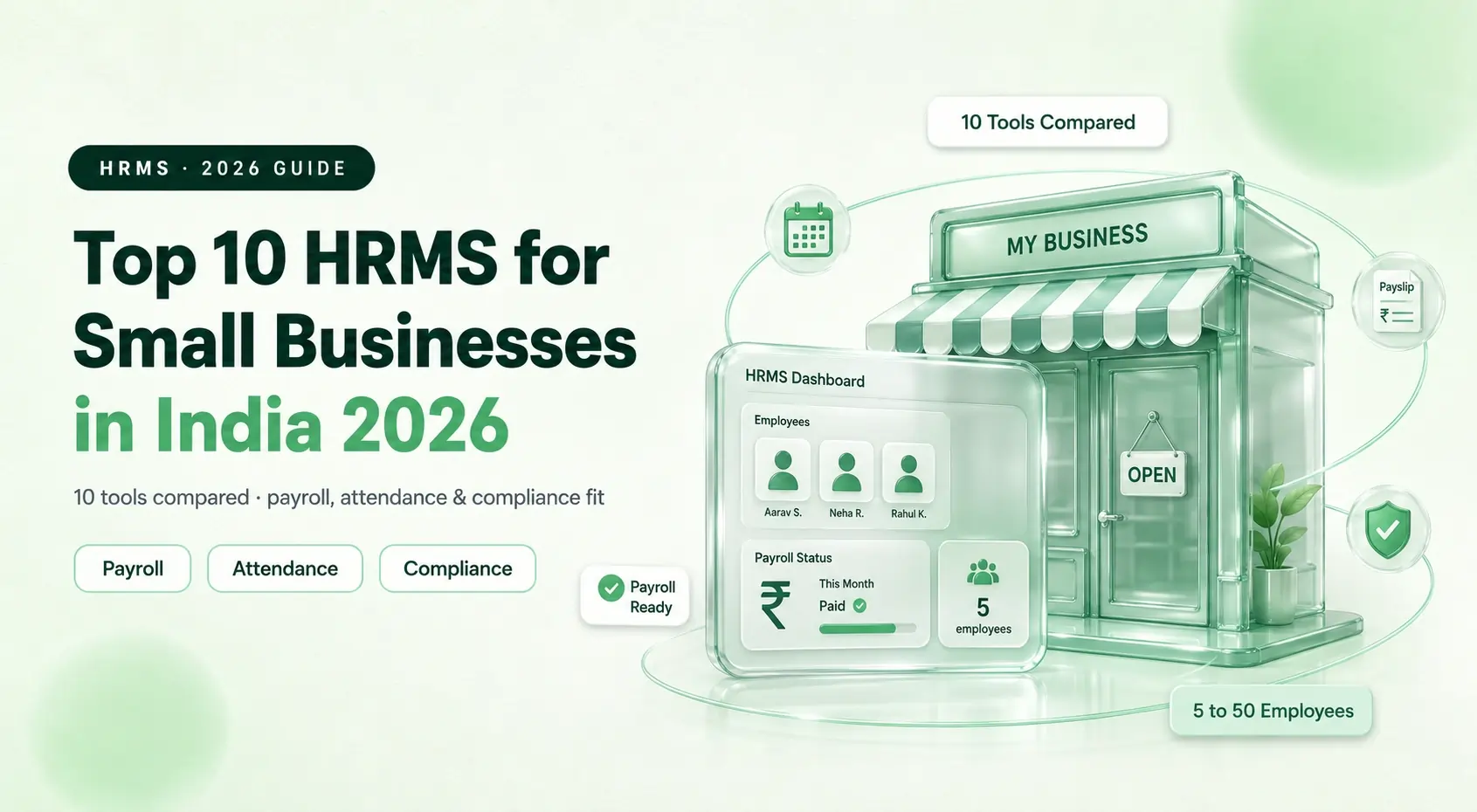
Small businesses often have ambitious goals but limited resources. The right tool simplifies payroll and employee management. As your team expands, manual spreadsheets and fragmented processes can hinder productivity and increase compliance risks.
New to the basics? Learn what HRMS software is and what payroll involves before you choose a tool.
In today's fast-paced environment, having a smart, flexible HRMS is important. Check out our list of the Top 10 HRMS for small businesses in 2026. These platforms are affordable, easy to use, and offer tools that help keep employees engaged while delivering a strong return on investment.
Key Takeaways
- Learn about the top 10 HRMS for small businesses in 2026 and what makes them stand out.
- Understand how to compare HRMS software using a simple comparison table.
- Learn how to choose the right HRMS based on your needs, budget, and growth plans.
- Discover the essential HRMS features every small business should consider.
- Get to know how HRMS tools simplify payroll, compliance, and employee management.
- Gain practical insights to select, implement, and maximize HRMS value.
The 10 Best HRMS for Small Businesses in 2026
This list was built on three criteria: ease of use for small teams, depth of Indian payroll and compliance support, and per-employee pricing fit for growing businesses.
Still deciding which category fits your team? Compare HRMS vs HRIS vs HCM first.
1. factoHR India
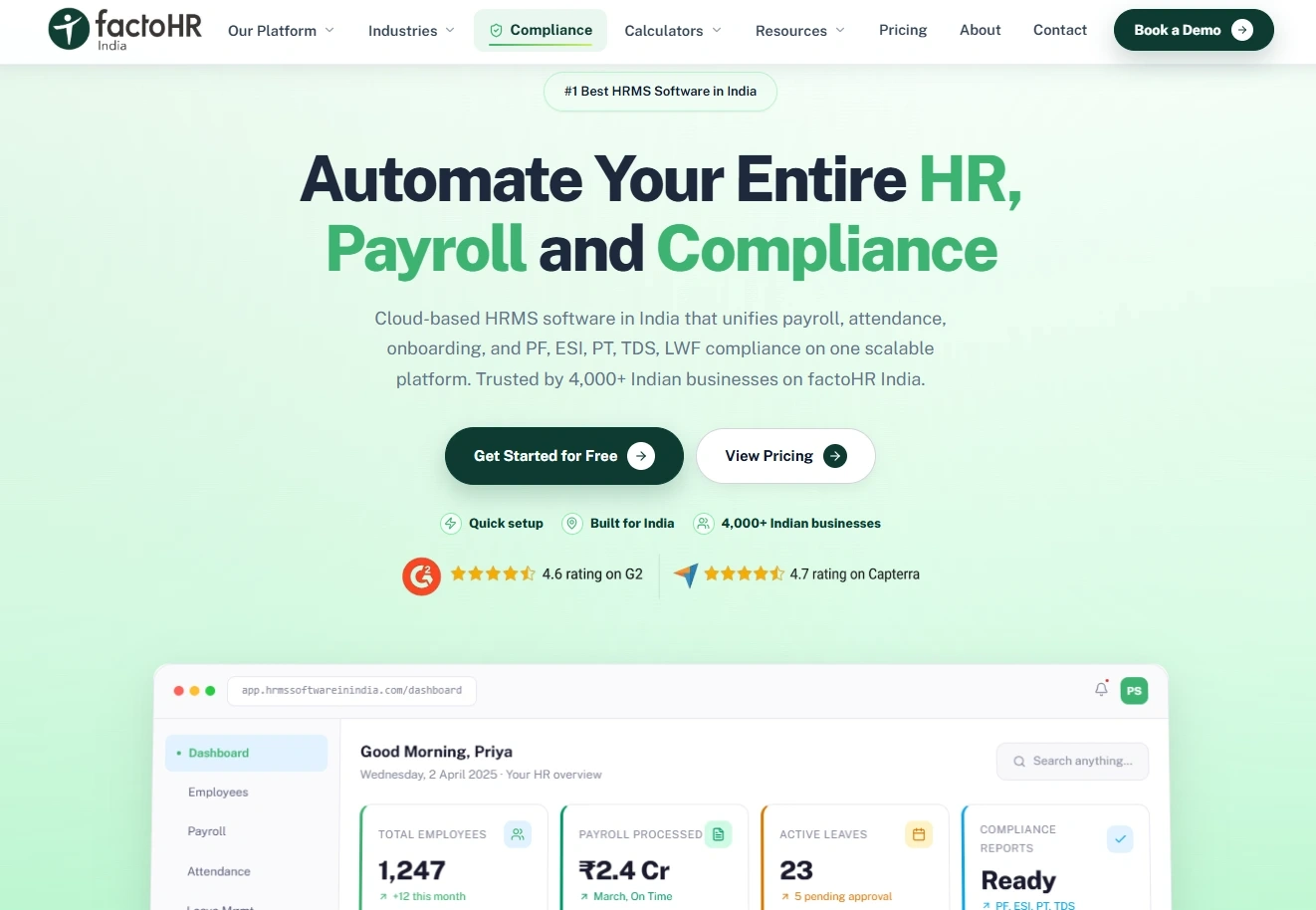
factoHR India lets small businesses manage the entire employee lifecycle, including hiring, onboarding, payroll, and performance, on a single platform. Automation reduces errors and supports Indian payroll compliance. Cloud-based, scalable, and designed to support business growth. Backed by factoHR.
Key Features
- Automated payroll & statutory compliance with PF, ESI, PT & LWF
- Biometric & geo-fencing attendance for office and field staff
- Mobile self-service portal for payslips, leave & tax details
- Performance management with goals & continuous feedback
- Expense and travel management with mobile claims & approvals
- Onboarding to exit management with documentation & FnF settlements
Pros:
- Reduced manual HR workload & time savings
- Improved payroll accuracy & statutory compliance
- Better employee experience via self-service & mobile access
- Seamless scalability as the business and team grow
- Live HR analytics for faster decision-making
Cons:
- Initial setup & training may take time
- May feel complex for very small teams
- Customization & legacy ERP/accounting integration may require extra effort or cost
Pricing: Custom cost based on company size and modules. Book a free demo to get a quote tailored to your needs.
Best suited for: Indian small businesses and growing SMEs that want a unified HRMS with built-in payroll compliance.
2. Pocket HRMS
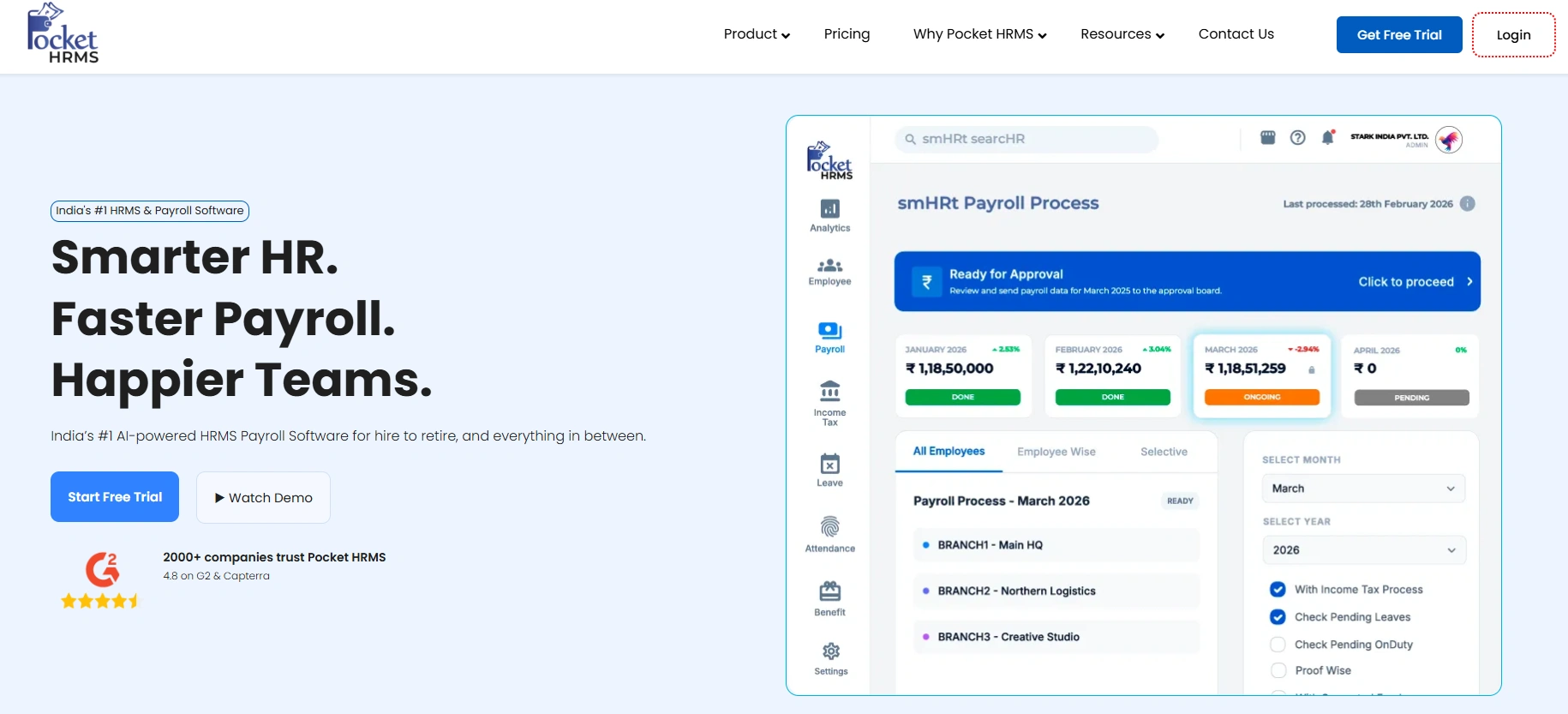
Pocket HRMS is a cloud-based HRMS built specifically for Indian small and mid-sized businesses. It bundles payroll, attendance, leave, and employee self-service into a clean, mobile-friendly platform that small teams can roll out in days. Strong focus on Indian payroll compliance with PF, ESI, PT, and TDS handled out of the box.
Key Features
- Cloud payroll with PF, ESI, PT & TDS calculations
- Biometric, GPS & mobile attendance with geo-fencing
- Leave management with multi-level approval workflows
- Employee self-service mobile app with payslips & tax declarations
- Document and asset management with offer letter templates
- AI chatbot "smHRty" for HR query handling
Pros:
- SMB-friendly pricing and quick rollout
- India-first compliance focus
- Mobile-first design for distributed teams
- Clean, easy-to-learn interface
- Responsive Indian customer support
Cons:
- Lighter on enterprise-scale features
- Reporting customization is limited at lower tiers
- Integration library smaller than enterprise HRMS
Pricing: Per-employee per-month, quote-based for full feature access.
Best suited for: Indian small businesses and growing SMEs that want focused HR + payroll without enterprise complexity.
Free hands-on small-business HRMS walkthrough.
We'll run your team size & payroll setup — live, 20 mins.
3. greytHR
greytHR is a cloud-based HRMS designed for small and medium businesses, widely used in India and the Middle East. The platform integrates payroll, attendance, leave management, employee records, and compliance into a single solution. Its user-friendly interface and strong local compliance features help reduce manual effort and errors.
Key Features
- Automated payroll supports complex salary structures, variable pay, and precise deductions
- Employee self-service portal with payslips, Form 16 & GPS live tracking
- Live attendance with geo-fencing, biometric integration & customizable leave policies
- AI-based candidate profile scoring for automated recruitment ranking
- Reimbursement management with multi-currency support & employee asset tracking
Pros:
- Strong compliance with regional labor laws and Indian tax updates
- Flexible plans with add-on modules that grow with business needs
- Multilingual mobile app support
- Free Forever plan available for startups with up to 25 employees
Cons:
- Occasional delays in technical support response during peak traffic
- Performance slowdowns during high-volume month-end payroll processing
- Initial setup of complex policies can feel challenging for new users
Pricing: Starts at ₹3,495 per month for up to 50 employees + ₹35 per employee per month on the Starter plan.
Best suited for: Indian small businesses and SMEs that want a free starter plan and a compliance-focused payroll engine.
4. HROne
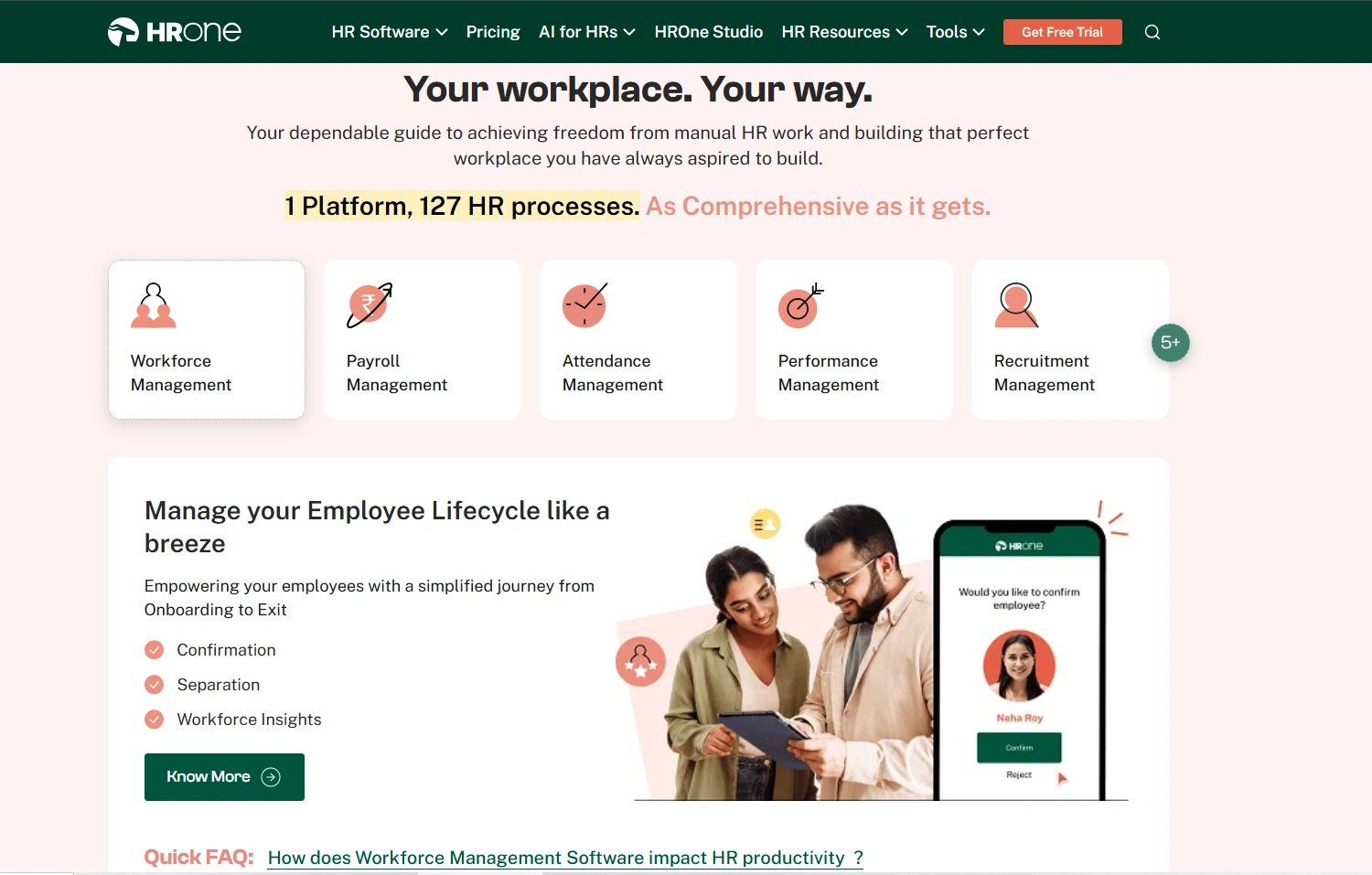
HROne is an automated HR software that makes managing people easier. Its main feature is the "Inbox-for-HR," a unique interface that works like an email inbox. Users can approve, reject, or delegate tasks from one screen, so there is no need to search through complicated menus.
Key Features
- Automated payroll with Indian statutory compliance and one-click payslips
- Geo-fencing, facial recognition, and automated shift rotation
- OKR tracking, 360-degree feedback, and continuous performance management
- Applicant tracking system (ATS) supporting hiring through digital onboarding
- Paperless expense management with mobile receipt scanning and instant approval
Pros:
- Inbox-style interface reduces screen fatigue and minimizes switching between modules
- Designed for Indian labor laws, simplifying payroll, compliance, and audit readiness
- Supports multi-company and multi-location management on a single platform
- User-friendly mobile app for managing attendance, leave, and tax tasks on the go
- Strong API integrations with tools like Slack, MS Teams, and biometric devices
Cons:
- Best suited for organizations with over 50 employees, making it less ideal for small startups
- Highly structured modules may be restrictive for businesses with unique workflows
- Advanced custom reporting may be less intuitive than dedicated BI tools
Pricing: Basic plan starts at ₹4,950 per month for up to 50 users + ₹99 per user per month.
Best suited for: Mid-sized Indian businesses that want an inbox-style HR workflow and strong API integrations.
5. Keka
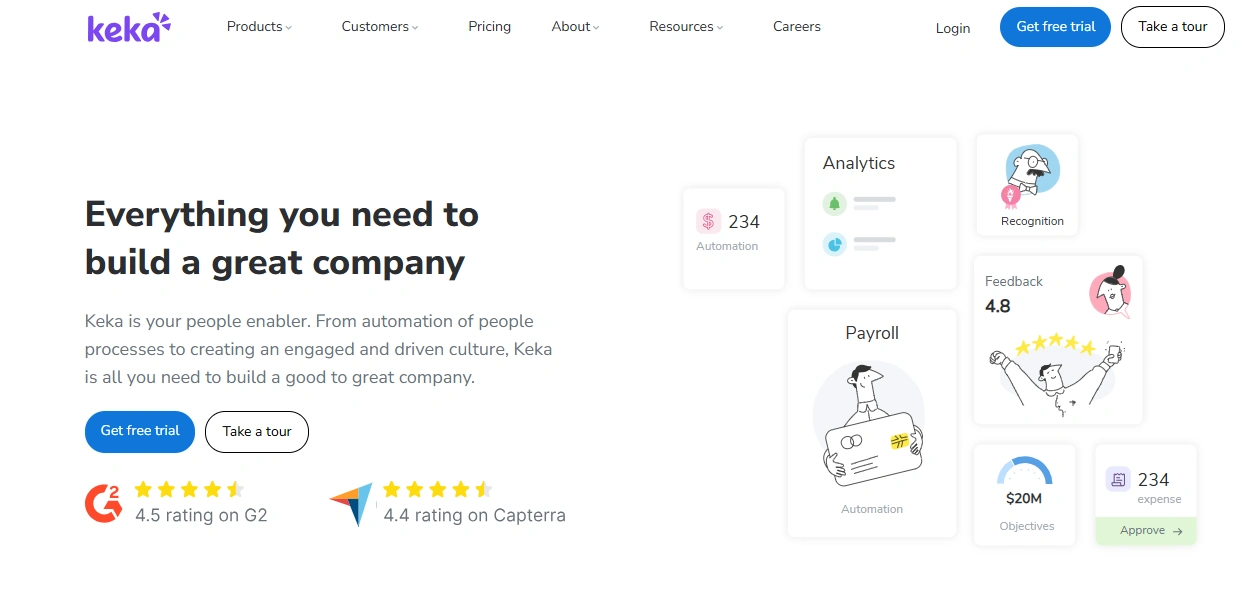
Keka is a cloud-based HRMS that helps small and mid-sized businesses manage complex workflows more easily. It brings together core HR, performance management, and hiring in one digital platform to improve the user experience. With its focus on design, Keka helps companies move from manual tasks to a workplace that supports employee engagement and growth.
Key Features
- Automated payroll with PF, ESI, TDS, and a simple six-step processing wizard
- Attendance tracking includes GPS, selfie punch-ins, geofencing, and gamified features
- Supports OKR-based goals, feedback badges, and 360-degree performance reviews
- Tracks project time for both resource management and service billing
- Leadership dashboards offer analytics and HR insights tailored to different roles
Pros:
- Modern, user-friendly interface requiring minimal employee training
- Complies with Indian regulations and keeps data stored locally
- Seamless integration across HR, payroll, and performance modules
- Role-based access control with high-level data security and access alerts
Cons:
- The mobile app is convenient, but lacks full web version functionality
- Slow customer support response times
- Rigid workflows with limited flexibility for custom processes
Pricing: Custom pricing based on company size.
Best suited for: Mid-market Indian businesses that prioritize design polish and a unified HR + performance experience.
6. Zoho People
Zoho People is a cloud-based HR management system that helps small and growing businesses handle employee data, attendance, leave, performance, and engagement all in one place. It works well with other Zoho apps and has both a free plan and several paid options, depending on the features and number of users you need.
Key Features
- Attendance and timesheet management with shift and remote work support
- Leave management with customizable policies and approval workflows
- Employee engagement tools, including surveys, announcements, and feedback
- Learning management system for self-paced training and course tracking
- Integrated help desk for employee queries and a grievance ticketing system
Pros:
- Free plan available for up to 5 users with cost-effective per-user pricing
- Strong integration with the Zoho ecosystem, like CRM, Projects, and Analytics
- Flexible customization to support unique company policies and workflows
Cons:
- Advanced analytics and some HR modules are available only in higher-tier plans, increasing cost at scale
- Collaboration features like chat and calls require separate Zoho add-ons, adding extra cost
- Pricing structure may feel less flexible for businesses needing only select features
Pricing: Starts at ₹48 per user per month.
Best suited for: Small businesses already using the Zoho ecosystem.
7. sumHR
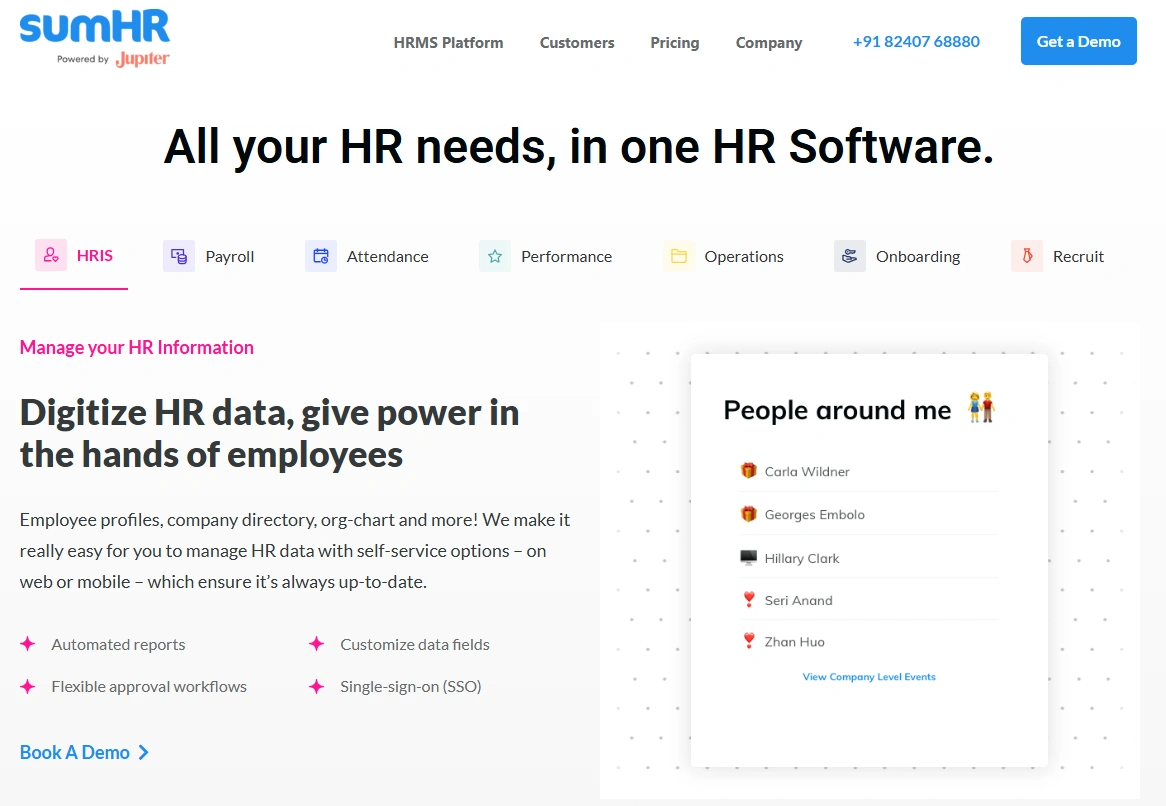
sumHR is a cloud-based HRMS and payroll software designed primarily for startups and SMEs in India. It aims to eliminate manual paperwork by centralizing employee data, attendance, and payroll into a single, user-friendly platform.
Key Features
- Employee database with directory, org chart, and self-service profiles
- Attendance tracking via biometric, mobile, and web integrations
- Automated payroll processing and expense reimbursements
- Leave management and shift scheduling
- Recruitment tools, including a career site and an applicant pipeline
Pros:
- User-friendly interface ideal for small teams
- Highly intuitive UI that requires minimal training for new users
- The "Pay-as-you-go" model makes it affordable for very small teams
- Strong focus on Indian labor laws and tax regulations (TDS, PF)
- A responsive customer success team
Cons:
- Limited advanced reporting and customization options
- Slow page loading or refresh issues in some cases
- Payslip download not available via app
Pricing: ₹49 per user per month (billed annually).
Best suited for: Indian startups and very small teams that want pay-as-you-go pricing.
8. Kredily
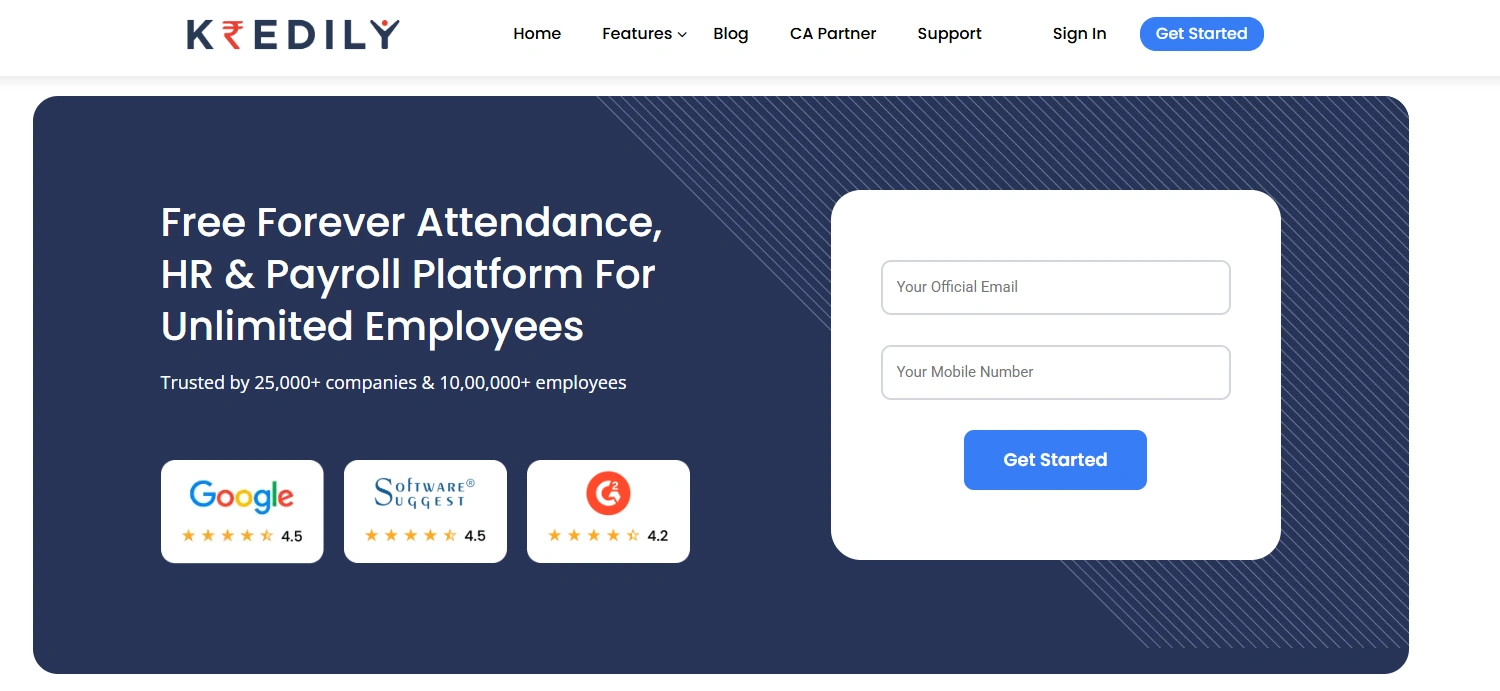
Kredily is a cloud-based HR and payroll platform for Indian MSMEs and startups. Its "Free Forever" plan streamlines employee onboarding, attendance, compliance, and salary payments on one platform.
Key Features
- One-click salary processing with automated calculations for bonuses, overtime, and deductions
- Automatically manages PF, ESI, Professional Tax, and TDS, including challan and Form 16 generation
- Offers "Selfie Attendance," GPS and geofencing tracking, web punch-in and punch-out, and customizable leave approval workflows
- Provides a portal and mobile app for employees to download payslips, declare investments, and request leave
- Tracks employee reimbursements digitally with sequential approval workflows, eliminating manual spreadsheets
Pros:
- Offers a free plan for basic HR and payroll with unlimited employees
- Simple, intuitive interface and mobile-first design for SMEs
- Offers a "15-minute setup" and same-day deployment
- Attendance-payroll integration that reduces manual data entry and errors
- Features a modern dashboard that requires minimal training
Cons:
- Some features, like geofencing and API integrations, may be limited or unavailable in the free plan
- Free users may experience slower customer support response times
Pricing: Free plan. The other basic plan starts from ₹1,249 per month for up to 25 employees + ₹50 per additional employee.
Best suited for: Indian MSMEs and bootstrapped startups that need a free or ultra-low-cost starting point.
9. ZingHR
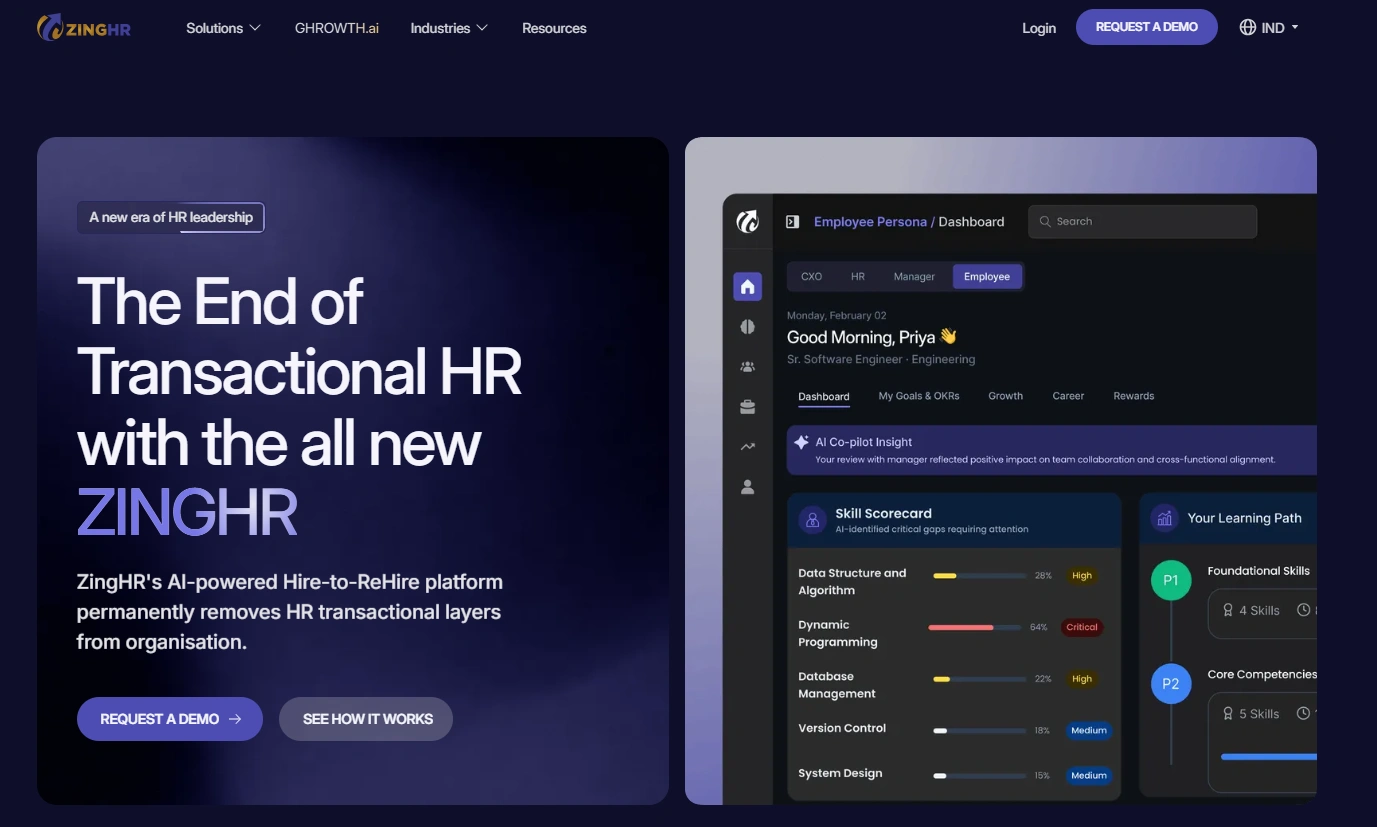
ZingHR is a cloud-based, AI-enabled HCM platform that offers a complete "Hire to Rehire" solution for managing the employee lifecycle. It emphasizes "Outcomation," helping organizations move beyond traditional HR processes to achieve measurable business outcomes through advanced, mobile-first HR technology.
Key Features
- Digital onboarding with paperless documentation and employee joining workflows
- Geo-fencing and mobile-based attendance tracking capabilities
- Live analytics and dashboards for workforce insights
- AI-enabled Applicant Tracking System (ATS) for recruitment and resume screening
- Learning, development, and employee engagement modules for talent growth
Pros:
- End-to-end HR lifecycle management in a single platform ("Hire to Rehire")
- Strong focus on AI-enabled automation and HR process digitization
- Mobile-first platform with self-service capabilities for employees and managers
Cons:
- Slow loading times and occasional performance issues, especially during peak usage
- Integration challenges with third-party applications and systems
- Frequent login/session issues that can delay access to the platform
Pricing: Customized based on company size, modules, and requirements.
Best suited for: Growing Indian businesses that want AI-led automation across the full hire-to-rehire lifecycle.
10. PeopleStrong
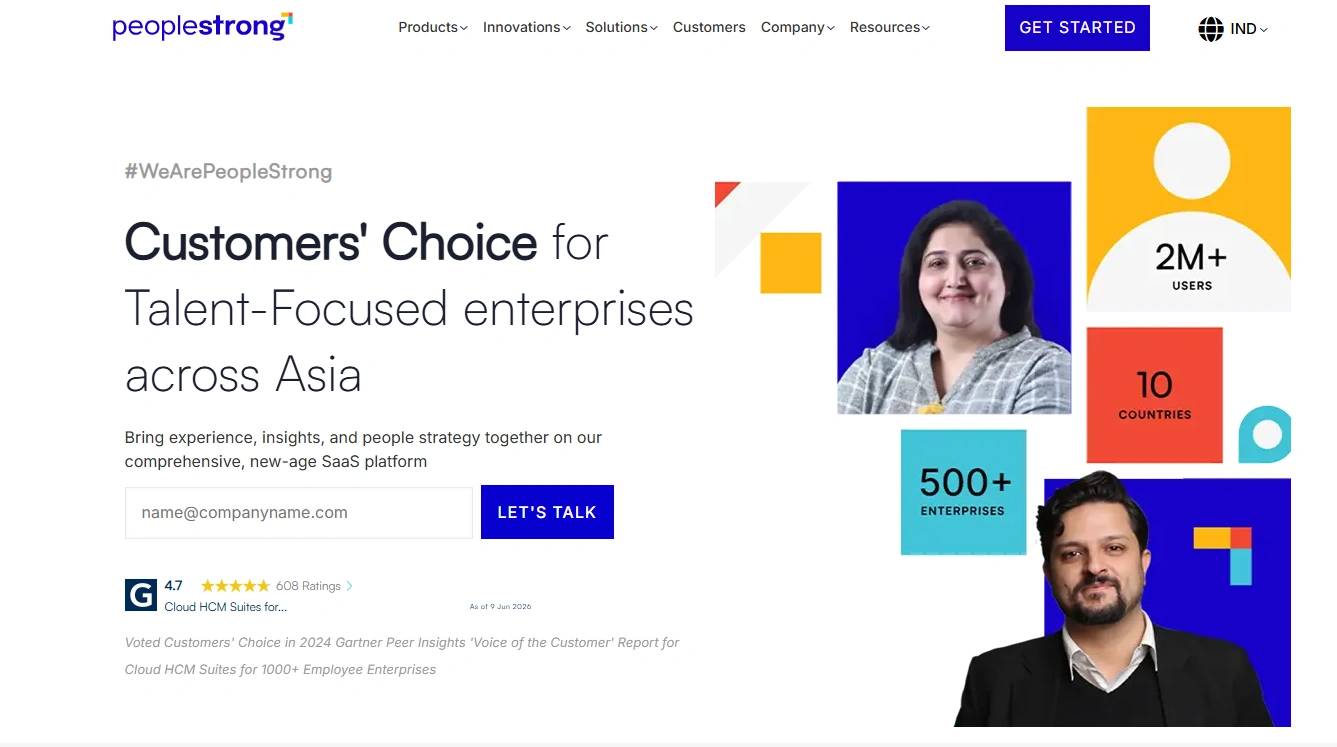
PeopleStrong is a leading comprehensive Human Capital Management (HCM) SaaS platform based in the Asia Pacific, designed to streamline the entire employee lifecycle from hire to exit. It focuses on creating a unified, data-driven HR experience with automation and employee-centric design.
Key Features
- AI-powered recruitment with resume parsing, automated interview scheduling, and integration with over 350 job boards
- Fully automated, compliant payroll processing with "punch-to-payroll" integration and AI-driven self-service for payslips
- Recruitment and onboarding (ATS, offer management, and digital joining workflows)
- A personalized, AI-driven learning ecosystem that offers industry-standard courses and tracks skill gaps
- An intelligent virtual assistant that provides instant query resolution and acts as a single interface for various HR tasks
Pros:
- Cloud-based, easy to deploy, and scalable
- Highly customizable workflows for different HR processes
- Agentic analytics with data-driven insights and visual dashboards
- Advanced analytics and reporting capabilities
- Good user experience and mobile responsiveness
- AI-driven performance, learning, and talent modules
Cons:
- An advanced platform may feel complex for new users or small teams
- Initial challenges in syncing performance modules with legacy systems
- Limited offline functionality
Pricing: Customized based on organization size and needs.
Best suited for: Indian growth-stage businesses planning to scale into mid-market and enterprise.
Quick Comparison Table
Picking the right software is critical for small businesses in India, where navigating statutory requirements such as PF, ESI, and TDS can be a manual nightmare. The software market in 2026 has shifted heavily toward AI-driven automation and mobile-first experiences. Compare on attendance, recruitment, performance, and analytics depth.
| HRMS | Attendance | Recruitment (ATS) | Performance Management | Analytics |
|---|---|---|---|---|
| factoHR India | Mobile and geo-fencing | ATS included | OKRs & continuous | Advanced |
| Pocket HRMS | Biometric, GPS, mobile | Basic ATS | Goal-based reviews | Moderate |
| greytHR | Biometric and mobile | Limited | Basic to moderate | Basic to moderate |
| HROne | Smart attendance | ATS included | OKRs & 360 | Advanced |
| Keka | Advanced tracking | ATS included | OKRs & 360 | Advanced |
| Zoho People | Basic to advanced | Basic ATS | Goal-based reviews | Moderate |
| sumHR | GPS / biometric | Career site & pipeline | Basic | Basic |
| Kredily | Selfie / GPS | Basic | Basic | Basic |
| ZingHR | Geo-fencing and mobile | AI-powered ATS | Continuous reviews | Advanced AI dashboards |
| PeopleStrong | Advanced tracking | AI-powered ATS | Advanced | Agentic analytics |
Key Features Every HRMS for Small Businesses Must Have
For small businesses, an HRMS must balance simplicity, automation, and compliance while driving efficiency. Here are the key features to look for:
Automated payroll & compliance
To avoid penalties, the system must automate tax calculations (TDS, PF, ESI) and adapt to regulatory changes as they happen.
Centralized employee database
Keeping all documents, contracts, and personal data in one place makes it easier to find information and maintain security.
Integrated time and attendance
Syncing punch-ins and punch-outs through biometric, mobile app, or GPS directly with payroll reduces manual errors and simplifies leave management.
Employee self-service (ESS)
A mobile-first portal lets employees access payslips, request leave, and update information, reducing HR workload by up to 50%.
Onboarding
Digital workflows for new hires create a professional impression and speed up productivity.
Data security
As Indian privacy norms evolve, strong encryption and role-based access are critical for protecting employee personal data.
How to Choose the Best HRMS for Small Businesses
Choosing the right HRMS is critical for growing a small business without getting stuck in manual work and paperwork. Here are the key things to look for:
- Identify business needs such as payroll, attendance, recruitment, or performance management before selecting an HRMS.
- Small teams rarely have dedicated IT support. Choose an intuitive, user-friendly interface that requires minimal training for both managers and employees.
- Choose a system with core features like employee records, attendance, leave management, payroll, and document storage.
- Evaluate integration capabilities with accounting, ERP, and other business tools.
- Opt for a cloud-based, subscription-model (SaaS) that grows with you. Look for "per-employee" pricing to keep costs predictable.
- Verify that the provider offers automated tax updates and strong data encryption to protect sensitive employee information.
- A good mobile app is essential for employees to clock in or request leave when they are not in the office.
- Compare pricing models and ensure the solution fits your budget without hidden costs.
- Check the quality of customer support to make sure you can get help quickly and easily when you need it, especially during setup.
- Request a demo so you can see how easy the system is to use before you decide.
Conclusion
Picking the right HRMS is essential for small businesses to simplify HR operations, improve efficiency, and support growth. The top 10 HRMS solutions, like factoHR India, Pocket HRMS, Keka, Zoho People, and greytHR, automate payroll, attendance, and compliance, which cuts down on manual work.
Look for a platform that is affordable and easy to use so your team stays engaged, and your business meets all requirements.
FAQs
What is HRMS software for small businesses?
HRMS software is a digital tool that helps manage employee data, payroll, attendance, and performance in one system. It reduces manual work, improves accuracy, and supports Indian payroll compliance.
Can HRMS software handle payroll and compliance in India?
Yes, most HRMS software in India automates payroll processing and supports PF, ESI, TDS, and other statutory workflows.
Do these HRMS platforms have mobile apps for employees?
Most top HRMS platforms, such as factoHR India, greytHR, Keka, Zoho People, and sumHR, offer mobile apps that let employees manage attendance, payslips, leave, and expense claims on the go.
How much does an HRMS for small businesses typically cost in India?
Many HRMS platforms start from around ₹48 to ₹49 per user per month, while some offer free plans, and others provide custom pricing based on company size and modules.
Are these HRMS solutions easy to use for non-IT teams?
Yes. Platforms like factoHR India, Keka, Zoho People, and sumHR focus on simple, intuitive interfaces and quick onboarding, making them easy to use even for non-IT teams.
Can HRMS software integrate with accounting or business tools?
Yes. Many HRMS platforms integrate with accounting and business tools; for example, Zoho People works with other Zoho apps, and HROne supports integrations with Slack, Teams, and biometric devices.
Is cloud-based HRMS safe for small businesses?
Cloud-based HRMS systems are generally secure, offering data encryption, role-based access, and regular backups to protect sensitive employee information.
How to choose the best HRMS software for small businesses?
To choose the best HRMS software, identify your needs, compare features, check pricing, ensure scalability, request demos, and read user reviews before making a decision.
What is "AI-enabled" HRMS, and do I really need it?
An AI-enabled HRMS automates tasks like resume screening, chatbots, and workforce insights. While small teams may not need advanced AI, basic features can improve accuracy, reduce errors, and save time.
How does an HRMS help manage remote or field-based employees?
Most modern HRMS platforms provide mobile features, like geofencing and GPS-based attendance, that allow employees to punch in from specific locations. These tools sync this data with payroll, helping businesses accurately track attendance and field activity.