Indian HR teams in 2026 manage everything from PF and ESI deductions to attendance, leave, performance, and onboarding. Doing it on Excel and email is slow, error-prone, and risky for compliance. HRMS software fixes that by putting every HR workflow on a single platform.
It brings payroll, attendance, and compliance into one system. For a module-by-module view, see the key HRMS features.
This guide explains what HRMS software is, what modules it includes, why Indian businesses need it, and how to choose the right one. Built for HR managers, founders, and finance leaders evaluating their first HRMS.
Key Takeaways
- HRMS software is a cloud platform that automates payroll, attendance, leave, performance, and statutory compliance from one system.
- Indian HRMS handles PF, ESI, PT across 19 states, TDS, LWF, Gratuity, Form 16, and ECR generation.
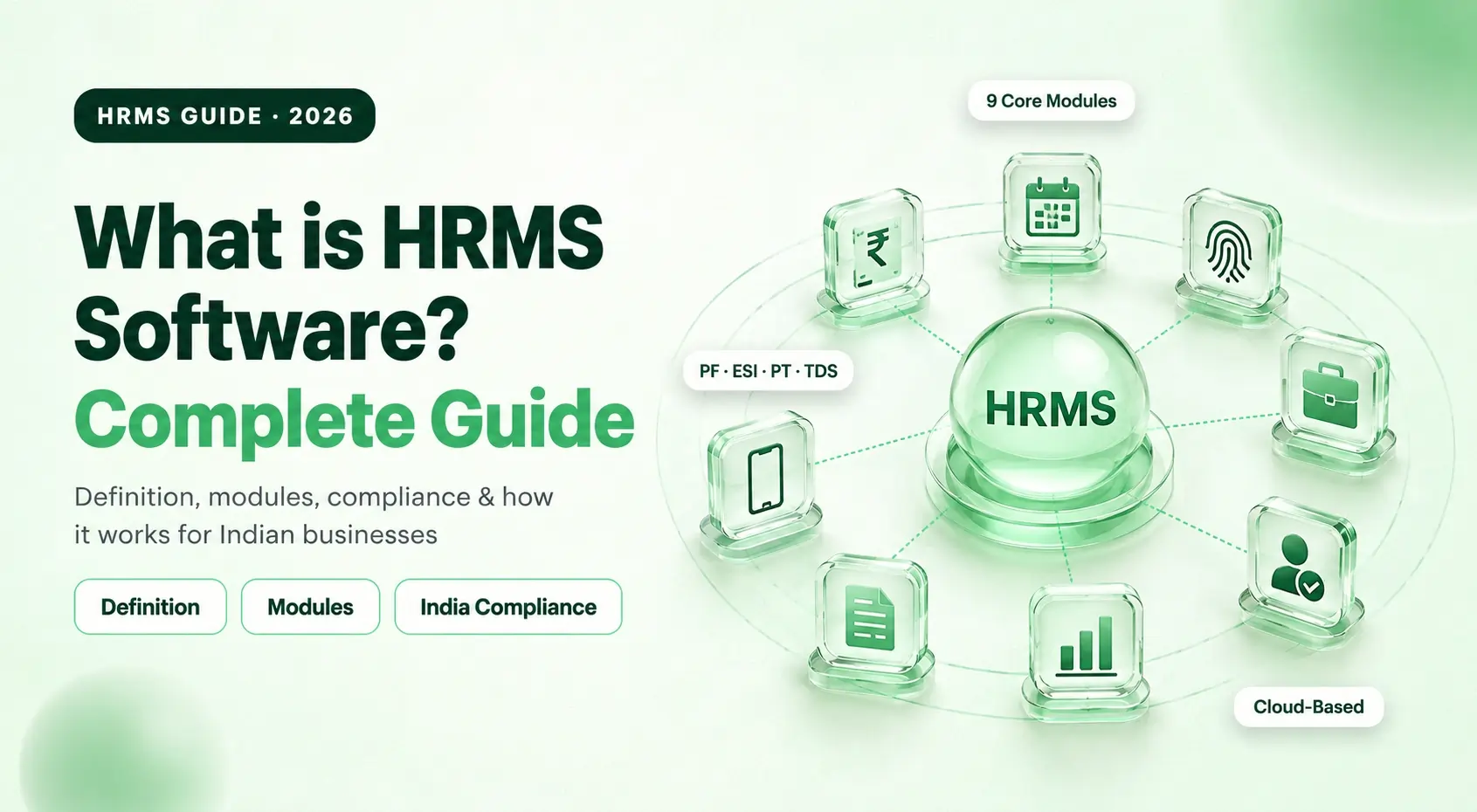
- Core modules: Payroll, Attendance, Leave, Performance, Recruitment, Onboarding, ESS, Expense, Timesheet.
- HRMS vs HRIS vs HCM: HRIS = records, HRMS = records + processes, HCM = HRMS + talent strategy.
- Pricing in India typically ranges from Rs 60 to Rs 300 per employee per month.
- Cloud HRMS goes live in 2 to 5 business days; on-premise takes weeks.
What is HRMS Software?
HRMS software (Human Resource Management System) is a cloud platform that helps companies manage every part of the employee lifecycle in one place. It covers payroll, attendance, leave, performance reviews, recruitment, onboarding, expense claims, employee self-service, and statutory compliance.
Modern HRMS replaces spreadsheets, standalone payroll tools, and email-based workflows with a connected system that runs on web and mobile. For Indian businesses, the right HRMS automates PF, ESI, Professional Tax, TDS, LWF, and Gratuity calculations through configurable rules updated as government regulations change.
HRMS Full Form and Meaning
HRMS stands for Human Resource Management System. It is software that combines HR records, payroll, attendance, performance, and compliance workflows into one digital system.
If the three labels confuse you, here is the difference between HRMS, HRIS and HCM.
The term is sometimes used interchangeably with HRIS (Human Resource Information System) and HCM (Human Capital Management), though the three differ in scope. We compare them in detail below.
Why Indian Businesses Need HRMS Software in 2026
Indian HR teams face complexity that global tools were not designed for. 19 states levy Professional Tax with different slabs, EPF and ESI thresholds change, TDS regimes shift mid-year, and labour laws vary by state. Manual systems break under this load.
Multi-state payroll without errors
An employee in Bengaluru, Mumbai, and Hyderabad has different PT slabs, LWF rates, and shift rules. Modern HRMS handles each state's rules automatically based on employee work-state, eliminating wrong deductions and compliance penalties.
Compliance updates that happen on time
When the government revises PF wage ceilings or PT slabs, a configurable HRMS updates rules across all employees without manual re-entry. Manual systems often miss notifications and create payroll errors that take weeks to reconcile.
Faster month-end close
What used to take 5 to 7 days of HR effort, payslip generation, manual TDS calculation, and bank advice file creation runs in hours on HRMS. Salary calculations, ECR file generation, and Form 16 output happen with one click.
Employee self-service that reduces HR tickets
Indian HRMS portals let employees download payslips, file IT declarations, apply for leave, and check tax projections on mobile. HR helpdesk tickets drop sharply, freeing the team for strategic work.
Audit and statutory readiness
EPFO inspections, ESIC audits, and Income Tax notices need clean records. HRMS keeps statutory registers, ECR challans, Form 16 PDFs, and audit trails ready for compliance reviews.
Core Modules of an HRMS
A modern Indian HRMS bundles 9 to 10 connected modules. Each can run standalone but works best when integrated.
Payroll
The financial engine handles salary calculation, CTC structures, PF / ESI / PT / TDS deductions, Form 16 and Form 138 output, ECR generation, and bank advice file creation. A robust Indian payroll software closes month-end in hours instead of days.
Attendance
This module captures punches via biometric devices, mobile GPS, geo-fencing, or web. A complete biometric and GPS attendance management system feeds attendance into payroll for LOP, overtime, and shift differential calculation.
Leave
A configurable leave management system manages 15+ leave types: earned, casual, sick, maternity, paternity, comp-off, sabbatical. It includes sandwich rules, location-based holiday calendars, and live payroll feed for LOP and encashment.
Performance
Modern performance management software covers OKRs, KRAs, 360-degree feedback, continuous check-ins, calibration, and 9-box succession grids. Performance ratings flow into payroll for merit increases.
Recruitment & ATS
An end-to-end recruitment and ATS software handles sourcing from Naukri, LinkedIn, and Indeed, AI resume screening, interview scheduling, scorecards, digital offer letters, and BGV vendor integration.
Onboarding
Strong employee onboarding software automates digital offer letters, Aadhaar e-Sign, document collection, induction workflows, and asset issue tracking. Connects to payroll, attendance, and ESS from day one.
Employee Self-Service
A mobile-first employee self-service portal lets staff access payslips, file IT declarations, apply for leave, submit expense claims, download Form 16, and view HR documents. ESS reduces HR helpdesk load by 50% or more.
Expense
Mobile-first expense management software handles claim submission with OCR receipts, GST-ready invoices, FBP routing, corporate card reconciliation, and payroll-linked reimbursements.
Timesheet
Project-based timesheet management software supports project and client time tracking with billable hours, utilisation reports, GST invoice generation, and payroll sync for consulting and services teams.
HRMS vs HRIS vs HCM: What is the Difference?
Buyers often see these three terms used interchangeably. The scope and depth differ.
| Term | Stands For | Scope | Best Suited For |
|---|---|---|---|
| HRIS | Human Resource Information System | Employee records, master data, basic reporting | Small businesses with simple needs |
| HRMS | Human Resource Management System | Records + payroll + attendance + leave + onboarding + compliance | Indian SMBs and mid-market businesses |
| HCM | Human Capital Management | HRMS + talent management + learning + workforce planning + analytics | Large enterprises with strategic HR goals |
For most Indian businesses with 20 to 5,000 employees, HRMS is the right fit. It handles operational HR plus Indian payroll compliance without the cost or complexity of full HCM.
Cloud HRMS vs On-Premise HRMS
Two deployment models, two very different total costs of ownership.
Cloud HRMS (Recommended)
- Subscription-based per-employee per-month pricing
- Goes live in 2 to 5 business days
- Automatic compliance and security updates
- Works on web and mobile from any location
- No IT infrastructure needed
- Vendor handles backups, uptime, and security
On-Premise HRMS (Legacy)
- Heavy upfront license cost plus annual maintenance
- Implementation takes 3 to 6 months
- Requires dedicated IT team for updates and patches
- Limited mobile and remote access
- Backup, security, and compliance updates handled in-house
- Typical for organisations with strict on-premise mandates
For most Indian businesses in 2026, cloud HRMS is the practical choice. It scales with growth, updates automatically, and removes IT overhead.
Key Features Every HRMS Must Have
Not every HRMS is built equally. These 10 features separate strong platforms from weak ones for Indian businesses.
Multi-state Indian payroll
Different PT slabs, LWF rates, and shift rules per state. The HRMS must apply the right rule based on employee work-state automatically.
PF, ESI, TDS, and Form 16 generation
ECR file generation for EPFO, ESIC contribution calculation, quarterly Form 138 output, and annual Form 16 PDFs. State-wise Professional Tax across 19 states must be pre-loaded.
Configurable salary structures
CTC components like Basic, HRA, DA, FBP, special allowance must be configurable per employee, grade, or location.
Biometric and mobile attendance integration
Native integration with eSSL, ZKTeco, HikVision, Realtime, and Suprema biometric devices, plus GPS and geo-fenced mobile attendance for field staff.
Leave management with sandwich rules
15+ leave types, sandwich rules, comp-off, encashment, and live payroll feed for LOP calculation.
Employee self-service on web and mobile
Payslips, IT declarations, leave apply, claim submission, and Form 16 download accessible to every employee.
Performance management with OKRs
OKRs, KRAs, 360-degree feedback, calibration, and bias-free review cycles aligned to Indian appraisal practice.
Reporting and analytics
40+ pre-built reports, payroll registers, compliance dashboards, and exportable data for finance and audit teams.
Mobile-first user experience
iOS and Android apps with feature parity to web. Indian employees expect mobile access for payslips, leave, and approvals.
Indian data residency and security
Employee data hosted on Indian cloud infrastructure with industry-standard encryption in transit and at rest, role-based access, and audit logs.
Indian Statutory Compliance HRMS Must Handle
Indian payroll compliance has more moving parts than most countries. The right HRMS handles these out of the box.
| Compliance Area | What HRMS Should Do |
|---|---|
| EPF | 12% employee + 12% employer calculation, ECR file generation for EPFO portal, UAN linking, monthly deductions |
| ESI | 0.75% employee + 3.25% employer calculation, ESIC IP capture, half-yearly returns |
| Professional Tax | State-wise PT slabs across all 19 PT-levying Indian states with deduction by employee work-state |
| TDS on Salary (Section 192) | Old vs new tax regime support, monthly TDS, Form 138 quarterly, Form 16 annual |
| LWF | State-wise LWF deductions and employer contribution |
| Gratuity | Calculation as per Payment of Gratuity Act 1972, with reports for FnF settlements |
| Form 16 and Form 138 | Auto-generation with TRACES integration and validation reports |
HRMS Pricing in India 2026
Indian HRMS pricing typically follows per-employee per-month subscriptions in INR with GST extra.
- Basic / Starter: Rs 60 to Rs 100 per employee per month — payroll, attendance, basic ESS
- Premium / Growth: Rs 100 to Rs 200 per employee per month — adds performance, recruitment, expense, advanced ESS
- Enterprise / Ultimate: Rs 200 to Rs 300 per employee per month — adds multi-entity, API access, dedicated success manager
Most platforms also offer custom pricing for 500+ employees and multi-entity setups.
How to Choose the Right HRMS for Your Business
Use this 8-step framework to shortlist and evaluate HRMS platforms.
Map your team size and growth plan
A 30-person startup needs a different HRMS than a 1,500-person manufacturing plant. See our pick of the best HR software for manufacturing for plant-ready options. Pick a platform that scales with your 18-month plan, not just current size.
List the modules you actually need
Avoid paying for modules you will not use in year one. Most Indian businesses need payroll, attendance, leave, and ESS first. Performance, recruitment, and expense come later.
Check Indian compliance depth
Test with a sample multi-state payroll cycle in the demo. Ask for ECR file generation, Form 16 output, and PT slab configuration walkthrough.
Evaluate mobile and ESS quality
Open the mobile app yourself. Try applying for leave, downloading a payslip, and filing an IT declaration. Indian employees use these features daily.
Ask about implementation timeline
Cloud HRMS should go live in 2 to 5 business days. Anything longer signals heavy customisation or weak onboarding playbook.
Check pricing transparency
Per-employee monthly pricing in INR with GST invoice. Watch for setup fees, module add-ons, and migration charges that inflate quoted price.
Verify support quality and language
Indian HR teams need English and Hindi support during business hours. Test response time during the demo cycle.
Run a parallel payroll before signing
Run one payroll cycle on the new HRMS alongside your current process. Compare numbers down to the rupee. This catches edge cases before go-live.
HRMS for Different Business Sizes
One size does not fit all. HRMS needs change as headcount grows.
Startups (10 to 50 employees)
Need affordable per-employee pricing, fast rollout, mobile-first ESS, and basic Indian compliance. Avoid heavy enterprise platforms.
SMEs (50 to 500 employees)
Need full HRMS suite covering payroll, attendance, leave, performance, ESS, plus India statutory compliance. Sweet spot for cloud HRMS like factoHR India.
Mid-market (500 to 2,000 employees)
Need multi-entity payroll, advanced calibration, OKR cascading, custom workflows, and dedicated success manager. Most cloud HRMS platforms scale here.
Enterprise (2,000+ employees)
Need API integrations, multi-country support, advanced analytics, talent management, and learning. HCM-class platforms or full-suite HRMS like factoHR India enterprise.
HRMS Implementation Process
Cloud HRMS implementation in India typically follows a 5-day playbook.
- Day 1: Data import — Employee master, salary structures, YTD payroll history loaded from Excel or current HRMS.
- Day 2: Compliance setup — PF, ESI, PT, LWF, TDS rules configured for every state in your workforce footprint.
- Day 3: Parallel run — Process a parallel payroll cycle alongside your existing system to validate every calculation.
- Day 4: Team training — Live training for HR, payroll, and finance teams on payroll run, ESS, and reports.
- Day 5: Go live — Full payroll cycle on the new engine with bank disbursement and ESS portal active for employees.
Future of HRMS in India 2026
Three big shifts are reshaping Indian HRMS in 2026.
AI-driven payroll and compliance
AI assists with tax regime selection, automatic anomaly detection in salary cycles, and predictive compliance alerts before deadlines.
Mobile-first employee experience
Indian employees increasingly do everything on mobile: punch attendance, apply leave, file IT declarations, and download Form 16. Web-only HRMS is losing ground.
Configurable Code on Wages readiness
The four labour codes (Code on Wages 2019, Code on Social Security 2020, Industrial Relations Code, Occupational Safety Code) are gradually being notified. HRMS platforms with configurable rule engines adapt fastest.
Conclusion
HRMS software is the operational backbone of modern Indian HR teams. It replaces fragmented spreadsheets and email-based workflows with a single platform that handles payroll, attendance, leave, performance, recruitment, onboarding, ESS, expense, and timesheet plus the full Indian payroll compliance stack of PF, ESI, PT, TDS, LWF, and Gratuity.
For Indian businesses in 2026, the choice between manual HR and HRMS is no longer about cost. It is about speed, accuracy, compliance readiness, and employee experience. The right cloud HRMS goes live in days, scales with growth, and pays for itself in saved HR hours and avoided compliance penalties. Book a free factoHR India demo to see all 9 modules in action.
FAQs About HRMS Software
What does HRMS stand for?
HRMS stands for Human Resource Management System. It is software that combines HR records, payroll, attendance, leave, performance, recruitment, onboarding, and statutory compliance into one platform.
What is the difference between HRMS and HRIS?
HRIS focuses on employee records and master data. HRMS adds operational workflows like payroll, attendance, leave, and onboarding on top of records. HCM extends HRMS further with talent management, learning, and workforce planning.
How much does HRMS software cost in India?
Indian HRMS pricing typically ranges from Rs 60 to Rs 300 per employee per month depending on modules and team size. Starter plans cover payroll and attendance; premium plans add performance, recruitment, and expense.
Is HRMS software useful for small businesses in India?
Yes. Small businesses benefit the most from HRMS because they typically lack a dedicated HR team. Automated payroll, compliance, attendance, and ESS reduce HR workload and prevent compliance errors.
How long does HRMS implementation take in India?
Cloud HRMS implementation in India typically takes 2 to 5 business days. The flow includes data import, compliance setup, parallel payroll run, team training, and go-live. On-premise HRMS takes 3 to 6 months.
Can HRMS handle PF, ESI, and TDS for Indian businesses?
Yes. A modern Indian HRMS handles PF (with ECR generation), ESI (with contribution calculation), Professional Tax across 19 states, TDS (with Form 16 and Form 138 output), LWF, and Gratuity automatically.
Is cloud HRMS safe for Indian companies?
Reputable cloud HRMS platforms host employee data on Indian cloud infrastructure with industry-standard encryption in transit and at rest, role-based access controls, configurable retention policies, and audit logs aligned with SOC 2 and ISO 27001 control families.
Can HRMS work on mobile?
Yes. Modern Indian HRMS platforms offer iOS and Android apps for employees to punch attendance via GPS, apply leave, download payslips, file IT declarations, and submit expense claims on the go.
What modules should an HRMS include?
A complete Indian HRMS should include 9 core modules: Payroll, Attendance, Leave, Performance, Recruitment, Onboarding, Employee Self-Service, Expense, and Timesheet. Each can run standalone but works best when integrated.
Which is the best HRMS software in India?
The best HRMS depends on team size, industry, and modules needed. For Indian SMBs and mid-market businesses, factoHR India offers a unified payroll, HR, and compliance platform with multi-state PT, LWF, ECR, and Form 16 output configured out of the box.