Every Indian business that pays employees runs payroll, yet most HR and finance teams underestimate how many moving parts it has. Salary structure, attendance data, statutory deductions, tax calculation, payslip generation, bank disbursement, and compliance filings all happen in a single cycle every month.
This guide explains what payroll is, how it works, what components make up an Indian salary, and what compliance every employer must handle. Built for HR managers, founders, payroll executives, and finance teams.
Key Takeaways
- Payroll is the end-to-end process of calculating, distributing, and recording employee compensation along with statutory deductions.
- Indian payroll includes salary calculation, PF, ESI, Professional Tax, TDS, LWF, Gratuity, payslip generation, and bank disbursement.
- Salary components are split into earnings (Basic, HRA, DA, allowances) and deductions (PF, ESI, PT, TDS, LWF).
- CTC, Gross, and Net salary are different. CTC is total cost; Gross is pre-deduction; Net is take-home.
- Multi-state payroll applies different PT and LWF rules based on each employee's work-state.
- A typical payroll cycle runs in 7 steps: data lock, calculation, deductions, approval, payslips, disbursement, filing.
What is Payroll?
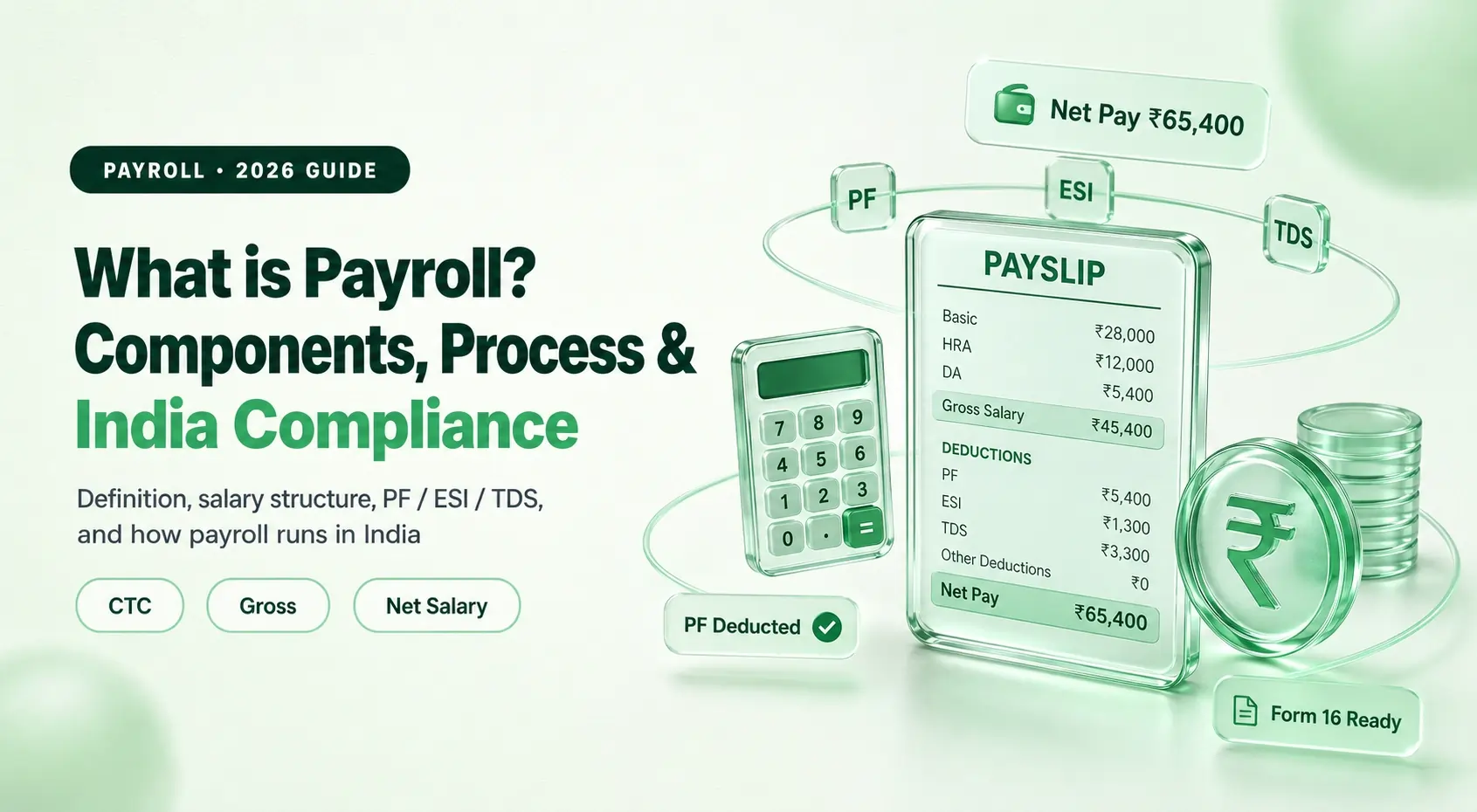
Payroll is the complete process by which an employer calculates wages, applies statutory deductions, distributes salary, and records the transactions for every employee in a pay cycle. It covers salary computation, tax deduction, payslip generation, bank transfer, and compliance reporting under Indian labour and tax law.
In simple terms, payroll is everything that happens between an employee finishing their work for the month and the salary landing in their bank account, plus all the statutory filings that follow. Indian payroll is more complex than most countries because it spans 19 states with different Professional Tax slabs, four Labour Codes in progressive rollout, and multiple statutory bodies (EPFO, ESIC, Income Tax, state Labour Departments).
Payroll Meaning and What It Covers
The word "payroll" can mean three different things depending on context.
Payroll as a process
The recurring cycle of calculating salaries, applying deductions, distributing pay, and filing compliance reports. This is what HR and finance teams "run" each month.
Payroll as a list
The list of all employees on a company's books, along with their salary details. "Adding to payroll" means hiring; "off payroll" means exiting.
Payroll as the total expense
The total compensation expense for a company in a given period. Used in financial reporting and budget planning.
For HR and finance professionals in India, the process meaning is the dominant one. Everything else flows from that.
Why Payroll Matters for Indian Businesses
Payroll is not just a transactional function. It directly affects compliance risk, employee trust, and finance accuracy.
Compliance risk
Late PF deposits attract 1.5% interest per month. PT defaults can result in penalty plus interest by state. TDS short deductions invite Income Tax notices. A clean payroll process protects the business from regulatory exposure.
Employee trust
Wrong salary calculation, late credit, or incorrect Form 16 erodes trust faster than almost any other HR mistake. Indian employees expect their salary on the same day each month with the right components.
Finance accuracy
Payroll is typically the largest controllable expense for any service business. Wrong cost-center allocation, incorrect arrears, or missed bonuses skew financial reporting.
Audit readiness
EPFO inspections, ESIC audits, Income Tax notices, and statutory audits all examine payroll records. Clean registers, ECR challans, and Form 16 PDFs save days during audit windows.
Indian Payroll Process: 7 Steps Every Cycle Follows
Whether you have 30 or 3,000 employees, every Indian payroll cycle follows the same flow.
For a hands-on walkthrough of each step, registrations, and due dates, see our guide on how to run payroll in India.
Step 1: Attendance and leave lock
The cycle begins when attendance for the month closes. Present days, absent days, late marks, and overtime hours are finalised. Most businesses use an attendance management system to capture biometric, GPS, or web-clock data and feed it directly into payroll.
Step 2: Leave reconciliation
Approved leaves flow from a connected leave management system. LOP days, comp-off, encashment, and sandwich-rule days are calculated and applied to the salary cycle.
Step 3: Gross salary calculation
The salary engine applies CTC structure rules per employee. Fixed components (Basic, HRA, DA, special allowance) are calculated. Variable components (overtime, late deductions, ad-hoc bonuses) are added or subtracted.
Step 4: Statutory deductions
PF (12% employee + 12% employer) is calculated on the wage definition. ESI (0.75% + 3.25%) applies if gross is below Rs 21,000. Professional Tax is deducted by employee work-state. TDS is calculated on annualised projected income. LWF is deducted half-yearly per state rate.
Step 5: Maker-checker approval
HR reviews the payroll register, flags variances, and approves the cycle. Mid-market businesses typically use a maker-checker workflow with dual approval and variance alerts before lock.
Step 6: Payslip and report generation
Branded password-protected payslip PDFs generate for every employee. Statutory registers, salary slip register, and bank advice files are created in the format required by your bank.
Step 7: Bank disbursement and statutory filing
The bank advice file is uploaded for NEFT or RTGS salary credit. The ECR file is uploaded to the EPFO portal by the 15th of next month. ESIC challan is uploaded. Form 138 quarterly TDS return is prepared. Form 16 is generated annually by 15 June.
Components of an Indian Salary
An Indian salary breaks into two halves: earnings (paid to the employee) and deductions (taken from the employee). Understanding both is essential to understanding payroll.
Earnings (paid components)
| Component | What it covers | Tax treatment |
|---|---|---|
| Basic Salary | Foundation of salary, usually 40-50% of CTC | Fully taxable |
| HRA | House Rent Allowance for employees who pay rent | Partially exempt under Section 10(13A) |
| DA | Dearness Allowance, common in PSU and govt | Fully taxable |
| Special Allowance | Catch-all balancing component | Fully taxable |
| LTA | Leave Travel Allowance for domestic travel | Exempt twice in a 4-year block |
| FBP / Flexi Benefits | Fuel, books, telephone, meal vouchers | Tax-exempt under Section 17 |
| Bonus / Variable Pay | Performance-linked bonus or annual incentive | Fully taxable |
| Reimbursements | Travel, telephone, internet, business expenses | Tax-exempt with bill submission |
Deductions (taken from earnings)
| Deduction | Rate / Amount | Statutory authority |
|---|---|---|
| EPF | 12% of Basic + DA (employee share) | EPFO under EPF Act 1952 |
| ESI | 0.75% of gross salary (if gross under Rs 21,000) | ESIC under ESI Act 1948 |
| Professional Tax | State-wise, max Rs 200/month | State governments (19 PT-levying states) |
| TDS on Salary | As per income tax slab and regime choice | Income Tax Department, Section 192 |
| LWF | State-wise, half-yearly | State Labour Welfare Boards |
| Loan / Advance Recovery | Per employee agreement | Internal company policy |
CTC vs Gross vs Net Salary: The Difference
Three terms confuse most Indian employees. Understanding them is core to understanding payroll.
CTC (Cost to Company)
The total annual cost the company spends on an employee. Includes Basic, HRA, allowances, employer PF contribution, employer ESI contribution, gratuity, insurance, bonus, and any reimbursements. CTC is what offer letters quote.
Gross Salary
The total monthly earnings before deductions. Includes Basic + HRA + DA + allowances. Excludes employer contributions to PF, ESI, and gratuity (those go to government, not the employee).
Net Salary (Take-home)
What actually lands in the employee's bank account. Net = Gross minus all deductions (employee PF, ESI, PT, TDS, LWF, loan EMI).
Quick example
For an employee with Rs 12 LPA CTC:
| Component | Annual | Monthly |
|---|---|---|
| CTC | Rs 12,00,000 | Rs 1,00,000 |
| Less: Employer PF + Gratuity + Insurance | Rs 1,20,000 | Rs 10,000 |
| Gross Salary | Rs 10,80,000 | Rs 90,000 |
| Less: Employee PF (Rs 1,800) + PT (Rs 200) + TDS (Rs 6,500) | Rs 1,02,000 | Rs 8,500 |
| Net Salary (Take-home) | Rs 9,78,000 | Rs 81,500 |
See payroll run on your salary structure live.
factoHR India walkthrough with PF, ESI, TDS, and Form 16 output, 20 minutes.
Indian Payroll Compliance: What Every Employer Must Handle
Indian payroll compliance has more moving parts than most countries. Each area below is non-negotiable for registered employers.
EPF (Employees Provident Fund)
Applicable to establishments with 20+ employees. 12% employee + 12% employer contribution on Basic + DA, capped at Rs 25,000 wage ceiling (raised from Rs 15,000 w.e.f 17 September 2026) for employer share. ECR file must be uploaded to the EPFO portal by the 15th of every month.
ESI (Employees State Insurance)
Applicable to factories with 10+ employees and other establishments with 20+ employees. 0.75% employee + 3.25% employer contribution on gross salary up to Rs 21,000. Half-yearly returns required.
Professional Tax
Levied in 19 of India's 28 states with state-wise slabs. Maximum Rs 200 per month. The slab applies based on employee work-state, not residence. Detailed slab and registration data is in the dedicated Professional Tax across 19 states reference.
TDS on Salary (Section 192)
Employer estimates annual taxable income, applies old or new tax regime as chosen by employee, and deducts monthly TDS. Form 138 quarterly return. Form 16 annually by 15 June.
Labour Welfare Fund (LWF)
State-wise rates with half-yearly deduction (typically June and December). Rates vary widely between states from a few rupees to Rs 100+ per half-year.
Gratuity
Payable after 5 continuous years of service under the Payment of Gratuity Act 1972. Formula: (Last drawn salary × 15 × years) ÷ 26. Most employers fund gratuity via LIC group gratuity policies.
Minimum Wages
State governments notify minimum wage rates by skill level (unskilled, semi-skilled, skilled, highly skilled) and zone. Employers cannot pay below the notified rate. Detailed state-by-state data is in the minimum wages in India reference.
Wider statutory context (Maternity Benefit Act, Bonus Act, POSH Act, four Labour Codes) is covered in the Indian labour laws library.
Payroll vs Salary vs Wages: Term Clarification
The three terms are often used interchangeably but have distinct meanings.
| Term | What it means | Common usage |
|---|---|---|
| Payroll | The full process of paying employees + compliance + records | "Run payroll" / "payroll team" |
| Salary | Fixed monthly compensation to white-collar employees | "Salary slip" / "annual salary" |
| Wages | Compensation typically based on hours, days, or piece-rate | "Daily wages" / "minimum wages" |
In Indian usage, "salary" usually refers to office and managerial roles, while "wages" applies to factory, construction, contract, and shift workers. Payroll is the umbrella term covering both.
Manual Payroll vs Automated Payroll
The gap between Excel-based payroll and software-driven payroll widens fast as headcount grows.
| Factor | Manual / Excel | Automated Payroll |
|---|---|---|
| Time per cycle | 40+ hours | 4 hours or less |
| Multi-state PT | Manual lookup, error-prone | Auto-applied by work-state |
| PF/ESI ECR generation | Manual file creation | One-click ECR output |
| Form 16 | Manual calculation per employee | Bulk auto-generation |
| Employee payslip access | Email PDFs one by one | Self-service portal + mobile |
| Audit trail | Email + Excel versions | Immutable system log |
| Compliance update propagation | Manual rule rewrites | Vendor pushes config update |
| Error rate | 5-10% per cycle | Less than 1% with checks |
For Indian businesses crossing 30-50 employees, automating payroll is no longer optional. Modern Indian payroll software handles the entire cycle in hours instead of days.
Common Payroll Challenges in India
These five challenges cost Indian HR and finance teams the most time and money.
Multi-state PT and LWF complexity
An employee in Bengaluru pays different PT than one in Mumbai or Pune. Manual lookup of state slabs causes wrong deductions, employee disputes, and compliance penalties.
Mid-year tax regime switching
Employees can switch between old and new tax regimes once per year. Recalculating TDS for the remaining months on Excel is slow and error-prone.
Arrears and back-dated revisions
Increment arrears, promotion-linked changes, and bonus payouts need accurate calculation across past months with TDS impact. Manual systems often miss compounding effects.
Attendance-to-payroll reconciliation
LOP, late marks, half-days, and overtime hours need to flow accurately into salary calculation. Disconnected systems mean HR teams reconcile manually for days.
Employee payslip distribution
Generating, password-protecting, and emailing 200+ payslips by hand burns hours. A connected employee self-service portal removes this work entirely.
Payroll Calendar: Key Indian Dates
Indian payroll has fixed compliance deadlines that drive the monthly cycle.
| Date | Activity |
|---|---|
| 1st to 5th of next month | Salary credit to employees |
| By 7th of next month | TDS deposit for previous month |
| By 15th of next month | EPF ECR file upload to EPFO portal |
| By 15th of next month | ESI challan upload to ESIC |
| End of every quarter | Form 138 TDS return filing |
| By 30th April / 31st October | LWF half-yearly deposit (state-dependent) |
| By 15th June | Form 16 issuance to all employees |
How to Improve Your Payroll Process
Whether you run payroll on Excel today or already use software, these five moves improve every cycle.
Lock attendance and leave by the 25th
Cut-off dates earlier in the month give HR time for variance review and corrections before salary processing.
Use a maker-checker workflow
Two-person approval before payroll lock catches anomalies like negative net pay, missing deductions, or wrong CTC application.
Run a variance report every cycle
Compare current cycle against the previous one. Flag employees whose salary changed by more than 5% and review reasons before approval.
Move to mobile self-service
Indian employees expect to download payslips, file IT declarations, and check tax projections on their phone. Web-only access drives 3x more HR helpdesk tickets.
Run a parallel payroll before any vendor switch
If switching from Excel to software or between vendors, run one cycle on both systems and reconcile to the rupee. This catches edge cases before go-live.
Conclusion
Payroll is the operational core of every business that pays employees. In India, it goes far beyond salary calculation. It includes multi-state PT and LWF compliance, PF and ESI contributions, TDS computation under two tax regimes, ECR generation, Form 16 issuance, and audit-ready statutory registers. Done well, payroll builds employee trust and protects the business from regulatory risk. Done poorly, it drains HR and finance time and creates compliance exposure.
The shift from manual to automated payroll is no longer about cost. It is about speed, accuracy, compliance readiness, and employee experience. The right cloud payroll handles a 500-person multi-state cycle in hours instead of days. Compare published vendors and feature mixes in the best payroll software in India buyer guide. Or book a free factoHR India demo to see a live payroll cycle for your salary structure and state footprint.
FAQs About Payroll
What is payroll in simple terms?
Payroll is the complete process of paying employees their salary, deducting statutory amounts like PF and TDS, generating payslips, and filing compliance reports under Indian law. It runs every month for every employee on the company's books.
What is included in payroll in India?
Indian payroll includes salary calculation, PF and ESI contributions, Professional Tax across 19 states, TDS deduction under Section 192, LWF deduction, Gratuity calculation, payslip generation, bank advice file creation, and statutory filings like ECR, Form 16, and Form 138.
What is the difference between payroll and salary?
Salary is the fixed monthly compensation paid to an employee. Payroll is the entire process of calculating that salary, applying deductions, paying it out, and recording it for compliance. Payroll covers all employees; salary is per employee.
What is the difference between CTC and net salary?
CTC (Cost to Company) is the total annual cost the company spends on an employee, including employer PF, gratuity, and insurance. Net salary is what actually lands in the employee's bank account after all deductions. Net is typically 75-85% of CTC depending on tax regime.
Who is responsible for payroll in a company?
In small businesses, the founder or HR manager runs payroll. In mid-market companies, dedicated payroll executives or shared services teams handle it. In larger organisations, payroll is managed jointly by HR, finance, and compliance teams or outsourced to a payroll service provider.
What are the main statutory deductions in Indian payroll?
The main statutory deductions are Employee Provident Fund (EPF), Employee State Insurance (ESI), Professional Tax (PT), TDS on Salary under Section 192, and Labour Welfare Fund (LWF). The exact applicability depends on company size, employee gross salary, and work-state.
What is the payroll cycle?
The payroll cycle is the recurring process by which an employer calculates and pays salary, typically monthly in India. The cycle covers attendance lock, salary calculation, statutory deductions, approval, payslip generation, bank disbursement, and compliance filing.
How is TDS calculated in payroll?
TDS on salary is calculated under Section 192 of the Income Tax Act. The employer estimates annual taxable income, applies the chosen tax regime (old or new), determines annual tax liability, divides by 12, and deducts that amount monthly from the employee's salary.
What is multi-state payroll?
Multi-state payroll is the process of running payroll for employees across different Indian states with different Professional Tax slabs, LWF rates, holiday calendars, and shift rules. The payroll system applies the right rule based on each employee's work-state automatically.
Can payroll be outsourced in India?
Yes. Many Indian businesses outsource payroll to specialist providers who handle salary calculation, statutory compliance, payslip generation, and filing. Outsourcing is common among startups and SMEs that lack in-house payroll capacity. Larger companies typically run payroll in-house using dedicated software.