Indian HR teams shortlist HRMS based on a feature checklist. Pick the wrong features and you end up with a tool that is too thin for compliance or too bloated for daily use. The right shortlist matches your team size, multi-state footprint, and growth plan.
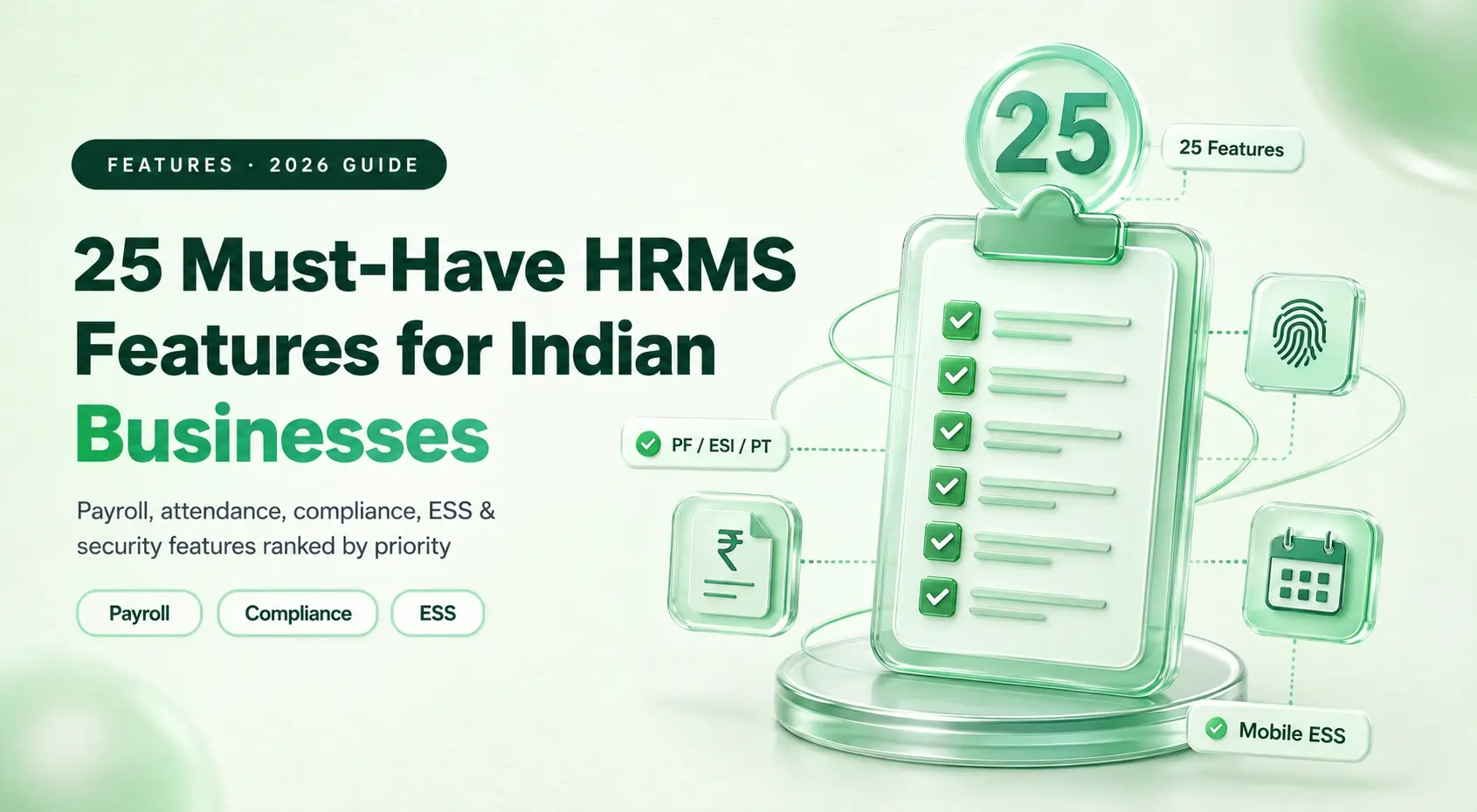
This guide covers the 25 must-have HRMS features for Indian businesses, grouped by category, with priority levels for startups, SMEs, and mid-market companies.
Key Takeaways
- Core HRMS features fall into 6 categories: payroll, attendance, lifecycle, performance, compliance, and security.
- Multi-state payroll, PF / ESI / PT / TDS, and Form 16 are non-negotiable for any Indian HRMS.
- Mobile-first ESS reduces HR helpdesk tickets by 50% or more.
- Audit-ready statutory registers and ECR generation save days during EPFO and ESIC inspections.
- Maker-checker payroll workflow prevents errors before they reach employees.
- Startups need ~12 of the 25 features. Mid-market needs 20+. Enterprise needs all 25.
What Are HRMS Features?
HRMS features are the individual capabilities a Human Resource Management System provides to handle different parts of HR work. They cover salary processing, attendance capture, leave management, performance reviews, hiring, onboarding, expense claims, employee self-service, and statutory compliance.
These operational features are what separate a full HRMS from a lighter HRIS; see how HRMS, HRIS and HCM compare.
For Indian businesses, the right feature mix depends on team size, multi-state footprint, industry, and integration needs. The 25 features below cover the full HRMS scope. Use the priority labels to shortlist what your business needs first. To understand the broader system these features sit inside, the foundational HRMS software guide explains how HRMS works end to end.
Category A: Core Payroll Features (5)
The financial backbone. Every HRMS must handle these or it is not really an HRMS for India.
1. Configurable salary structures
Unlimited CTC components like Basic, HRA, DA, FBP, special allowance configurable per employee, grade, location, or department. Bulk revision support for appraisal cycles. Priority: Critical for all sizes.
2. Multi-state payroll engine
Different PT slabs, LWF rates, and shift rules per state with automatic application based on employee work-state. Robust Indian payroll software handles this without manual lookup. Priority: Critical if you operate in 2+ states.
3. PF, ESI, PT, TDS auto-calculation
12% + 12% PF on Basic + DA, 0.75% + 3.25% ESI on gross under Rs 21,000, multi-state PT, TDS Section 192 with old or new regime support. Apply rules automatically every cycle. Priority: Critical for all sizes.
4. Form 16 and Form 138 generation
Annual Form 16 with TRACES Part A integration and Part B salary computation. Quarterly Form 138 output with annexures and validation reports for TIN portal upload. Priority: Critical for compliance.
5. Bank advice files and direct API payouts
NEFT, RTGS, and IMPS file generation for HDFC, ICICI, SBI, Axis, Kotak, and 20+ Indian banks. Premium platforms add direct bank API integration for one-click salary push. Priority: High for SMEs and above.
Category B: Attendance and Leave Features (4)
Attendance and leave drive 30-40% of payroll variability. Strong capture eliminates reconciliation work.
6. Biometric and mobile attendance integration
Native integration with eSSL, ZKTeco, HikVision, Realtime, and Suprema biometric devices, plus GPS and selfie-capture mobile attendance for field staff. A modern biometric attendance management system feeds payroll directly. Priority: Critical for all sizes.
7. Geo-fencing and shift management
Location-based punch validation for field teams, multi-shift rotation engine, overtime rules, weekly off configuration, and double-rate OT for shop-floor employees. Priority: Critical for manufacturing, logistics, retail.
8. Leave management with sandwich rules
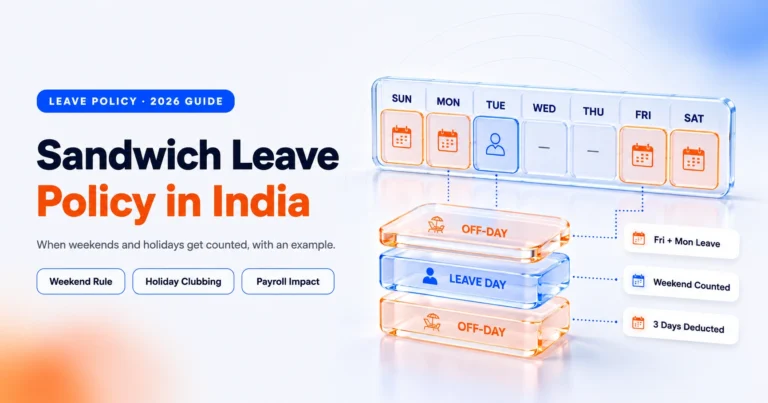
15+ leave types (earned, casual, sick, maternity, paternity, comp-off, sabbatical, work from home), sandwich rules for weekend bridging, location-based holiday calendars, live payroll feed for LOP and encashment. A configurable leave management system handles every leave type. Priority: Critical for all sizes.
9. Comp-off and leave encashment
Auto-credit comp-off for weekend work, year-end leave encashment with tax calculation, FnF leave settlement during exit. Priority: High for SMEs and above.
Category C: Employee Lifecycle Features (4)
Hire to retire flow on a single platform. Reduces parallel tools and data silos.
10. Digital onboarding with e-Sign
Aadhaar-based e-Sign for offer letters and joining documents, BGV vendor integration, document collection workflow, asset issue tracking. Modern employee onboarding software closes the offer-to-day-1 loop digitally. Priority: High for growing teams.
11. Recruitment ATS with multi-channel sourcing
Naukri, LinkedIn, Indeed, Hirect, Apna integration, AI resume screening, interview scheduling, scorecards, and digital offer letter generation. A complete recruitment ATS software covers source-to-offer flow. Priority: High for hiring-active teams.
12. Performance management with OKRs
OKRs, KRAs, 360-degree feedback, continuous check-ins, calibration, 9-box succession grids, and bias-free review cycles. A configurable performance management software drives appraisal cycles. Priority: Medium for startups, high for SMEs+.
13. Full and final settlement automation
Auto-calculate gratuity, leave encashment, notice pay recovery, loan balance recovery, and bonus proration. Generate FnF PDF and bank advice in one click. Priority: Critical for all sizes.
Category D: Engagement and Self-Service Features (3)
Modern Indian employees expect mobile access to everything HR-related.
14. Mobile-first employee self-service portal
Web and mobile apps for payslips, IT declarations, leave apply, expense claims, Form 16 download, salary projections, and HR document access. A robust employee self-service portal reduces HR helpdesk load by 50% or more. Priority: Critical for all sizes.
15. Hindi and regional language support
Employee-facing screens in Hindi plus regional languages for blue-collar, field, and shop-floor workforce. Critical for manufacturing, logistics, retail. Priority: High for non-IT industries.
16. AI HR chatbot for queries
Natural-language queries for leave balance, payslip lookup, policy questions, and tax projection. Reduces HR helpdesk tickets further. Priority: Medium, value scales with team size.
Category E: Compliance and Reporting Features (5)
India payroll compliance is heavy. These features keep your business audit-ready.
17. ECR file generation for EPFO
One-click ECR file output ready for upload to the EPFO portal by 15th of every month. Auto-validate UAN linking, member data, and contribution amounts before generation. Priority: Critical for all sizes.
18. Multi-state Professional Tax (19 states)
State-wise PT slabs across all 19 PT-levying states pre-loaded. Deduction applies based on employee work-state automatically. Detailed slab data in the Professional Tax across 19 states reference. Priority: Critical for multi-state businesses.
19. Statutory registers and audit-ready reports
Pre-built payroll register, salary slip register, PF and ESI summary, TDS return data, cost-center reports, and year-on-year comparison. Exportable for finance and audit teams. Priority: Critical for all sizes.
20. Maker-checker payroll workflow
Dual-approval payroll workflow with variance alerts for anomalies, payroll lock after approval, and immutable audit trail for every change. Priority: Critical for SMEs and above.
21. Mid-year tax regime switching
Employees select old or new regime via ESS. System recalculates TDS liability for remaining months automatically and reflects the change in next payslip and Form 16 projection. Priority: High for all sizes.
See all 25 features in action.
factoHR India walkthrough on your salary structure, 20 minutes.
Category F: Security and Integration Features (4)
Critical for buyer trust, especially for BFSI, healthcare, and IT services.
22. Role-based access control
Granular permissions per role: HR, manager, employee, finance, admin. Each user sees only their data scope. Strict access enforcement with audit logs for every view and edit. Priority: Critical for all sizes.
23. India data residency
Employee data hosted on Indian cloud infrastructure with industry-standard encryption in transit and at rest. No cross-border transfer of personal data without contractual safeguards. Priority: Critical for BFSI, healthcare, regulated industries.
24. ERP and accounting integration
Pre-built connectors to Tally, QuickBooks, Xero, SAP, Oracle for journal entry export, plus identity providers (Auth0, Entra ID, Okta, OneLogin) for SSO. Priority: Medium for startups, high for mid-market+.
25. SOC 2 and ISO 27001 alignment
Audit-ready security controls aligned with SOC 2 and ISO 27001 control families. Penetration test reports and vendor security questionnaire packs available on request. Priority: Critical for enterprise procurement.
How to Prioritize Features by Business Size
Not every business needs all 25 features in year one. Use this priority map to shortlist what to demand from your shortlisted vendors.
| Feature Category | Startup (10-50) | SME (50-500) | Mid-Market (500-2000) | Enterprise (2000+) |
|---|---|---|---|---|
| Core Payroll (5) | All 5 | All 5 | All 5 | All 5 |
| Attendance & Leave (4) | 3 | 4 | 4 | 4 |
| Lifecycle (4) | 2 (onboarding, FnF) | 3 | 4 | 4 |
| Engagement & ESS (3) | 1 (ESS portal) | 2 | 3 | 3 |
| Compliance (5) | 3 | 4 | 5 | 5 |
| Security & Integration (4) | 2 | 3 | 4 | 4 |
| Total features needed | ~16 | ~21 | ~25 | All 25 |
Feature Evaluation Checklist During Demo
Use this checklist when you sit through HRMS demos. Tick the box only if the vendor demonstrates the feature live, not just on slides.
- Configure a multi-state CTC structure live (Mumbai + Bengaluru + Hyderabad)
- Run a 5-employee payroll cycle with PF, ESI, PT, TDS calculation visible
- Generate ECR file output and Form 16 for one employee
- Show biometric integration with eSSL or ZKTeco device
- Apply leave from mobile app and see live LOP impact in payroll preview
- Demonstrate maker-checker workflow with dual approval
- Show payslip download from mobile ESS app
- Run a variance report between two payroll cycles
- Show audit trail for one employee's salary change
- Confirm India data residency and encryption
Common Mistakes When Evaluating HRMS Features
Five mistakes Indian buyers make most often.
Buying for hypothetical future scale
A 30-person business does not need calibration, succession planning, or 9-box grids in year one. Pay for what you use now and plan to use in 12 months, not what sounds impressive in the demo.
Choosing on price alone
The cheapest tool often has the weakest Indian compliance, slowest support, and missing audit trails. Total cost of ownership matters more than per-employee headline price.
Ignoring mobile parity
If your ESS portal is web-only, expect 3x more HR tickets. Indian employees check payslips and file declarations on phones, not laptops. Test mobile app yourself before signing.
Skipping parallel payroll validation
Cutting over to new HRMS without running a parallel payroll cycle on real data is the fastest way to break trust. Always validate calculations down to the rupee first.
Not asking about compliance updates
When PF wage ceilings revise or PT slabs change, how does the vendor push the update? Manual configuration burdens fall on you. Vendor-pushed config updates save weeks per year.
Conclusion
The 25 features above cover the full Indian HRMS scope. Strong vendors handle 20+ out of the box. Weak vendors charge for the missing 10 as add-ons or simply do not have them. Use the priority map to know what your business needs first, the demo checklist to verify each capability live, and the parallel payroll validation step to confirm before cutover.
For shortlisted vendor comparisons across feature mix, pricing, and Indian compliance depth, the best payroll software in India guide compares 10 major Indian HRMS platforms head to head. Or book a free factoHR India demo to see all 25 features in a live walkthrough on your salary structure and state footprint.
FAQs About HRMS Features
What are the most important HRMS features for Indian businesses?
The five most critical HRMS features for Indian businesses are multi-state payroll, PF / ESI / PT / TDS auto-calculation, ECR file generation for EPFO, multi-state Professional Tax handling, and a mobile-first employee self-service portal. These cover the core compliance and employee experience needs.
How many features should an HRMS for small businesses have?
Small Indian businesses with 10 to 50 employees need around 16 of the 25 features covered in this guide. Core payroll, basic attendance, leave management, ESS, and statutory compliance are non-negotiable. Performance management and advanced analytics can come later as the team grows.
What HRMS features are required for multi-state payroll?
For multi-state Indian payroll, the HRMS must handle state-wise Professional Tax slabs across 19 PT-levying states, location-specific LWF rates, state-wise holiday calendars, and PF / ESI returns generated separately by state code for accurate compliance filing.
Is mobile app a must-have HRMS feature?
Yes. Mobile self-service is critical for Indian businesses in 2026. Employees expect to check payslips, apply leave, file IT declarations, and submit expense claims on mobile. HRMS without mobile parity drives 3x higher HR helpdesk volume.
What HRMS features support EPF compliance?
For EPF compliance, the HRMS must calculate 12% employee + 12% employer contribution on Basic + DA, generate ECR files ready for EPFO portal upload, support UAN linking, capture employee KYC data, and produce monthly PF challan output by the 15th of next month.
Do all HRMS platforms have the same features?
No. Indian HRMS platforms differ widely in compliance depth, mobile experience, integration libraries, and customisation flexibility. Run a parallel payroll cycle and a mobile self-service test before any contract to confirm the platform matches your actual needs.
What is the difference between standalone payroll software and HRMS features?
Standalone payroll software covers salary calculation and statutory compliance only. HRMS bundles payroll plus attendance, leave, performance, recruitment, onboarding, ESS, expense, and timesheet features into one connected platform. Mid-market and larger Indian businesses benefit more from full HRMS.
Can HRMS features integrate with accounting software?
Yes. Modern Indian HRMS platforms include pre-built integrations with Tally, QuickBooks, Xero, SAP, and Oracle for journal entry export. Identity provider integration with Auth0, Entra ID, Okta, and OneLogin is standard for SSO.
How important is the AI chatbot HRMS feature?
AI chatbots are valuable but not critical for small teams. They scale with size. For HR teams handling 200+ employees, a chatbot for leave balance, payslip lookup, and tax queries reduces helpdesk load measurably. Below 100 employees, the impact is smaller.
What HRMS features improve audit readiness?
Five features improve audit readiness: pre-built statutory registers, ECR file generation with validation, immutable audit trail for every salary change, maker-checker payroll workflow, and exportable cost-center reports for finance teams.