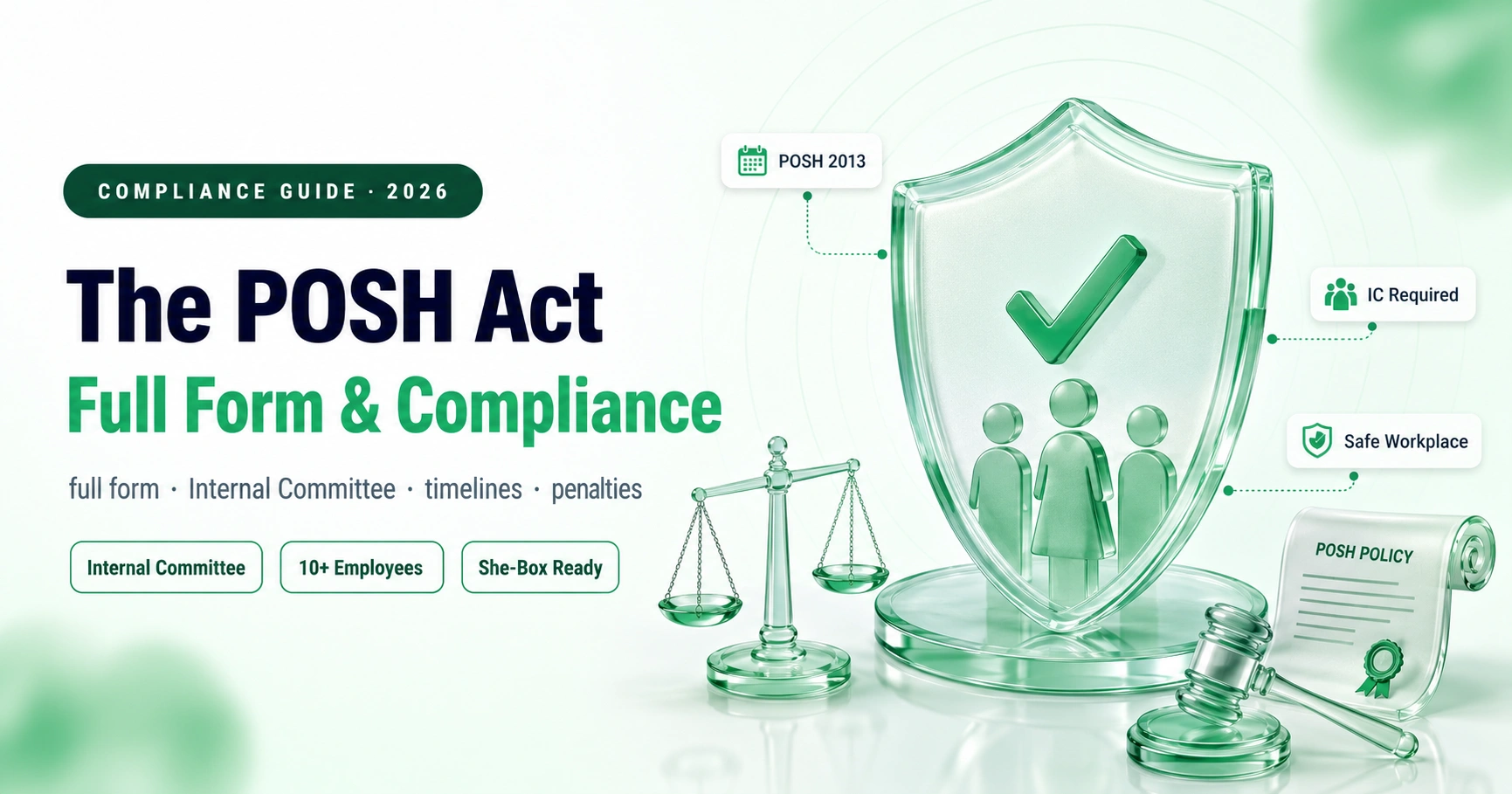
POSH stands for Prevention of Sexual Harassment. The POSH Act is India's law that protects women from sexual harassment at the workplace, formally the Sexual Harassment of Women at Workplace (Prevention, Prohibition and Redressal) Act, 2013. It makes a written policy and an Internal Committee mandatory for every workplace with 10 or more employees.
This guide covers the full form and meaning, what counts as sexual harassment, the Internal Committee, the complaint process and timelines, penalties, employer duties, and the government She-Box portal. It is general information for HR and employers, not legal advice.
Key Takeaways
- POSH stands for Prevention of Sexual Harassment; the full law is the Sexual Harassment of Women at Workplace (Prevention, Prohibition and Redressal) Act, 2013.
- Every Indian workplace with 10 or more employees must form an Internal Committee (IC) and adopt a written POSH policy.
- An aggrieved woman can file a written complaint within 3 months of the incident, and the IC must finish its inquiry within 90 days.
- Non-compliance draws a fine up to Rs. 50,000, rising to cancellation of licence or registration for repeat breaches.
- Since 2024, the Supreme Court has pushed employers to register their IC on the government She-Box portal.
- POSH is an HR-owned duty: policy, IC, training, annual reporting, and strict confidentiality.
What is the POSH Act?
The POSH Act is the Sexual Harassment of Women at Workplace (Prevention, Prohibition and Redressal) Act, 2013. It gives every working woman in India the right to a safe workplace and lays down how employers must prevent, prohibit, and redress sexual harassment.
The law was passed to give statutory force to the Supreme Court's Vishaka Guidelines of 1997, issued in the case of Vishaka v. State of Rajasthan. Before 2013, those guidelines were the only workplace protection; the Act turned them into binding law with committees, timelines, and penalties.
POSH Full Form and Meaning
POSH is short for Prevention of Sexual Harassment. In everyday HR use, "POSH" refers to the 2013 Act, the workplace policy built on it, and the training and committee that make a workplace compliant. So a "POSH policy", a "POSH committee", and "POSH training" all trace back to the same law.
What Counts as Sexual Harassment Under POSH?
Section 2(n) of the Act defines sexual harassment as any one or more of the following unwelcome acts or behaviour, whether direct or by implication.
- Unwelcome physical contact and advances.
- A demand or request for sexual favours.
- Sexually coloured remarks.
- Showing pornography.
- Any other unwelcome physical, verbal, or non-verbal conduct of a sexual nature.
Section 3 adds the situations that make such conduct harassment, including an implied or explicit promise of preferential treatment, a threat of detrimental treatment or about present or future employment, interference with work or a hostile work environment, and humiliating treatment likely to affect a woman's health or safety.
Who Does the POSH Act Protect?
The Act protects any "aggrieved woman" at a workplace, whatever her employment status. That covers regular, contract, temporary, and daily-wage staff, apprentices and interns, and even a woman who is not an employee, such as a client, customer, or visitor to the workplace.
"Workplace" is read widely too. It includes offices, factories, hospitals, and any place an employee visits during work, plus transport provided by the employer and, increasingly, the remote or work-from-home setting.
The Internal Committee (IC) Under POSH
Every workplace with 10 or more employees must set up an Internal Committee, earlier called the Internal Complaints Committee (ICC). The IC receives complaints, runs the inquiry, and recommends action. Its composition is fixed by law.
- Presiding Officer: a senior woman employee of the workplace.
- At least two members: employees committed to the cause of women, or with legal or social-work experience.
- One external member: from an NGO or a person familiar with issues of sexual harassment.
- At least half the members must be women. Members serve a term of up to three years.
For a workplace with fewer than 10 employees, or where the complaint is against the employer, the District Officer sets up a Local Committee (LC) at the district level to handle the case.
The POSH Complaint Process, Step by Step
The Act sets a clear, time-bound process so complaints are handled fairly and quickly.
- File the complaint: The aggrieved woman submits a written complaint to the IC within three months of the incident, extendable by three more months for valid reasons.
- Optional conciliation: At her request, the IC may attempt conciliation before an inquiry. No monetary settlement is allowed as a basis for conciliation.
- Inquiry: The IC conducts the inquiry following the principles of natural justice, and can recommend interim relief such as leave or a transfer during the process.
- Report: The IC submits its report to the employer within 10 days of completing the inquiry.
- Action: The employer acts on the recommendations within 60 days.
- Appeal: Either party may appeal to a court or tribunal within 90 days.
The key timelines, at a glance:
| Stage | Timeline |
|---|---|
| File a complaint with the IC | Within 3 months of the last incident (extendable by 3 months) |
| IC completes the inquiry | Within 90 days |
| IC submits its report to the employer | Within 10 days of completing the inquiry |
| Employer acts on the recommendations | Within 60 days |
| Appeal to a court or tribunal | Within 90 days of the recommendations |
Penalties for Non-Compliance
Ignoring the POSH Act is expensive and public. The consequences escalate with repeat breaches.
- First failure: A fine of up to Rs. 50,000 for not constituting an IC, not acting on recommendations, or otherwise breaching the Act.
- Repeat failure: Twice the penalty, plus cancellation or non-renewal of the business licence or registration.
- Breach of confidentiality: A separate penalty for publishing the identity of the complainant, respondent, witnesses, or the inquiry details.
Beyond fines, listed companies must disclose POSH complaints in their annual report, so gaps become visible to investors and the public.
Employer Duties Under POSH
The Act places clear, ongoing duties on the employer, not just a one-time setup. Use this as a compliance checklist.
- Adopt, publish, and display a written POSH policy against sexual harassment.
- Constitute an Internal Committee at every office or branch with 10 or more employees.
- Run regular awareness sessions for employees and skill-building for IC members.
- Provide a safe working environment and treat sexual harassment as misconduct under service rules.
- Assist the IC during inquiries and help the woman file a complaint under other laws if she chooses.
- File an annual report of complaints with the District Officer.
- Display the penalties and the IC's details prominently at the workplace.
- Maintain strict confidentiality throughout.
She-Box and the 2024 Supreme Court Push
She-Box, the Sexual Harassment electronic Box, is the central government's online portal run by the Ministry of Women and Child Development. It lets any woman file a workplace sexual-harassment complaint through a single, pan-India window, whatever her sector or location, and routes it to the right authority.
Enforcement has tightened recently. In Aureliano Fernandes v. State of Goa (2023), the Supreme Court criticised the weak implementation of the Act and directed stronger compliance. The government relaunched She-Box in 2024, and employers are now expected to register their Internal Committee details on the portal and keep them current. Treat She-Box registration as part of your POSH compliance, not an optional extra.
How HR Software Simplifies POSH Compliance
Most POSH gaps are administrative: an outdated policy, a lapsed IC term, no proof of training, or a missing acknowledgement. An HR platform closes those gaps quietly in the background.
Store and version your POSH policy and capture every employee's acknowledgement during onboarding, keep IC member terms and training completion tracked in your HR policy records, and hold confidential case and annual-report data in one auditable place. That way, if a District Officer or the board asks for proof, it is a report, not a scramble.
Final Word
The POSH Act is not just paperwork. It gives every woman at your workplace a clear, time-bound route to safety, and it holds employers to real deadlines and real penalties. The basics are simple: a written policy, a properly constituted Internal Committee, regular training, She-Box registration, and honest annual reporting.
Get those in place before a complaint arrives, not after. This guide is general information and not legal advice, so consult a qualified lawyer or POSH consultant for your specific situation.
Frequently Asked Questions
What is the full form of POSH?
POSH stands for Prevention of Sexual Harassment. It refers to the Sexual Harassment of Women at Workplace (Prevention, Prohibition and Redressal) Act, 2013, and the workplace policy, committee, and training built on it.
Is the POSH Act only for women?
Yes. As written, the POSH Act, 2013 protects women from sexual harassment at the workplace. Many Indian employers voluntarily extend a gender-neutral anti-harassment policy to all employees, but the statutory committees and process under this Act apply to complaints by women.
How many employees before the POSH Act applies?
A workplace with 10 or more employees must form an Internal Committee and adopt a POSH policy. For workplaces with fewer than 10 employees, or complaints against the employer, a Local Committee at the district level handles the case.
What is the time limit to file a POSH complaint?
An aggrieved woman must file a written complaint with the Internal Committee within three months of the incident. The committee can extend this by another three months if there is good reason.
What is the penalty for not following the POSH Act?
A first failure attracts a fine of up to Rs. 50,000. Repeat non-compliance leads to twice the penalty and cancellation or non-renewal of the business licence or registration, along with reputational damage.
Who can be on the Internal Committee?
The IC is led by a senior woman employee as Presiding Officer, with at least two members committed to the cause of women or with legal or social-work experience, and one external member from an NGO or familiar with sexual harassment issues. At least half the members must be women.
What is the She-Box portal?
She-Box is the government's online portal for filing workplace sexual-harassment complaints across India. Since 2024, employers are expected to register their Internal Committee details on She-Box as part of POSH compliance.