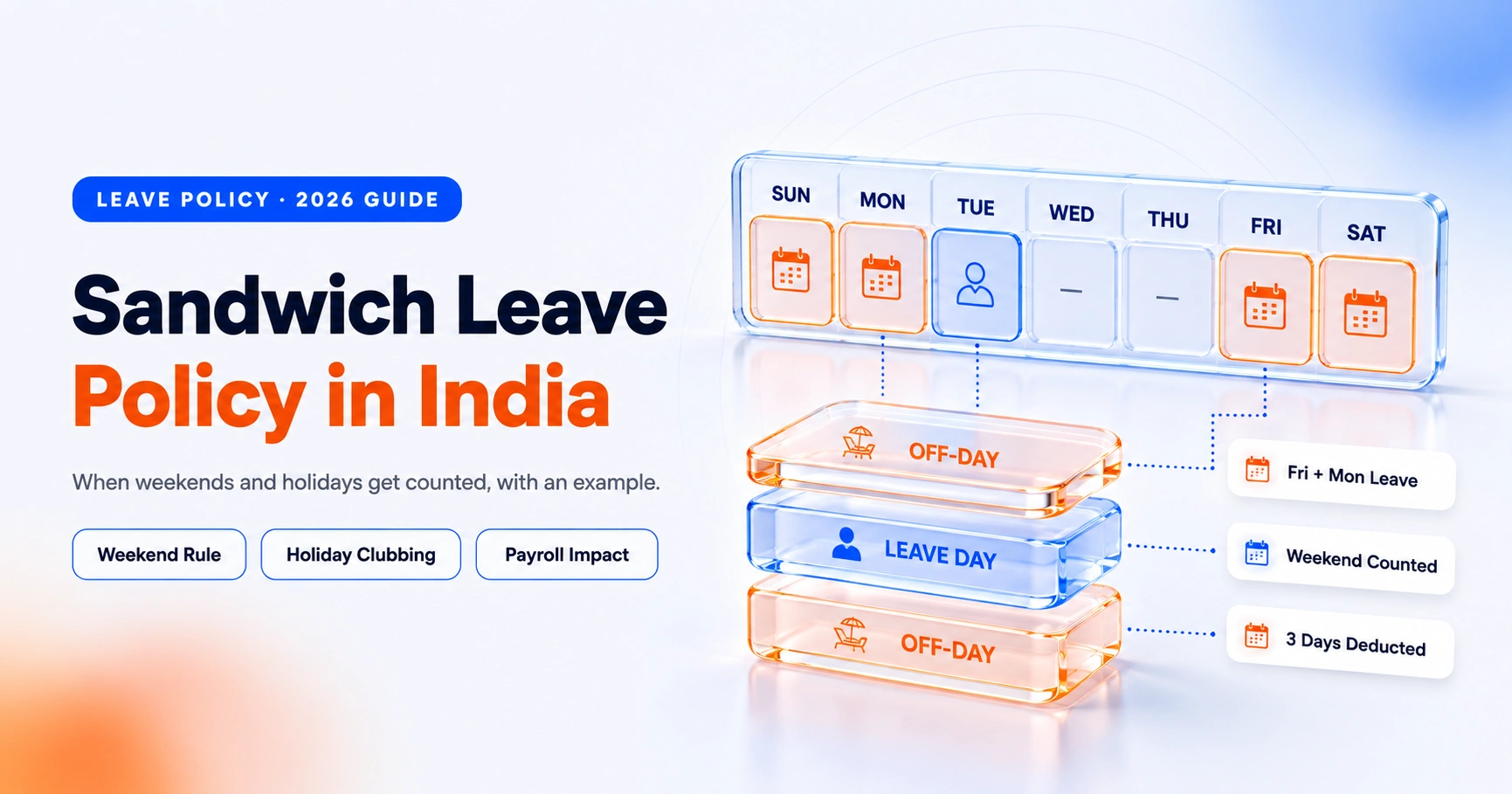
A sandwich leave policy is a rule where a weekly off or holiday that falls between two days of leave is also counted as leave. If an employee takes leave on a Friday and the following Monday, the Saturday and Sunday in between get sandwiched and deducted too. It is legal when written into the company leave policy, but it needs to be clear and fair to avoid disputes.
Key Takeaways
- Sandwich leave counts a holiday or weekly off that falls between two leave days as leave.
- Example: leave on Friday and Monday can turn into four days deducted, not two.
- There is no central law on it. It is valid only if it is stated in the company leave policy.
- Companies use it to discourage employees from stretching short leaves around weekends.
- A fair policy is written clearly, applied consistently, and communicated to every employee.
What Is Sandwich Leave?
Sandwich leave is a leave rule where an intervening holiday or weekly off, one that sits between two days of approved leave, is treated as leave and deducted from the employee's balance. The holiday is sandwiched between the two leave days, hence the name.
Without the rule, only the actual working days you take off are deducted. With the rule, the non-working days in between are deducted too. The difference can be significant over a year, so both employers and employees need to understand exactly how their policy works.
How Sandwich Leave Works: An Example
Take an employee whose weekly off is Saturday and Sunday, who applies for leave on Friday and the next Monday.
| Policy | Days deducted |
|---|---|
| Without sandwich rule | 2 days (Friday and Monday only) |
| With sandwich rule | 4 days (Friday, Saturday, Sunday, and Monday) |
The same logic applies around public holidays. If a holiday falls on a Wednesday and an employee takes Tuesday and Thursday off, a sandwich policy may count the Wednesday holiday as leave too.
Why Do Companies Use a Sandwich Leave Policy?
The rule exists to protect operations and fairness, not to punish employees.
- It discourages stretching a two-day break into a long weekend that leaves a team short-staffed.
- It stops the pattern of taking leave only on Fridays and Mondays to gain free weekends repeatedly.
- It keeps leave usage predictable, which matters in shift-based and customer-facing roles.
The trade-off is employee goodwill. A rule that feels like it eats into weekends can hurt morale, so many modern employers apply it selectively or drop it entirely.
Is Sandwich Leave Legal in India?
There is no central law that mandates or bans sandwich leave. It is a matter of company leave policy. That means it is valid and enforceable only if two conditions are met: it is clearly written into your leave policy, and it is applied consistently to everyone.
State Shops and Establishment Acts set minimums for leave and weekly offs, and a sandwich rule cannot be used to deny an employee their statutory leave entitlement. As long as the policy respects those minimums and is transparent, it is on solid ground. Applying it informally or inconsistently is where employers run into disputes.
How to Frame a Fair Sandwich Leave Policy
If you choose to use the rule, these steps keep it fair and defensible.
- Put it in writing. State the rule explicitly in the leave policy, with examples.
- Define the triggers. Clarify whether it applies to weekly offs, public holidays, or both.
- Decide the scope. Some companies apply it only when leave is on both the day before and the day after the holiday, not just one side.
- Apply it consistently. The same rule for every employee, with no case-by-case exceptions.
- Communicate it. Make sure every employee knows the rule before they apply for leave, not after.
A common middle path is a softer rule: the intervening holiday is counted as leave only if the employee is absent on both adjacent working days, which targets genuine long-weekend stretching without penalising a single day of leave.
Sandwich Leave and Your Leave Management
The hardest part of a sandwich rule is applying it accurately and consistently, especially across states with different public holiday calendars. Doing this by hand invites errors and disputes. A good leave management system encodes your exact rule, applies it automatically, and shows the employee the real deduction before they submit, which removes the surprise that causes most complaints.
Frequently Asked Questions
What is a sandwich leave policy?
It is a leave rule where a holiday or weekly off that falls between two days of leave is also counted as leave and deducted from the balance. For example, leave on Friday and Monday can result in the weekend being deducted too.
Is sandwich leave legal in India?
There is no central law on it. It is legal only if it is clearly stated in the company leave policy, applied consistently, and does not reduce an employee's statutory leave entitlement under the applicable state law.
How is sandwich leave calculated?
The intervening non-working days between two leave days are added to the leave count. If you take Friday and Monday off, a sandwich policy deducts four days: Friday, Saturday, Sunday, and Monday.
Can an employer apply sandwich leave without informing employees?
No. To be fair and enforceable, the rule must be documented in the leave policy and communicated to employees before they apply. Applying it informally leads to disputes.
Does sandwich leave apply to public holidays?
It can, if the policy says so. Some companies count a public holiday that falls between two leave days as leave, while others limit the rule to weekly offs. The policy should state exactly which applies.
Apply Every Leave Rule Automatically
Configure sandwich leave, holiday calendars, and accruals once, and let the system apply them accurately for every employee across every state, with no manual counting.