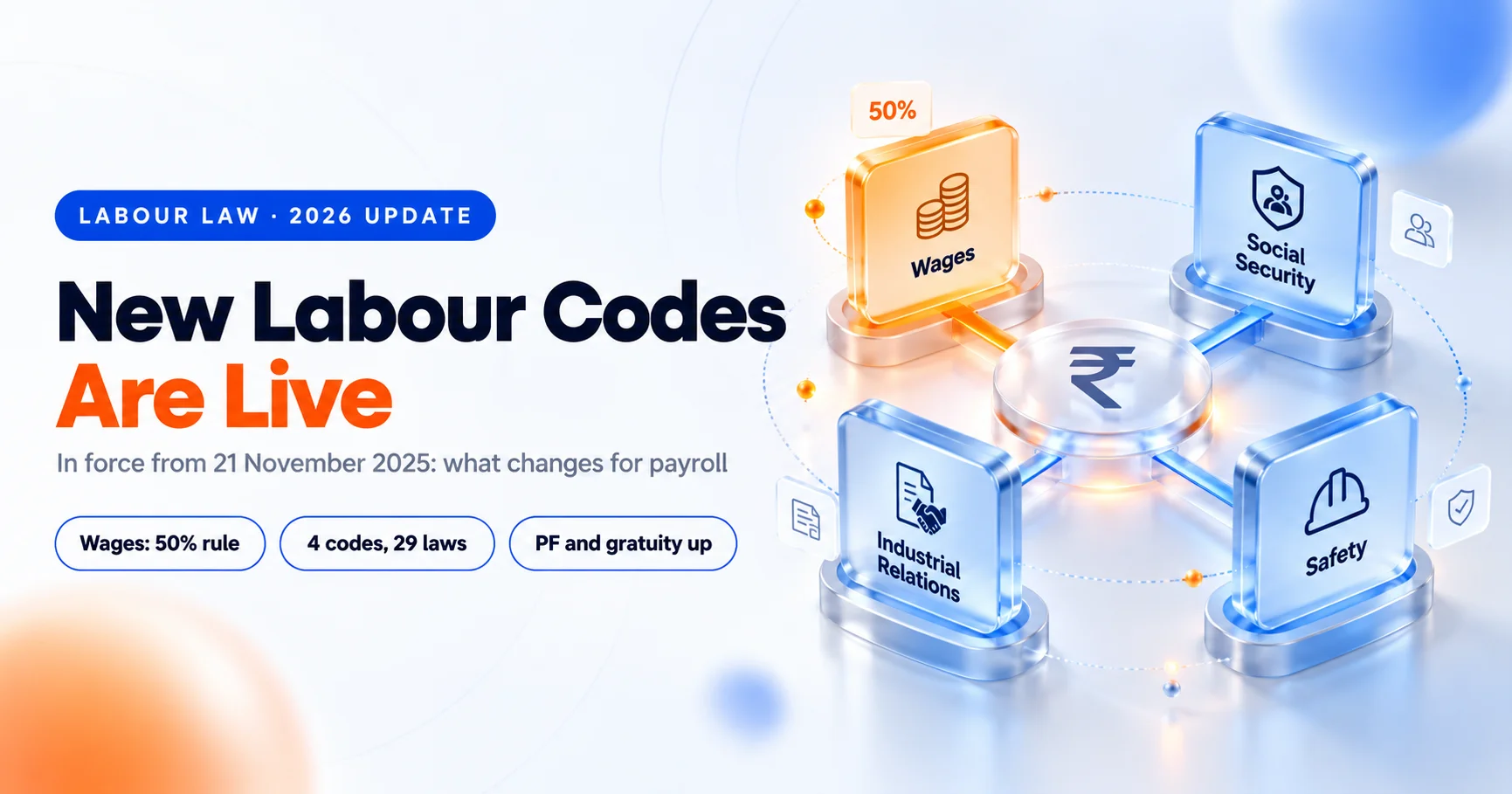
India's four Labour Codes are now live. They came into force on 21 November 2025, and the central rules that make them operable, the forms, registers and returns, were notified on 8 May 2026. Four codes replace 29 older central laws, and most states are now notifying their own rules. For payroll teams this is the biggest shift in decades, but almost all of the payroll impact comes down to one change: how wages are defined. Here is what changed and what you must do.
Key Takeaways
- The four Labour Codes came into force on 21 November 2025, with central rules notified on 8 May 2026.
- They replace 29 older central labour laws with one framework for wages, social security, industrial relations and workplace safety.
- The big payroll change is a single definition of wages: basic plus DA must be at least 50 percent of total pay.
- A wider wage base lifts PF, gratuity and leave encashment, so take-home can dip and employer cost rises.
- Fixed-term employees now earn gratuity after one year of service, not five.
- An appointment letter is now mandatory for every employee under the OSH rules.
- Labour is a concurrent subject, so watch your own state, which notifies its rules separately.
The four codes, in one line each
- Code on Wages, 2019: one definition of wages, minimum wages, timely payment and bonus.
- Code on Social Security, 2020: PF, ESI, gratuity, maternity and coverage for gig and platform workers.
- Industrial Relations Code, 2020: standing orders, trade unions, fixed-term employment and retrenchment.
- Occupational Safety, Health and Working Conditions Code, 2020: working hours, overtime, leave and appointment letters.
The timeline you should know
The codes were notified into force on 21 November 2025. For about six months they were law without the machinery to run them, until the central rules on 8 May 2026 supplied the forms, registers, returns and timelines. Because labour is on the Concurrent List, each state and union territory must still frame and notify its own rules, and several are in draft. So the central position is live, but your exact start date for some provisions depends on your state.
The one change that hits every payslip
The codes introduce a single definition of wages across PF, gratuity, bonus and more. Under it, your defined wages, broadly basic plus dearness allowance and retaining allowance, must be at least 50 percent of total pay. For years many companies kept basic low and loaded the rest into allowances to reduce contributions. That is no longer allowed. Overtime is counted towards the 50 percent test, while annual performance incentives sit outside the wage definition.
What the wage change does to payroll
Because PF, gratuity and leave encashment are all calculated on this wider base, the numbers move together. If your salary structure leans heavily on allowances, you will feel the biggest shift, and you can model the new provident fund outgo against the higher EPF wage ceiling of Rs 25,000 that also took effect in September 2026.
| Item | Common practice before | Under the Labour Codes |
|---|---|---|
| Basic pay | Often 30 to 40 percent of CTC | At least 50 percent of total pay |
| PF and gratuity base | Narrow, on a low basic | Wider, on the higher basic |
| Gratuity for fixed-term staff | After 5 years | After 1 year |
| Employee take-home | Higher | Can dip slightly |
| Employer cost per head | Lower | Higher |
Other changes employers should not miss
- Gratuity for fixed-term employees: they now qualify for gratuity after one year of service, computed on the revised wages, from 21 November 2025. Use a gratuity calculator to re-estimate your liability on the new base.
- Appointment letters are mandatory: under the OSH rules, no employee may be engaged without a written appointment letter in the prescribed format.
- Gig and platform workers: the Social Security Code brings them into a social security framework for the first time.
- Working hours and overtime: the standard day and overtime at twice the ordinary rate are codified, with flexibility on how weekly hours are arranged.
- Timely wage payment: wage periods and payment timelines are standardised across establishments.
What payroll teams must do now
- Audit every salary structure against the 50 percent wage rule and redesign where basic is too low.
- Recompute PF, gratuity and leave-encashment liability on the revised wage base and brief finance.
- Reconfigure your payroll software so contributions compute on the new wage definition, not the old basic.
- Issue appointment letters in the prescribed format to anyone who does not have one.
- Track your state's rule notifications and align start dates accordingly on the India payroll compliance hub.
- Communicate the take-home change to affected employees before the next cycle.
Frequently asked questions
When did the new Labour Codes come into force?
The four Labour Codes took effect on 21 November 2025, and the central rules that operationalise them were notified on 8 May 2026. State rules are still being notified in stages.
What is the 50 percent wage rule?
Under the single definition of wages, your defined wages (broadly basic plus dearness allowance and retaining allowance) must be at least 50 percent of total pay. This caps how much salary can sit in allowances.
How do the codes affect PF and gratuity?
Rates do not change, but the wage base widens. PF, gratuity and leave encashment are computed on the higher basic, so contributions and payouts rise while take-home can dip slightly.
Do fixed-term employees get gratuity now?
Yes. Fixed-term employees are eligible for gratuity after one year of service, rather than the usual five, computed on the revised wages from 21 November 2025.
Which 29 laws do the codes replace?
The four codes consolidate 29 central labour laws, including the Payment of Wages Act, Minimum Wages Act, EPF and ESI Acts, Payment of Gratuity Act, Payment of Bonus Act and the Factories Act provisions on hours and safety.
Are the codes fully implemented everywhere?
The central provisions are in force, but labour is a concurrent subject, so each state notifies its own rules separately. Confirm the exact position for every state where you employ staff.
Final word
The Labour Codes sound sweeping, but for payroll the work is focused: fix your salary structures to the 50 percent wage rule, recompute PF, gratuity and leave on the wider base, issue appointment letters, and watch your state. Do the restructuring once and the monthly run stays clean. Factories feel the 50 percent wage rule most, so see our guide to the best HR software for manufacturing. Want a payroll system that applies the new wage definition for you? Book a free factoHR India demo.