Every Indian employer that pays salaries runs payroll, and each cycle carries many moving parts. Attendance, salary structure, statutory deductions, tax, payslips, bank disbursement, and return filing all happen in one month.
This guide shows you how to run payroll in India step by step in 2026, with the registrations, rates, due dates, and registers every employer must handle. Built for HR managers, founders, payroll executives, and finance teams.
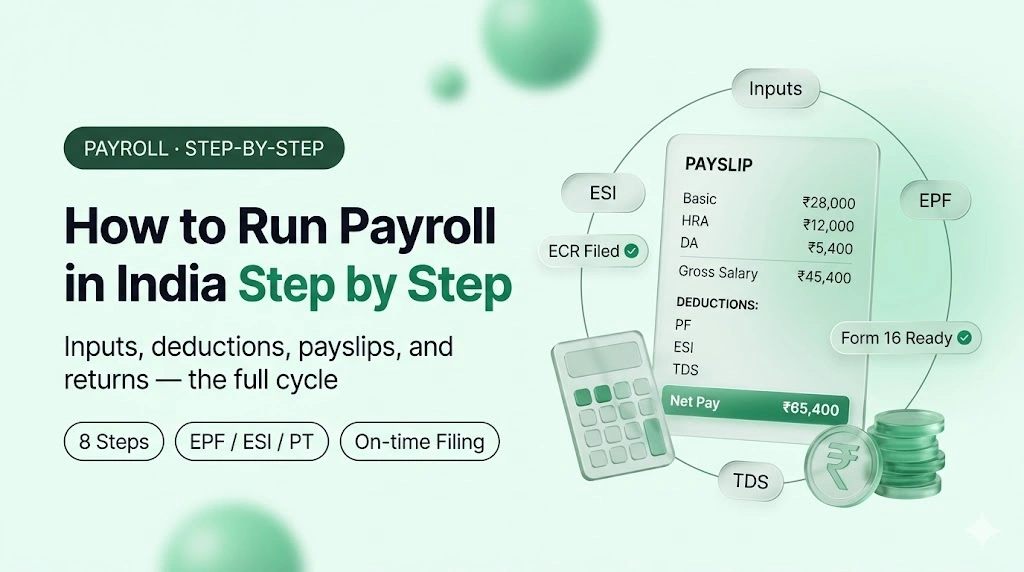
- 8-step cycle: collect inputs, set salary structure, calculate gross, apply statutory deductions, compute net pay, issue payslips, file returns, maintain registers.
- EPF: 12% employee plus 12% employer on Basic and DA (ceiling Rs 25,000 from 17 September 2026); upload the ECR by the 15th of the next month.
- ESI: 0.75% employee plus 3.25% employer on gross up to Rs 21,000.
- Professional Tax: state-wise, capped at Rs 2,500 a year; TDS follows Section 192 of the Income Tax Act.
- Pay window: salary by the 7th (under 1,000 workers) or 10th of the next month; issue Form 16 by 15 June.
What does running payroll in India involve?
Payroll is more than paying salaries. You calculate earnings, apply the correct statutory deductions, pay employees within the legal window, and file returns with the EPFO, ESIC, Income Tax Department, and your state authorities. A single missed deduction or late return invites interest, damages, and inspection risk.
If you want the concept first, read what is payroll. This guide focuses on the practical, repeatable process you follow every month.
What you need before you run payroll
Set up these registrations once. Without them you cannot deposit statutory dues or file returns.
EPF registration
Mandatory once you employ 20 or more people under the Employees Provident Funds and Miscellaneous Provisions Act, 1952. You get an establishment code to file the ECR each month.
ESI registration
Mandatory at 10 or more employees in covered areas under the Employees State Insurance Act, 1948. Employees earning gross up to Rs 21,000 a month are covered.
Professional Tax registration
Register for PTRC and PTEC in the states that levy Professional Tax. See the state-wise slabs on the Professional Tax hub.
TAN and Shops and Establishments
You need a TAN to deduct and deposit TDS under Section 192 of the Income Tax Act, 1961. Register under your state Shops and Establishments Act for working-hour and leave rules.
The Indian payroll process: 8 steps
Step 1: Collect payroll inputs
Gather attendance, approved leave, overtime, new joiners, exits, and salary revisions for the month. Fix the attendance cut-off date. Clean inputs at the start prevent rework and reprocessing later.
Step 2: Define the salary structure
Split each employee's CTC into Basic, Dearness Allowance, House Rent Allowance, and other allowances. Under the Code on Wages, 2019, wages (Basic plus DA) should be at least 50% of total remuneration. Basic and DA drive your EPF and gratuity liability, so structure them with care.
Step 3: Calculate gross salary
Add Basic, DA, HRA, and all allowances to reach gross earnings for the month. Pro-rate gross for mid-month joiners and exits based on payable days.
Step 4: Apply statutory deductions
This is where compliance happens. Apply each deduction at the correct rate and ceiling.
| Deduction | Rate | Basis |
|---|---|---|
| EPF | 12% employee + 12% employer | Basic + DA (ceiling Rs 15,000) |
| ESI | 0.75% employee + 3.25% employer | Gross up to Rs 21,000 |
| Professional Tax | State slab (max Rs 2,500/year) | Monthly gross, by work state |
| TDS | As per income slab | Section 192, old or new regime |
| LWF | State fixed amount | 16 states levy LWF |
Check exact figures with the EPF calculator, ESI calculator, and the LWF rates by state.
Step 5: Compute net pay
Net pay equals gross salary minus total statutory and voluntary deductions. Use a take-home salary calculator to verify gross-to-net, and compare each payslip with the previous month to catch outliers before you pay.
Step 6: Disburse salary and issue payslips
Pay salaries within the window set by the Payment of Wages Act, 1936: by the 7th of the next month for establishments with under 1,000 workers, and by the 10th for larger ones. Give every employee a payslip that shows earnings and each deduction.
Step 7: File statutory returns
- EPF (ECR): upload and pay by the 15th of the next month.
- ESI: pay the contribution by the 15th of the next month.
- TDS: deposit by the 7th of the next month and file Form 138 each quarter.
- Professional Tax and LWF: file as per your state cadence.
- Form 16: issue to employees by 15 June for the previous financial year.
Step 8: Maintain payroll registers
Keep the wage register, attendance register, and deduction records ready for inspection. Use the statutory register formats and run the HR audit checklists to stay inspection-ready.
How to set up a compliant salary structure
A clean structure keeps statutory liability predictable and audit-safe.
Basic and Dearness Allowance
Keep Basic plus DA at 50% or more of CTC to meet the Code on Wages definition. This base decides EPF, ESI eligibility, gratuity, and bonus.
House Rent Allowance
HRA gives employees a tax exemption under Section 10(13A). Test the exemption with the HRA exemption calculator.
Allowances and reimbursements
Add conveyance, special allowance, and reimbursements as policy needs. Keep taxable and exempt components clearly separated on the payslip.
India payroll due-date calendar
| Task | Frequency | Due date |
|---|---|---|
| TDS deposit | Monthly | 7th of next month |
| EPF ECR | Monthly | 15th of next month |
| ESI contribution | Monthly | 15th of next month |
| Form 138 (TDS return) | Quarterly | 31 Jul / 31 Oct / 31 Jan / 31 May |
| Form 16 | Annual | 15 June |
Dates are indicative. Confirm state Professional Tax and LWF dates before filing.
Manual payroll vs payroll software
Spreadsheets work for a handful of employees. They break as headcount, states, and statutory rules grow, and a single formula error can underpay staff or miss a deduction.
Where manual payroll fails
- State-wise PT, LWF, and minimum wage rules are hard to track by hand.
- ECR, Form 138, and Form 16 formats change and need rework.
- No audit trail when an inspector asks for records.
Where software helps
factoHR payroll software computes salaries, applies state-wise PF, ESI, PT, and LWF, generates the ECR, Form 138, and Form 16, and keeps registers audit-ready. See factoHR payroll software or the full India compliance hub.
Common payroll mistakes to avoid
- Keeping Basic below 50% of CTC, which understates EPF and gratuity.
- Missing the ECR or ESI deadline, which attracts interest and damages.
- Applying the wrong Professional Tax slab for the employee work state.
- Ignoring the old versus new tax regime choice while computing TDS.
- Not updating wage masters when a state notifies new minimum wages.
- Skipping payslips or leaving deductions undisclosed.
How to make payroll error-free
- Lock the attendance cut-off and freeze inputs before processing.
- Reconcile headcount, new joiners, and exits every cycle.
- Validate each payslip against the previous month.
- Automate statutory rates so state changes apply on their own.
- Run a monthly mini-audit using the audit checklists.
Conclusion
Running payroll in India is a fixed, repeatable cycle once you set up registrations and a clean salary structure. Collect inputs, calculate gross, apply EPF, ESI, PT, TDS, and LWF, pay on time, file returns, and keep registers. Get the statutory part right and payroll stays audit-safe every month. factoHR automates the whole cycle so your team files on time without spreadsheets.
Frequently asked questions
What are the steps to run payroll in India?
Collect inputs, define the salary structure, calculate gross, apply statutory deductions (EPF, ESI, PT, TDS, LWF), compute net pay, disburse salary with payslips, file returns, and maintain registers.
What deductions apply to Indian salaries?
EPF at 12% plus 12% on Basic and DA, ESI at 0.75% plus 3.25% on gross up to Rs 21,000, state Professional Tax up to Rs 2,500 a year, TDS under Section 192, and Labour Welfare Fund in 16 states.
What is the EPF payment due date?
Employers upload the ECR and pay EPF by the 15th of the following month. Late payment attracts interest and damages under the EPF and MP Act, 1952.
When must Form 16 be issued?
Employers must issue Form 16 to employees by 15 June for the previous financial year, after filing the Q4 Form 138.
How long does it take to run monthly payroll?
With clean inputs and payroll software, a cycle takes a few hours. Manual payroll for the same headcount can take several days and carries higher error risk.
Can small businesses run payroll without software?
Very small teams can use spreadsheets, but state-wise PF, ESI, PT, and LWF plus return filing make errors likely. Software pays off once you cross a handful of employees or operate in multiple states.