HR teams lose hours every week to repetitive work: chasing approvals, re-keying attendance into payroll, sending the same onboarding emails, and copying data between apps. HR automation tools take that work off your plate so your team can spend time on people, not admin.
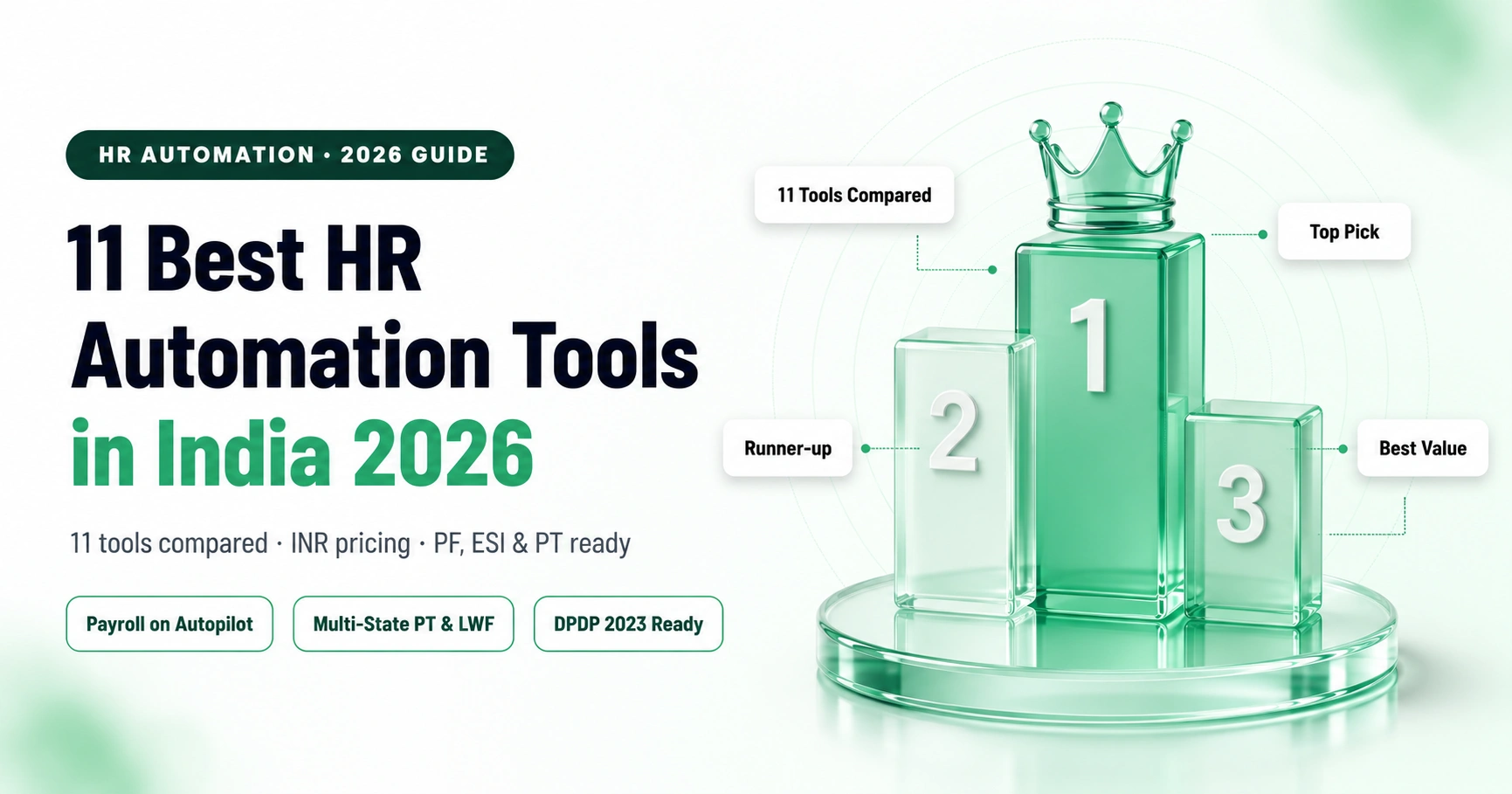
This guide covers the 10 best HR automation tools for 2026, across payroll, onboarding, scheduling, recruiting, attendance, and engagement. Each entry explains what the tool automates and who it suits, with an India-first pick at the top.
Key Takeaways
- The 10 best HR automation tools for 2026 span payroll, onboarding, scheduling, recruiting, attendance, and engagement.
- HR automation tools run repetitive HR tasks automatically, keep your systems in sync, and cut manual errors.
- Some tools are all-in-one (factoHR India, BambooHR); others automate one process well, such as Deputy for scheduling or Ashby for hiring.
- Connector tools like Zapier link the apps you already use instead of replacing them.
- For Indian teams, statutory automation (PF, ESI, PT, TDS) and attendance for distributed staff matter most.
- Match the tool to the process you want to fix first, then check integrations and India fit.
What are HR Automation Tools?
HR automation tools are software that run repetitive HR tasks automatically instead of by hand. They cover recruitment, onboarding, attendance, leave, payroll, performance, and employee engagement, keeping your systems in sync and cutting manual errors.
Some are all-in-one HR platforms; others specialise in a single process, such as scheduling or hiring. A workflow tool can also connect the apps you already run. The best choice depends on which tasks eat your team's time.
The time savings are real. A Deloitte study found HR teams spend up to 57 percent of their time on routine administrative work, while the McKinsey Global Institute estimates that 56 percent of HR tasks can be automated with existing technology. Automation moves that effort from data entry to people.
The 10 Best HR Automation Tools for 2026
This list spans the main HR automation categories, so you can match a tool to the process you want to fix. We looked at what each tool automates, how well it fits the rest of your stack, and its suitability for Indian teams.
1. factoHR India
factoHR India automates the full employee lifecycle in one platform: payroll, attendance, leave, recruitment, onboarding, and performance. Built for Indian businesses, it runs PF, ESI, professional tax, and TDS automatically through built-in payroll, and feeds attendance and leave straight into it, so one data entry drives the whole cycle.
Automates: Payroll, attendance, leave, hiring, onboarding, and statutory filing.
Best for: Indian SMBs and mid-market teams that want end-to-end HR automation in one system.
2. Zapier
Zapier is not an HRMS. It connects the HR, ATS, and payroll apps you already use and triggers actions between them, from posting a new hire to Slack to syncing candidates into your ATS. Its AI steps let you build agentic workflows without code.
Automates: Cross-app HR workflows and AI task triggers.
Best for: Teams that want to link existing tools instead of replacing them.
See HR automation run on your data.
We'll automate payroll, attendance & onboarding live in 20 mins.
3. BambooHR
BambooHR centralises employee records and automates onboarding with task checklists, e-signatures, and new-hire workflows. It suits small and mid-size teams that want tidy core HR and clean reporting without heavy setup.
Automates: Onboarding checklists, e-signatures, PTO, and reporting.
Best for: Small and mid-size teams that want simple core HR.
4. Rippling
Rippling unifies HR, payroll, and IT. Its Workflow Studio automates tasks across functions, and it can provision apps and equipment the moment payroll adds a new hire. India payroll support is growing but less deep than India-first tools.
Automates: Payroll, device and app provisioning, and cross-system workflows.
Best for: Companies that want HR and IT automation together.
5. Deputy
Deputy automates employee scheduling using historical demand, then tracks time, labour cost, and compliance alerts. It fits shift-based teams in retail, hospitality, and healthcare that juggle rosters every week.
Automates: Auto-scheduling, time tracking, and labour-cost alerts.
Best for: Shift-based and hourly workforces.
6. Ashby
Ashby is a modern, all-in-one recruiting platform with AI sourcing, structured hiring workflows, and built-in analytics. It automates the pipeline from sourcing to offer and gives talent teams data on every stage.
Automates: Candidate sourcing, interview workflows, and hiring reports.
Best for: Talent teams that want data-driven hiring.
7. Enboarder
Enboarder builds guided onboarding journeys with a visual workflow builder, timed emails, reminders, and manager nudges, so new hires stay engaged before day one. It is built for experience, not just paperwork.
Automates: Personalised onboarding journeys and reminders.
Best for: Teams that want a high-touch onboarding experience.
8. Truein
Truein automates attendance for on-site and contract workforces with AI face recognition and GPS geofencing, plus shift management and real-time dashboards. It is built with Indian field and contract teams in mind.
Automates: Face-based attendance, geofencing, and shift tracking.
Best for: Distributed, field, and contract workforces.
9. Workhuman
Workhuman automates peer recognition, rewards, and performance check-ins, with AI insights into engagement. It helps large teams keep recognition consistent across locations and departments.
Automates: Peer recognition, rewards, and engagement surveys.
Best for: Large teams focused on culture and engagement.
10. monday.com
monday.com lets HR teams build no-code automations for onboarding, leave requests, and performance cycles on a flexible work-management board. It suits teams that want to shape their own workflows rather than fit a fixed HRMS.
Automates: Custom HR workflows, approvals, and tracking.
Best for: Teams that want flexible, no-code HR processes.
Quick Comparison Table
The table below compares all 10 tools on what they automate, their category, and best-fit team. Pricing models vary from free connectors to per-employee plans, so confirm the latest with each vendor.
| Tool | Category | What It Automates | Best For |
|---|---|---|---|
| factoHR India | All-in-one (India) | Payroll, attendance, leave, hiring, onboarding | Indian SMBs & mid-market |
| Zapier | Workflow connector | Cross-app HR workflows | Linking existing tools |
| BambooHR | All-in-one HR | Onboarding, PTO, reporting | Small & mid-size teams |
| Rippling | Payroll + IT | Payroll, IT provisioning | HR and IT together |
| Deputy | Scheduling | Rosters, time, labour cost | Shift-based teams |
| Ashby | Recruiting | Sourcing, interviews, reports | Data-driven hiring |
| Enboarder | Onboarding | Onboarding journeys | High-touch onboarding |
| Truein | Attendance | Face & GPS attendance | Field & contract staff |
| Workhuman | Engagement | Recognition, rewards, surveys | Culture & engagement |
| monday.com | Work management | Custom HR workflows | No-code HR processes |
How HR Automation Works, Process by Process
The fastest way to pick a tool is to map it to the process you want to automate first. Here is how automation applies to the main HR processes for Indian teams.
Attendance. Automation captures biometric, face, or GPS punches and feeds them into payroll, which removes double entry and buddy punching. This is where attendance management software earns its keep for distributed teams.
Leave. Policy-based balances and approval routing replace email chains and manual registers, so a leave management system keeps balances accurate and audit-ready.
Recruitment. Resume screening, interview scheduling, and offer letters move on their own through a recruitment and ATS platform, which shortens time to hire.
Onboarding. Document collection, e-signatures, and day-one readiness run as a checklist with digital employee onboarding software, so nothing slips before the first day.
Payroll and compliance. Salary, PF, ESI, professional tax, and TDS calculate automatically, then filings and Form 16 generate without manual math. This is the process where Indian statutory depth separates the strong tools from the rest.
What to Look For When Choosing
Judge an HR automation tool on more than its interface. Check these first.
- The process it automates best: Pick a tool that fixes your biggest bottleneck, whether that is payroll, scheduling, or hiring.
- Integrations: The tool should connect cleanly with your existing HR, payroll, and finance apps so data is entered once.
- India fit: For Indian teams, confirm PF, ESI, professional tax, and TDS automation and support for distributed or contract staff.
- Mobile and self-service: Employees should handle attendance, leave, and payslips from their phone.
- Data protection: Look for encryption, role-based access, audit logs, and Indian data residency in line with the DPDP Act, 2023.
- Total cost: Compare setup, add-ons, and per-user pricing, not just the headline plan.
How to Choose the Right HR Automation Tool
Follow a simple order. First, list the processes that eat your team's time. Second, decide whether you need an all-in-one platform or a point tool for one job. Third, check integrations and India compliance. Finally, shortlist two or three tools and run a live demo with your own data before you commit.
Final Word
The right HR automation tool is the one that removes your biggest manual bottleneck. If that is scheduling, a tool like Deputy pays for itself; if it is hiring, Ashby does. If you want payroll, attendance, leave, and onboarding automated in one India-first platform, factoHR India covers the whole lifecycle.
Shortlist two or three tools from this list, run a demo with your real data, and pick the one your team will actually use every day.
Frequently Asked Questions
What are HR automation tools?
HR automation tools are software that run repetitive HR tasks automatically, such as payroll, attendance, leave, onboarding, recruitment, performance, and engagement. They keep your systems in sync and cut manual errors, and range from all-in-one platforms to single-process tools and workflow connectors.
Which is the best HR automation tool in India?
It depends on the process you want to automate. factoHR India suits teams that want payroll, attendance, and onboarding automated in one platform. Zapier connects tools you already use, Deputy automates scheduling, and Ashby automates hiring.
What HR tasks can be automated?
You can automate payroll and statutory filing, attendance and leave, recruitment and onboarding, performance reviews, and employee recognition. Most teams start with the task that consumes the most manual hours, usually payroll or attendance.
Do HR automation tools handle Indian statutory compliance?
India-first tools do. They automate PF, ESI, professional tax, and TDS, and generate Form 16 and Form 138. Many global tools have limited Indian statutory depth, so confirm this before you buy.
How much do HR automation tools cost?
Pricing varies by model. Workflow connectors have free tiers, point tools charge per user, and all-in-one platforms are often quoted by employee count and modules. Compare setup and add-on costs, not just the headline price.
Can small businesses use HR automation tools?
Yes. Many tools offer free or low-cost plans for small teams. Automation helps small businesses run payroll, attendance, and onboarding without a large HR team.