A salary structure in India is the way total pay is split into parts: earnings you receive, deductions taken from them, and contributions your employer adds on top. It has three layers: earnings (Basic, HRA, allowances), deductions (PF, Professional Tax, TDS), and employer contributions (employer PF, gratuity) that make up your CTC. Understand this split and your offer letter, payslip, and in-hand pay stop being a mystery.
- CTC is not your salary. CTC is the total company cost, including employer PF and gratuity. Your in-hand pay is much lower.
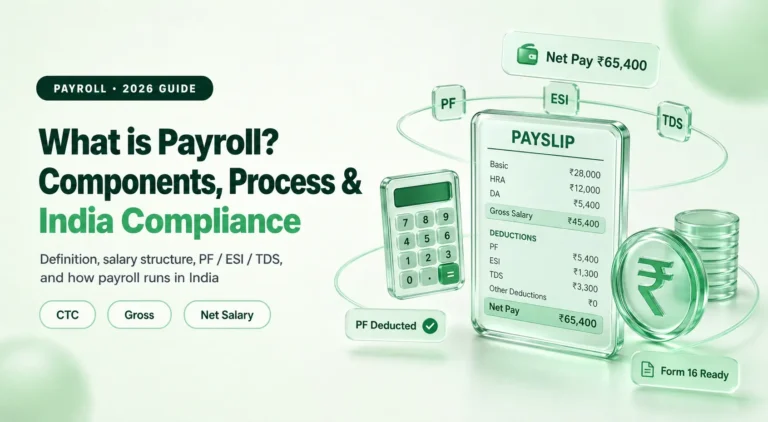
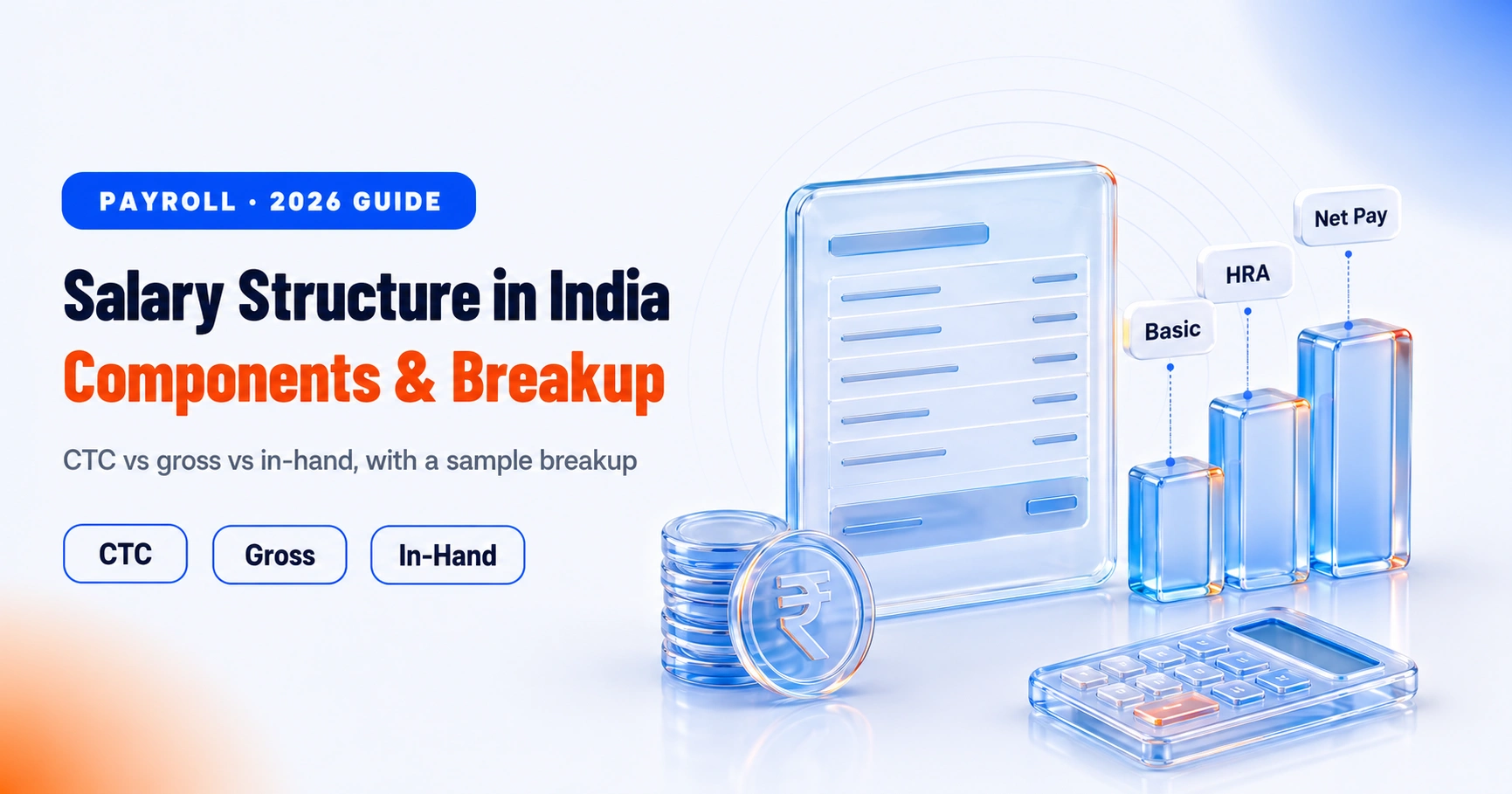
- The flow is simple: CTC minus employer contributions is Gross, and Gross minus deductions is your Net (in-hand) salary.
- Basic salary drives everything. It sets your PF, gratuity, and HRA exemption, so its percentage matters more than any other component.
- Under the Code on Wages 2019, wages (Basic plus DA) must be at least 50 percent of total pay, which raises PF and gratuity for many employees.
- A smart structure balances take-home pay today against tax savings and retirement benefits, using HRA, LTA, and NPS legally.
What Is a Salary Structure?
A salary structure is the breakdown of an employee's total compensation into fixed components, variable components, statutory deductions, and employer contributions. It is what turns a single number in an offer letter into a monthly payslip.
Every Indian salary structure has three layers. The first is earnings, the money credited to you such as Basic, House Rent Allowance, and other allowances. The second is deductions, amounts taken out such as your Provident Fund share, Professional Tax, and TDS. The third is employer contributions, which the company pays on top of your gross, such as its share of PF and a gratuity provision. These three layers together form your Cost to Company.
CTC vs Gross Salary vs Net (In-Hand) Salary
This is where most confusion starts. These three numbers are always different, and knowing the gap protects you when comparing offers.
| Term | What it means |
|---|---|
| CTC (Cost to Company) | The total annual cost the company bears for you, including employer PF, gratuity, and any benefits. This is the big offer-letter number. |
| Gross Salary | CTC minus employer contributions. The total of all your earnings before deductions. |
| Net / In-Hand Salary | Gross minus your deductions (employee PF, Professional Tax, TDS). The money that actually reaches your bank account. |
The one-line formula: CTC minus employer contributions equals Gross, and Gross minus deductions equals Net. A CTC of Rs 12 lakh a year rarely means Rs 1 lakh in hand every month, and this is exactly why. You can model your own split with a CTC calculator before you accept an offer.
The Components of an Indian Salary Structure
Here is every part you will see on an Indian payslip, grouped by the three layers.
Earnings (your gross salary)
- Basic Salary. Usually 40 to 50 percent of CTC. It is the base for PF, gratuity, and HRA exemption, so it is the most important number in the whole structure.
- House Rent Allowance (HRA). Paid to cover rent, and partly tax-exempt if you actually pay rent. Usually 40 to 50 percent of Basic.
- Dearness Allowance (DA). A cost-of-living component, common in government and PSU pay, and treated as wages for PF.
- Leave Travel Allowance (LTA). Reimburses domestic travel and is tax-exempt twice in a block of four years, against actual travel bills.
- Special Allowance. The balancing figure that makes the numbers add up. It is fully taxable.
- Reimbursements. Fuel, telephone, or books and periodicals, tax-free against bills where the structure allows.
- Variable Pay / Bonus. Performance-linked pay, often paid quarterly or annually, and fully taxable.
Deductions (taken from your gross)
- Employee Provident Fund (EPF). Estimate the corpus with the EPF calculator. 12 percent of Basic plus DA, deducted from your salary, matched by the employer, and deposited with the EPFO.
- Professional Tax (PT). A small state tax, capped at Rs 2,500 a year. It varies by state and some states do not levy it at all. See the state-wise Professional Tax rules for your slabs.
- TDS (Tax Deducted at Source). Income tax deducted monthly based on your projected annual income and your chosen tax regime.
- ESI. For employees earning up to Rs 21,000 a month, 0.75 percent is deducted (employer adds 3.25 percent).
Employer contributions (part of CTC, not paid to you)
- Employer EPF. The company's matching 12 percent of Basic plus DA.
- Gratuity. A provision of about 4.81 percent of Basic, payable to you as gratuity after five years of service.
- Employer ESI. 3.25 percent, where ESI applies.
A Sample Salary Structure (Worked Example)
Numbers make this concrete. Below is an illustrative monthly structure for a CTC of about Rs 12,00,000 a year (roughly Rs 1,00,000 a month). Your own figures will differ by employer and tax declarations.
| Component | Monthly (Rs) |
|---|---|
| Basic Salary | 40,000 |
| HRA | 20,000 |
| LTA | 5,000 |
| Special Allowance | 28,000 |
| Gross Salary (A) | 93,000 |
| Employer EPF | 4,800 |
| Gratuity provision | 1,924 |
| CTC (A + employer contributions) | approx 99,724 (Rs 11.97 lakh a year) |
| Less: Employee EPF | 4,800 |
| Less: Professional Tax | 200 |
| Less: TDS (illustrative) | 4,000 |
| Net In-Hand Salary | approx 84,000 |
Notice the gap: a Rs 12 lakh CTC lands as roughly Rs 84,000 in hand, not Rs 1 lakh. The difference is the employer contributions and your own deductions.
Key Salary Component Formulas
These are the formulas behind the components, useful whether you are checking your payslip or building a structure.
| Component | Formula |
|---|---|
| Basic Salary | Usually 40 to 50 percent of CTC (minimum 50 percent of pay as wages under the Code on Wages 2019) |
| EPF (employee and employer each) | 12 percent of (Basic + DA) |
| Gratuity (on exit) | (15 / 26) x last drawn (Basic + DA) x years of service |
| HRA exemption | Least of: actual HRA; 50 percent of Basic (metro) or 40 percent (non-metro); rent paid minus 10 percent of Basic |
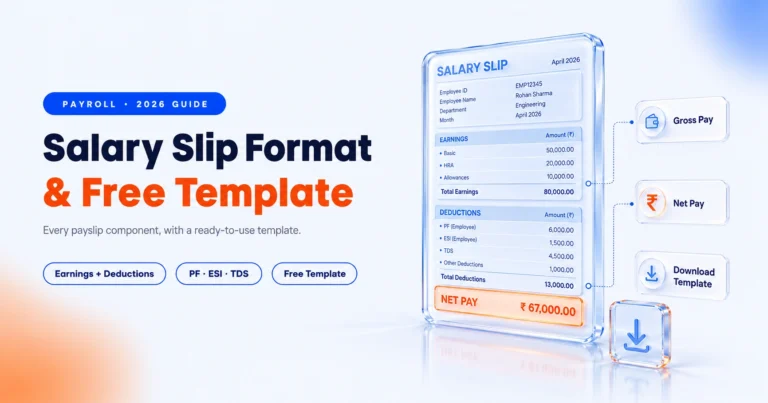
| Net In-Hand | Gross Salary minus (Employee EPF + Professional Tax + TDS) |
How the Code on Wages 2019 Changes Salary Structures
The Code on Wages 2019 redefines wages so that Basic plus DA must be at least 50 percent of total remuneration. Many companies used to keep Basic low (say 30 percent) and load the rest into special allowance, which reduced PF and gratuity costs.
Once the 50 percent rule applies, Basic rises for those employees. That increases both employee and employer PF, raises the gratuity provision, and can slightly lower immediate take-home pay while boosting retirement savings. If you design salary structures, build them at 50 percent wages now rather than restructuring later.
How to Design a Salary Structure
For employers and HR teams, building a clean structure follows a clear order.
- Start from the CTC. Fix the total annual cost you are offering.
- Set Basic at 40 to 50 percent. Keep it compliant with the Code on Wages 2019 wage definition.
- Add HRA. Typically 40 to 50 percent of Basic, so employees who pay rent get the exemption.
- Carve out tax-friendly heads. LTA, and reimbursements like fuel or books, where genuine bills exist.
- Use Special Allowance as the balancer. Whatever is left after the above becomes special allowance.
- Layer in employer contributions. Add employer PF and the gratuity provision to reach the CTC.
- Check compliance. Confirm PF, ESI eligibility, Professional Tax by state, and minimum wages are all satisfied.
Tax-Efficient Salary Structuring
A good structure legally lowers tax without cutting real pay. These levers work within the law.
- HRA. Check your exemption with the HRA exemption calculator. If you pay rent, a well-sized HRA is one of the largest exemptions available.
- LTA. Claim it against domestic travel bills, twice per four-year block.
- Employer NPS contribution. Under Section 80CCD(2), the employer's NPS contribution is deductible over and above other limits, useful at higher salaries.
- Reimbursements. Fuel, phone, and books and periodicals against genuine bills are tax-free where offered.
- Meal cards. A small but clean exemption many structures include.
One caution: the old tax regime rewards these exemptions, while the new regime offers lower slab rates but removes most of them. Compare both before locking your declarations, since the best structure depends on the regime you pick.
Common Salary Structure Mistakes
- Chasing a big CTC. A higher CTC with a low Basic and heavy employer loading can mean less in hand than a lower CTC with a cleaner split.
- Ignoring Basic. A very low Basic shrinks your PF and gratuity, hurting long-term savings.
- HRA with no rent. HRA is only exempt if you actually pay rent and can prove it.
- Forgetting the regime choice. Structuring for exemptions and then picking the new regime wastes the exemptions.
- Non-compliant Basic. Ignoring the 50 percent wage rule invites future PF and gratuity liabilities.
Frequently Asked Questions
What is a salary structure in India?
A salary structure is how total pay is split into components: earnings such as Basic and HRA, deductions such as PF and TDS, and employer contributions such as employer PF and gratuity. Together these form your CTC.
Why is my in-hand salary lower than my CTC?
Because CTC includes employer contributions you never receive directly (employer PF and gratuity), and your gross is further reduced by employee PF, Professional Tax, and TDS. In-hand pay is typically 65 to 80 percent of gross.
How much should Basic salary be?
Usually 40 to 50 percent of CTC. Under the Code on Wages 2019, Basic plus DA should be at least 50 percent of total pay. A higher Basic increases PF and gratuity but lowers immediate take-home.
Which salary structure gives the most in-hand pay?
One with a compliant Basic, a right-sized HRA you can claim, tax-friendly heads like LTA, and the tax regime that suits you. There is no single best structure; it depends on rent, investments, and regime choice.
Is HRA always tax-free?
No. HRA is exempt only up to the least of three limits and only if you actually pay rent. If you do not pay rent, your HRA is fully taxable.
Build Compliant Salary Structures in Minutes
Set Basic, HRA, and allowances once, stay compliant with PF, ESI, PT, and the Code on Wages, and generate accurate payslips automatically for every employee.