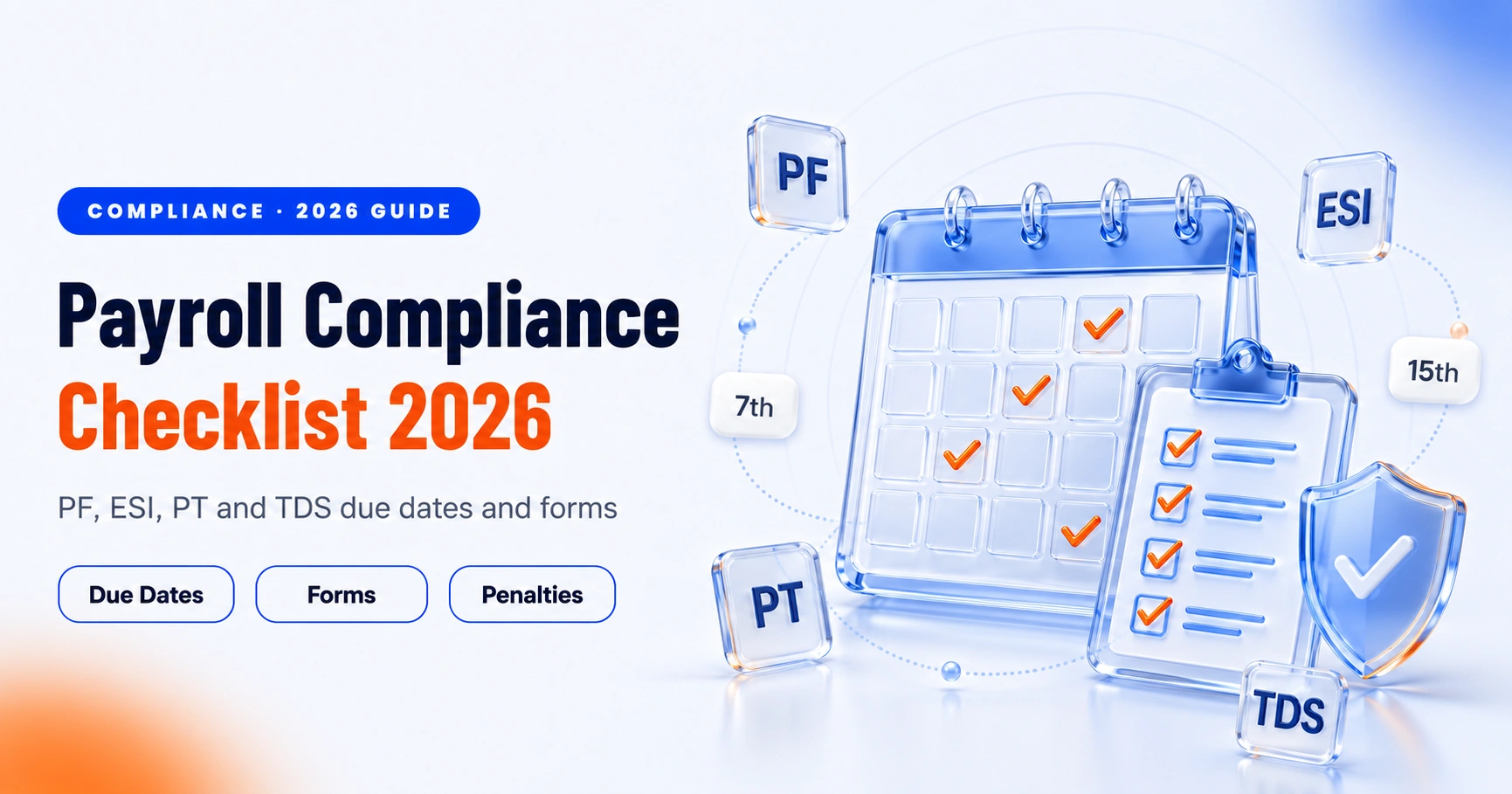
Payroll compliance in India means paying employees correctly and depositing every statutory due, PF, ESI, Professional Tax, TDS, and Labour Welfare Fund, on time, with the right returns and records. Miss a deadline and you face interest, damages, and penalties that often cost far more than the amount you were late on. This checklist and due-date calendar keep your payroll audit-ready every month.
- Core payroll compliance covers five statutory dues: PF, ESI, Professional Tax, TDS, and Labour Welfare Fund.
- The two dates to burn into memory: TDS deposit by the 7th, and PF and ESI by the 15th of the next month.
- Returns matter as much as payments: TDS Form 138 is quarterly, ESI returns are half-yearly, and Form 16 is due by 15 June.
- Penalties compound fast: PF adds interest plus damages, and late TDS filing alone costs Rs 200 a day.
- Compliance is not only payroll. Minimum wages, bonus, gratuity, POSH, and maternity rules all sit alongside it.
What Is Payroll Compliance in India?
Payroll compliance is the set of legal obligations an employer must meet every time it runs payroll. It has three parts: deducting and depositing the right statutory amounts, filing the correct returns on time, and maintaining the registers and records that prove you did both.
The obligations flow from central and state laws, so the exact list depends on your headcount, your states of operation, and your industry. But for almost every Indian employer, the same core dues repeat each month, which is why a checklist beats memory.
The Payroll Compliance Checklist
Run this checklist every cycle. It follows the natural order of a payroll run.
Before running payroll
- Confirm all new joiners have UAN, PF, ESI (if applicable), and bank details captured.
- Check the latest minimum wage and VDA rates for each state you operate in.
- Update any statutory changes, such as revised PT slabs or wage-ceiling changes.
- Validate attendance, leave, and LOP data with a hard cut-off date.
- Collect investment declarations to compute correct TDS.
During payroll processing
- Calculate gross, deductions, and net for every employee.
- Compute employee and employer PF, ESI, PT, and TDS accurately.
- Apply the correct tax regime per each employee's declaration.
- Generate payslips and get them reviewed before release.
After running payroll
- Deposit TDS by the 7th of the next month.
- File PF ECR and pay PF and ESI by the 15th.
- Deposit Professional Tax and Labour Welfare Fund per your state schedule.
- File quarterly and half-yearly returns when due.
- Update statutory registers and archive payslips and challans.
Statutory Contributions at a Glance
These are the recurring dues behind Indian payroll, with who pays what.
| Due | Employee | Employer | Applies when |
|---|---|---|---|
| EPF (Provident Fund) | 12% of Basic + DA | 12% of Basic + DA | 20 or more employees (wage ceiling Rs 25,000) |
| ESI | 0.75% of gross | 3.25% of gross | 10 or more employees; wages up to Rs 21,000/month |
| Professional Tax | Up to Rs 2,500/year | Deduct and deposit | State-specific; not levied in every state |
| TDS on salary | As per income tax slabs | Deduct and deposit | When salary crosses the taxable limit |
| Labour Welfare Fund | Small fixed amount | Larger fixed amount | State-specific; half-yearly or annual |
The Payroll Compliance Calendar: Due Dates and Forms
This is the part most guides leave out. Here is the consolidated calendar of what is due, when, and on which form.
Monthly
| Obligation | Due date | Form |
|---|---|---|
| TDS deposit | 7th of next month (April to February) | Challan ITNS 281 |
| PF payment and return | 15th of next month | ECR (Electronic Challan cum Return) |
| ESI contribution | 15th of next month | Online challan |
| Professional Tax | State-specific (often 10th to last day) | State PT form |
Quarterly
| Obligation | Due date | Form |
|---|---|---|
| TDS return, Q1 (Apr-Jun) | 31 July | Form 138 |
| TDS return, Q2 (Jul-Sep) | 31 October | Form 138 |
| TDS return, Q3 (Oct-Dec) | 31 January | Form 138 |
| TDS return, Q4 (Jan-Mar) | 31 May | Form 138 |
Half-yearly and annual
| Obligation | Due date | Form |
|---|---|---|
| TDS deposit for March | 30 April | Challan ITNS 281 |
| ESI half-yearly return | 11 May and 11 November | ESI return |
| Form 16 to employees | 15 June | Form 16 |
| Payment of Bonus | Within 8 months of year end (by 30 November) | Form D (annual return) |
| Labour Welfare Fund | State-specific (commonly June and December) | State LWF form |
State dues such as Professional Tax and LWF vary widely, so always confirm against your own state notifications and the official EPFO and Income Tax portals. A payroll system that tracks these by state removes most of the manual risk.
Penalties for Non-Compliance
The cost of missing a deadline is rarely just the pending amount. These are the common consequences.
- PF (EPF). Interest at 12 percent a year on the delay, plus damages of 5 to 25 percent a year depending on how late you are.
- TDS. Interest of 1 percent a month for late deduction and 1.5 percent a month for late deposit, plus a late-filing fee of Rs 200 a day under Section 234E, and a possible penalty under Section 271H.
- ESI. Interest at 12 percent a year on delayed contributions, plus damages, and possible prosecution for persistent default.
- Professional Tax and LWF. State-specific interest and penalties on late deposit and non-filing.
- Bonus, gratuity, minimum wages. Fines and, in serious cases, imprisonment for the responsible person under the respective acts.
Because damages compound with delay, the cheapest strategy is simply never to be late.
Statutory Registers and Records to Maintain
Compliance is judged at audit by your records. Keep these ready and current.
- Register of wages, and the wage slips issued.
- Register of employees, attendance, and leave.
- Register of fines, deductions, and advances.
- PF and ESI challans, ECR receipts, and contribution statements.
- TDS challans, Form 138 acknowledgements, and Form 16 copies.
- Bonus register (Forms A, B, C) and gratuity nomination forms (Form F).
Under the Code on Wages, many of these registers can now be maintained electronically, which makes audit-readiness far easier if your payroll data is already digital.
Beyond Payroll: Labour-Law Compliance
Payroll compliance sits inside a wider set of labour obligations. Do not treat these as optional.
- Minimum wages. Pay at least the notified minimum wage for the state, skill level, and zone, and apply VDA revisions.
- Professional Tax. Register and deposit where the state levies Professional Tax.
- Provident Fund. Enrol eligible employees and remit under the EPF Act.
- Bonus. Compute statutory bonus with the bonus calculator. Pay statutory bonus of 8.33 to 20 percent to eligible employees.
- Gratuity. Provide for and pay gratuity after five years of service.
- POSH. Maintain an Internal Committee and file the annual report under the POSH Act if you have 10 or more employees.
- Maternity benefit. Grant maternity leave of 26 weeks to eligible employees.
Common Payroll Compliance Mistakes
- Missing the 7th and 15th. The most common and most expensive error. Automate reminders or, better, automate the filing.
- Wrong state rules. Applying one state's PT or LWF logic to employees in another state.
- Misclassifying workers. Treating employees as contractors to dodge PF and ESI invites back-dues and penalties.
- Stale minimum wage rates. Forgetting the twice-yearly VDA revisions.
- Poor records. Correct payments but missing registers still fail an audit.
- Ignoring returns. Paying dues but not filing the return is still non-compliance.
Frequently Asked Questions
What is payroll compliance in India?
Payroll compliance is meeting every statutory obligation tied to paying employees: deducting and depositing PF, ESI, Professional Tax, TDS, and LWF on time, filing the correct returns, and maintaining the required registers.
What are the key monthly payroll due dates?
Deposit TDS by the 7th of the next month, and pay PF and ESI (with the PF ECR) by the 15th. Professional Tax and LWF follow your state's schedule.
What returns must an employer file?
The main ones are the monthly PF ECR, the quarterly TDS return in Form 138, the half-yearly ESI return, and Form 16 to employees by 15 June. State PT and LWF returns apply where relevant.
What is the penalty for late PF or TDS payment?
Late PF attracts interest at 12 percent a year plus damages of 5 to 25 percent a year. Late TDS attracts 1.5 percent a month interest plus a late-filing fee of Rs 200 a day. Both add up quickly, so timely deposit is the only safe approach.
Does payroll compliance change by state?
Partly. PF, ESI, and TDS are central and uniform, but Professional Tax, Labour Welfare Fund, minimum wages, and Shops and Establishments rules vary by state, so multi-state employers must track each state separately.
Never Miss a Payroll Compliance Deadline Again
Automate PF, ESI, PT, TDS, and LWF across every state, generate returns and challans on time, and keep audit-ready registers without the manual chase.