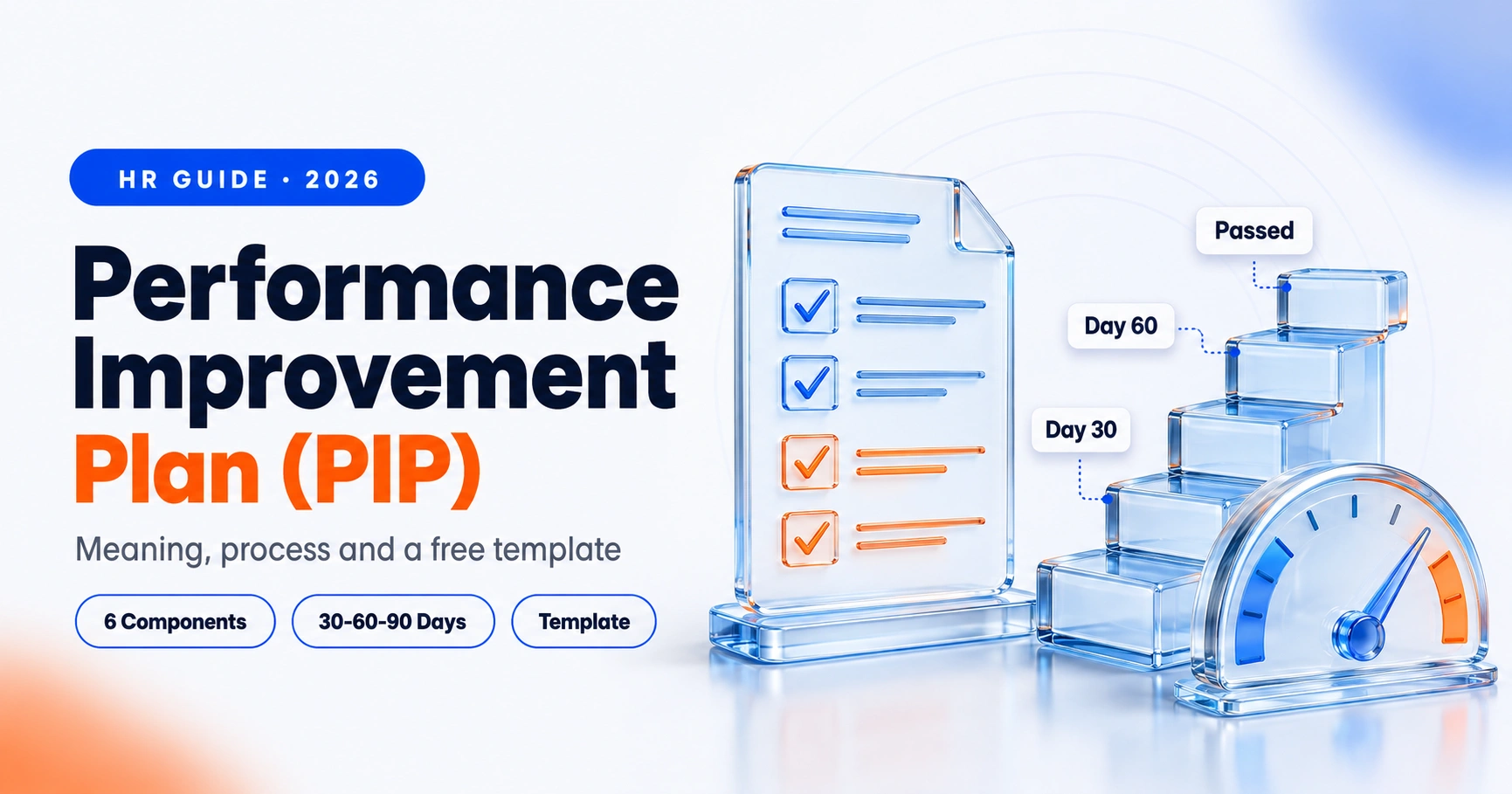
A Performance Improvement Plan, or PIP, is a formal written document that a manager and employee agree on to fix specific performance gaps within a set time, usually 30, 60, or 90 days. PIP full form is Performance Improvement Plan. Done right, it is not a firing tool. It is a structured, fair chance to improve, with clear goals, support, and a deadline that both sides sign off on.
- PIP full form is Performance Improvement Plan, a written plan to close a specific performance gap in a fixed time frame.
- A fair PIP has six parts: the problem, measurable goals, a timeline, support, how progress is measured, and clear consequences.
- Typical duration is 30 to 90 days, with regular check-ins, not a single review at the end.
- For employers in India, a documented PIP is your evidence that you gave a fair chance before any exit, which matters if a termination is ever challenged.
- If you are put on a PIP, do not panic or quit. Read it, ask for clarity, get the goals in writing, and work the plan.
What Is a Performance Improvement Plan (PIP)?
A Performance Improvement Plan is a formal agreement between a manager and an employee that spells out what needs to improve, by how much, by when, and with what support. It turns a vague concern like "your work is slipping" into specific, measurable targets with a deadline.
Think of it as a contract, not a warning letter. The company commits to provide help, and the employee commits to reach clear goals. Both sides sign it. That mutual commitment is what separates a genuine PIP from a disguised exit notice.
A PIP works best when the targets are built on the employee's existing responsibilities and metrics. If you already run a clean goal-setting system based on KRAs and KPIs, the PIP simply zooms in on the one or two areas that have fallen below target, which makes it far easier to write and to defend.
When Should You Use a PIP, and When Not?
A PIP is the right tool only in specific situations. Using it in the wrong ones damages trust and can backfire.
Use a PIP when:
- An employee is consistently missing clear, measurable targets, not just having one bad month.
- Informal feedback has already been given and the gap has not closed.
- The problem is fixable with support, training, or focus.
- You genuinely want the person to succeed and stay.
Do not use a PIP when:
- You have already decided to let the person go. A PIP used as a formality is unfair and easy to see through.
- The issue is a one-off mistake or a short dip caused by a known personal reason.
- The real problem is unclear expectations that were never set. Fix the expectations first.
- The issue is serious misconduct, which follows a disciplinary process, not a PIP.
The honest test: if you cannot picture a realistic path where the employee passes the PIP and thrives, you should not be issuing one.
What a Good PIP Must Include
A PIP that holds up, both for the employee and for the record, contains six clear parts.
- A specific problem statement. Not "poor performance" but "missed 9 of 12 delivery deadlines in the last quarter".
- Measurable goals. For example, "meet 100 percent of sprint deadlines" or "reduce error rate from 8 percent to under 3 percent".
- A clear timeline. Start date, end date, and the total duration, usually 30, 60, or 90 days.
- Support and resources. Training, a mentor, tools, or more frequent feedback. A PIP with no support is not a fair PIP.
- How progress is measured. The exact metrics and how often they are checked.
- Consequences. An honest statement of what happens if the goals are not met, including possible role change or exit.
Miss any one of these and the plan becomes either unclear or unfair. All six together make it a real improvement tool.
The PIP Process: Step by Step
A PIP is a process that runs over weeks, not a form you fill once. Here is how it should flow.
- Informal feedback first. Before any formal plan, the manager raises the concern in a normal conversation and gives the person a chance to correct course.
- Formal conversation. If the gap persists, the manager meets the employee, states the specific issue, and explains that a PIP will follow.
- Draft the PIP. Write the six parts above. Keep goals realistic and tied to real metrics.
- Kickoff meeting. Walk the employee through the plan, agree on the goals and support, and both sign. Signing means acknowledgement, not admission of guilt.
- Regular check-ins. Meet weekly or fortnightly, not just at the end. Track progress against the milestones and adjust support if needed.
- Final review. At the end date, compare results to the targets and decide the outcome.
A useful cadence for a 90-day PIP is a review at day 30, day 60, and day 90, so there are no surprises at the finish line.
Free PIP Template (Sample)
Use this structure as a ready-to-fill PIP document. Copy it, replace the placeholders, and keep the tone factual and supportive.
PERFORMANCE IMPROVEMENT PLAN
Employee Name: __________ Employee ID: __________
Designation: __________ Department: __________
Manager: __________ HR Partner: __________
Plan Start Date: __________ Plan End Date: __________ Duration: 30 / 60 / 90 days
1. Performance Concern
State the specific gap with evidence. Example: "Over Q1, delivery deadlines were met 25 percent of the time against a team standard of 90 percent."
2. Improvement Goals
- Goal 1: __________ (target and metric)
- Goal 2: __________ (target and metric)
3. Support Provided
Training, mentor, tools, or extra feedback the company will provide.
4. How Progress Is Measured
Metric(s), source of data, and review frequency.
5. Review Schedule
Check-in dates: Day 30 __________, Day 60 __________, Day 90 __________.
6. Consequences
"If the goals above are not met by the end date, the company may consider a role change or separation, following due process."
Acknowledgement
Employee Signature: __________ Date: __________
Manager Signature: __________ Date: __________
A Filled PIP Example
Here is the same template completed for a customer support executive, so you can see how specific it should get.
| Section | Content |
|---|---|
| Performance Concern | CSAT score of 68 percent over the last two months, against a team standard of 90 percent. |
| Goal 1 | Raise CSAT to 90 percent or above by the end of 60 days. |
| Goal 2 | First response within 2 hours on 95 percent of tickets. |
| Support | Two refresher training sessions, a senior agent as mentor, and weekly ticket reviews. |
| Measurement | CSAT and response-time reports from the helpdesk tool, reviewed weekly. |
| Timeline | 60 days, with reviews at day 30 and day 60. |
How to Write a Fair PIP: A Manager's Guide
The difference between a PIP that helps and one that hurts is almost entirely in how the manager writes and runs it.
- Lead with evidence, not emotion. Use numbers and dates, not adjectives like "careless" or "lazy".
- Set achievable targets. If the goal is impossible, the PIP reads as a setup, and everyone knows it.
- Put real support in writing. A mentor, training, or lighter load shows you want the person to pass.
- Meet often. Weekly check-ins catch problems early and prove you engaged, rather than waiting to fail the person.
- Document everything. Notes from every check-in protect both the employee and the company.
- Keep it private and respectful. A PIP is a confidential conversation, never a public callout.
How to Respond If You Are Put on a PIP
Being placed on a PIP feels alarming, but panic is the worst response. Here is how to handle it well.
- Stay calm and do not resign on the spot. A PIP is a chance to improve, not automatic termination.
- Read it carefully. Make sure every goal is specific and measurable. Vague goals are impossible to pass, so ask for clarity in writing.
- Ask what support you will get. Training, a mentor, or clearer priorities are reasonable to request.
- Agree on the metrics. Confirm exactly how success will be judged, so there is no dispute later.
- Work the plan and keep records. Save proof of your progress and attend every check-in.
- Communicate. Regular updates to your manager show effort and good faith.
Many employees pass their PIP and go on to do well. Treating it as a clear brief rather than a threat is what makes the difference.
PIP and Indian Labour Law: The Documentation Angle
In India, there is no single statute that mandates a PIP. However, a well-run PIP is important evidence of fair process. If an employee is later separated for performance and challenges it, a documented PIP shows the employer identified the gap, communicated it clearly, offered support, and gave a reasonable chance to improve.
This matters because Indian employment disputes often turn on whether the process was fair and followed the principles of natural justice. Skipping straight to termination without documentation is far riskier than exiting someone only after a genuine, recorded PIP. If separation does follow, it should be handled cleanly through the proper full and final settlement process.
The takeaway for HR: treat the PIP as both a real improvement tool and a fair, contemporaneous record. Never backdate it, and never use it as a box-ticking step toward a decision already made.
Common PIP Mistakes to Avoid
- Using a PIP to fire someone. If the decision is already made, a PIP is dishonest and legally weak.
- Vague goals. "Improve your attitude" cannot be measured or passed. Make every goal specific.
- No support. A plan that demands more but offers no help is unfair.
- No check-ins. A single review at the end removes any chance to course-correct.
- Impossible timelines. A 15-day PIP for a deep skill gap is a setup, not a plan.
- Poor documentation. No notes means no evidence that the process was fair.
Frequently Asked Questions
What is PIP full form in HR?
PIP full form is Performance Improvement Plan. It is a formal written plan that helps an employee improve specific performance gaps within a set time frame, usually 30 to 90 days, with clear goals and support.
Is a PIP a sign that I am getting fired?
Not necessarily. A genuine PIP is a real chance to improve, and many employees pass. It becomes a problem only if the company uses it dishonestly. Read the plan, check that the goals are achievable, and work them seriously.
How long does a PIP usually last?
Most PIPs run 30, 60, or 90 days, with regular check-ins during that period. The exact length should match how long it realistically takes to close the specific gap.
Can I refuse to sign a PIP?
You can, but signing usually means acknowledgement, not agreement that you underperformed. Refusing to sign does not stop the plan. It is often better to sign, note any disagreement in writing, and focus on meeting the goals.
What happens after a PIP ends?
There are three outcomes: you met the goals and the PIP closes successfully, you made progress and are given more time, or the goals were not met and the company may consider a role change or separation following due process.
Run Fair, Documented PIPs Without the Paperwork
See how a modern platform tracks goals, logs every check-in, and keeps a clean performance record, so your PIPs are fair to employees and defensible for the company.