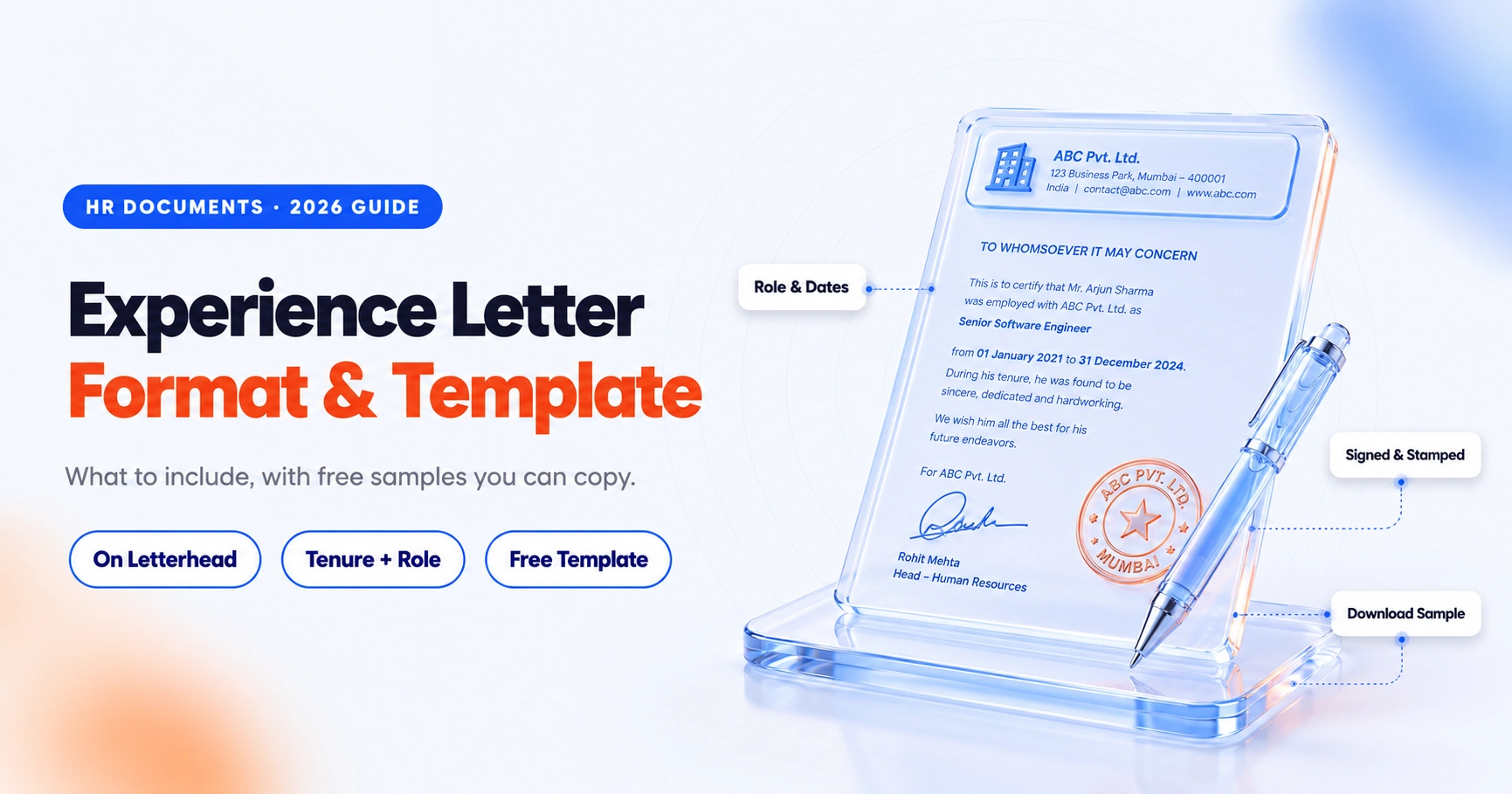
An experience letter is a formal document an employer gives a departing employee that confirms their designation, the dates they worked, and a brief note on their conduct or role. It is proof of employment that the person carries to their next job. A clear, factual experience letter protects both sides and takes only minutes to issue when you use a standard format.
Key Takeaways
- An experience letter confirms an employee worked with you, in what role, and for how long.
- It is different from a relieving letter, which formally releases the employee from duties.
- A good letter is on company letterhead, factual, positive or neutral, and signed by an authorised person.
- Keep it accurate. A false or defamatory statement can create legal exposure for the employer.
- Issue it as part of the exit process, alongside the relieving letter and final settlement.
What Is an Experience Letter?
An experience letter, sometimes called a work experience certificate, is a written statement from an employer confirming that a person was employed with the company. It records the designation held, the period of employment, and usually a short line about the employee's contribution or conduct.
Employees need it to prove past experience to future employers, for background verification, for higher studies, and sometimes for visa or loan applications. For the employer, issuing one cleanly is part of a professional exit and reflects well on the brand.
Experience Letter vs Relieving Letter vs Service Certificate
These three documents are often confused. They serve different purposes and are frequently issued together at exit.
| Document | What it does |
|---|---|
| Experience Letter | Confirms role, tenure, and conduct. Proof of experience for the next employer. |
| Relieving Letter | Formally releases the employee from duties and confirms they have completed exit formalities. |
| Service Certificate | A basic certificate of service, often required under state Shops and Establishment Acts. |
Many employers combine the experience and relieving letter into one document, but keeping the roles clear avoids disputes during background checks.
What to Include in an Experience Letter
A complete experience letter has these elements. Missing any of them weakens it during verification.
- Company letterhead with name, address, and logo.
- Date of issue.
- Employee's full name and designation.
- Start date and last working day.
- A short, factual line on role or conduct.
- A statement wishing the employee well (optional but common).
- Name, designation, and signature of the authorised issuer, usually HR.
Keep the tone professional and the facts exact. The dates and designation must match your records, because background verification agencies check them.
Experience Letter Format: Standard Sample
Copy this format, replace the placeholders, and print it on your letterhead.
[Company Letterhead]
Date: __________
TO WHOMSOEVER IT MAY CONCERN
This is to certify that Mr./Ms. __________ (Employee ID: __________) was employed with [Company Name] as __________ (designation) from __________ (start date) to __________ (last working day).
During this period, we found [him/her/them] to be sincere, hardworking, and professional in [his/her/their] conduct. [He/She/They] contributed to the __________ team and carried out the assigned responsibilities to our satisfaction.
We wish [him/her/them] all the best in [his/her/their] future endeavours.
For [Company Name],
__________
(Name)
(Designation, e.g. HR Manager)
(Signature and company seal)
Experience Letter Format: Detailed Sample
Use this longer version when the employee needs more detail on responsibilities, for example for a senior role or a visa application.
[Company Letterhead]
Date: __________
EXPERIENCE CERTIFICATE
This is to certify that Mr./Ms. __________ worked with [Company Name] as __________ from __________ to __________.
Key responsibilities during the tenure included:
- __________
- __________
- __________
[He/She/They] demonstrated strong ownership and professionalism, and [his/her/their] contribution was valued by the team. [He/She/They] is leaving on [his/her/their] own request, and all dues have been settled.
We wish [him/her/them] continued success.
For [Company Name],
__________
(Name and Designation)
(Signature and company seal)
Do's and Don'ts for Employers
- Do keep every fact accurate and verifiable against your records.
- Do issue it on official letterhead with a signature and seal.
- Do keep the tone positive or neutral, even for an average performer.
- Don't include salary details unless the employee specifically requests it.
- Don't write anything false or defamatory, as this can invite a legal claim.
- Don't delay it. Issue the letter promptly as part of the exit process.
If the exit is on poor terms, keep the letter strictly factual and neutral rather than negative. A neutral letter is safer than one that could be read as damaging the person's career.
When Should You Issue an Experience Letter?
The experience letter is issued at the end of employment, once the employee has served notice and completed exit formalities. It usually goes out together with the relieving letter and after the full and final settlement is cleared. Building it into your standard exit checklist means no employee has to chase HR for it, which is a common source of friction. Issuing exit documents cleanly is one of the core functions of human resource management.
Frequently Asked Questions
What is an experience letter?
An experience letter is a formal document from an employer confirming that a person worked there, in what designation, and for what period, usually with a short note on conduct. It serves as proof of experience for future employers.
Is an experience letter the same as a relieving letter?
No. An experience letter confirms your role and tenure, while a relieving letter formally releases you from duties and confirms you completed exit formalities. Employers often issue both at exit.
Is an employer legally required to give an experience letter?
There is no single central law mandating an experience letter, but many state Shops and Establishment Acts require a certificate of service. In practice, most employers issue one as standard good practice.
What should an experience letter contain?
Company letterhead, date, the employee's name and designation, start and end dates, a short factual line on conduct, and the signature of an authorised person such as HR.
Can an experience letter mention salary?
It can, but usually only if the employee requests it. Most standard experience letters leave out salary and focus on role, tenure, and conduct.
Generate Exit Documents in One Click
Auto-generate experience letters, relieving letters, and final settlements from employee records, so exits stay clean and no one has to chase HR.