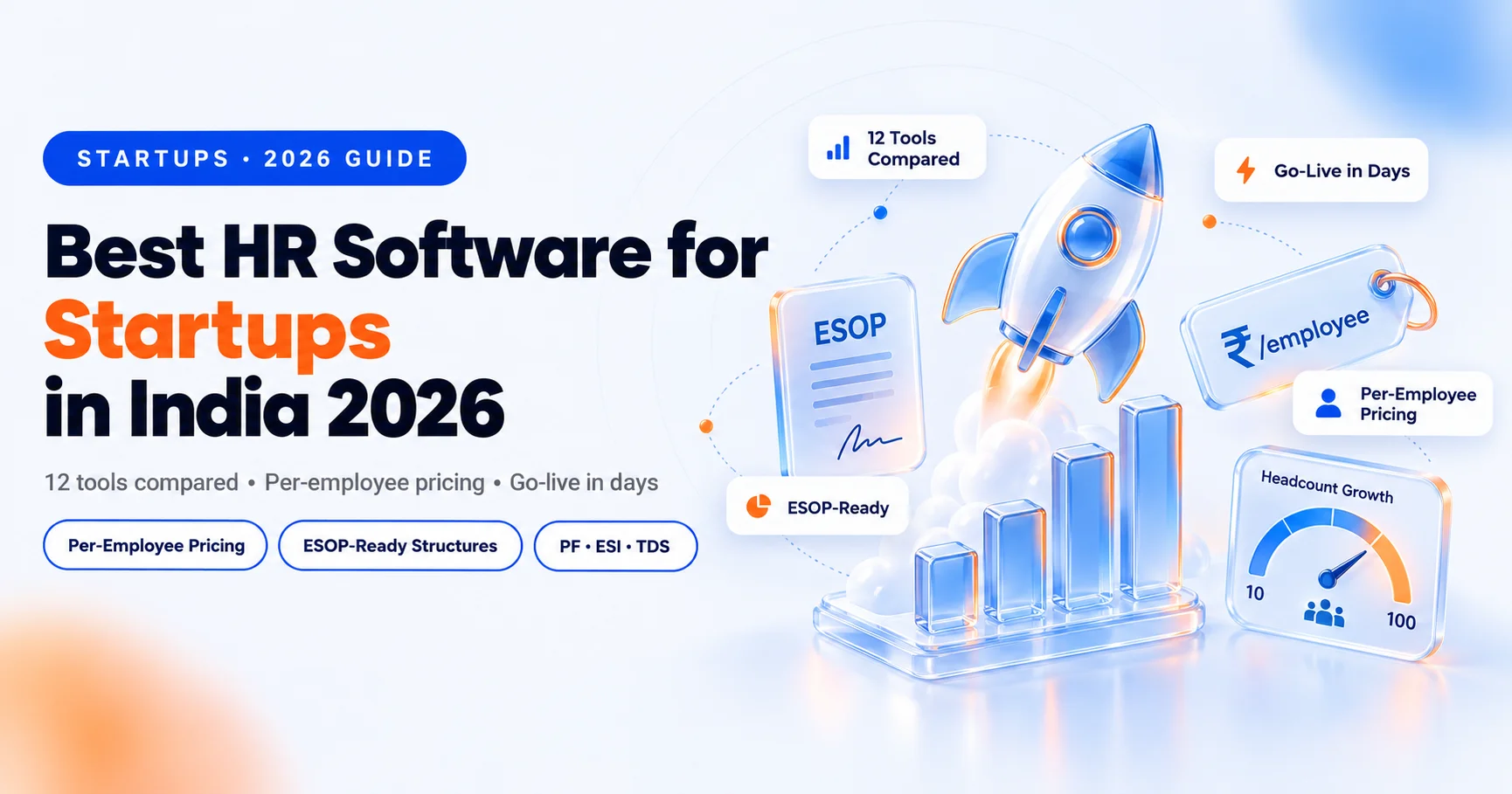
A startup needs HR software that a founder or an ops lead can run alone, that stays affordable while cash is tight, and that keeps PF, ESI, PT and TDS correct from the very first hire. As the team scales from five to fifty to two hundred, the tool has to scale with it, handle remote and global hiring, and never need a consultant to operate. A heavy enterprise suite is the wrong fit. This guide grades twelve startup-ready HR and payroll platforms on what an early and growth-stage company actually needs, with real pricing, so you can shortlist fast.
Short Answer
factoHR India, Keka and Qandle are strong all-round picks for Indian startups. Kredily and the free tiers of Zoho People and greytHR suit the earliest, cash-tight teams, RazorpayX Payroll and sumHR fit automated-payroll-first startups, HROne suits teams adding entities, and Jibble covers remote attendance.
Key Takeaways
- Startups need HR software that is self-serve, affordable and compliant from the first hire, and that scales without a painful migration later, not a heavy enterprise suite.
- factoHR India, Keka and Qandle lead for all-round startup fit; Kredily and the free tiers of Zoho People and greytHR suit the earliest teams; HROne and Jibble cover multi-entity growth and remote attendance.
- The non-negotiables are quick setup with no consultant, PF, ESI, PT and TDS automation, a clean mobile experience, and per-head pricing that grows with you.
- Founders must run compliance from day one; many early employees earn above the Rs 21,000 ESI ceiling, so PF, PT and TDS apply, while interns and support staff under the ceiling trigger ESI.
- Budget from free up to around Rs 200 per employee per month; Kredily offers a free-forever plan and greytHR and factoHR India have free tiers for small teams.
- Funded startups hiring contractors or employees abroad should pair an Indian payroll tool with a global employer-of-record service, which sits outside this list.
- Shortlist two or three, run a live payroll on your current team, and pick the one your ops lead can operate without help.
Why Generic and Enterprise HR Software Breaks for Startups
Startups fail with the wrong HR tool in both directions: a basic office tool misses compliance, and an enterprise suite is too heavy and costly. Before you compare products, know the seven things a startup actually needs:
- Self-serve, no consultant. A founder or ops lead must set it up and run payroll without an implementation team. If it needs a consultant, it is the wrong tool.
- Affordable and flexible. Free or low-cost tiers, per-head pricing and no long lock-in, so cost tracks headcount while cash is tight.
- Compliance from day one. PF, ESI, PT and TDS must be correct from the first hire, because founders rarely know statutory rules and penalties start early.
- Scales without migration. The same tool should carry you from five to two hundred, so you never have to rip and replace mid-growth.
- Equity, variable pay and modern CTC. ESOP records, variable pay and founder-friendly salary structures need to live in the system, not a spreadsheet.
- Remote, hybrid and global hiring. Distributed teams, contractors and, for funded startups, employees abroad need remote attendance and sometimes a global EOR.
- Modern experience and integrations. Slack or Teams, single sign-on and a clean mobile app, because early employees expect good tools.
Score every shortlisted tool against these seven. A platform that nails five or more is startup-ready. One that misses compliance or needs a consultant will cost you founder time and penalties in the first year.
How We Graded These Platforms
Each tool below is weighed on six startup criteria, not generic feature counts:
- Self-serve setup (most weight): a founder or ops lead can configure and run payroll without an implementation consultant.
- Affordability: free or low-cost tiers and transparent per-head pricing.
- Compliance automation: PF, ESI, PT and TDS correct from the first hire.
- Scalability: the same tool grows from five to two hundred without a migration.
- Experience and integrations: clean mobile app, single sign-on and Slack or Teams.
- Global and contractor support: remote attendance and, where needed, a global EOR for hiring abroad.
Quick Comparison: HR Software for Startups
| Tool | Best for | Standout strength | Watch-out | Starting price |
|---|---|---|---|---|
| factoHR India | Scaling startups wanting one platform | Attendance plus payroll, free tier | Advanced modules are add-ons | Free up to 20; from Rs 4,999/mo |
| Keka | Funded product and SaaS startups | OKRs and loved, modern UX | Pricier at very small headcount | Around Rs 6,999/mo (up to 100) |
| Qandle | Early and mid-stage tech teams | Modern, configurable, affordable | Smaller brand footprint | Around Rs 49 to 100 per emp/mo |
| RazorpayX Payroll | Payroll-first automated startups | Automated payroll and compliance | Lighter on full HRMS depth | Free core; paid per employee |
| Kredily | The earliest, cash-tight teams | Free-forever for unlimited employees | Advanced features are paid | Free; paid add-ons |
| Zoho People | Startups on the Zoho stack | Free tier, low per-head price | Payroll is a separate add-on | Free up to 10; Rs 48 to 230/emp/mo |
| Zimyo | Value-focused scaling teams | Modern features at a low price | Smaller partner network | Around Rs 60 to 160 per emp/mo |
| Pocket HRMS | Small teams wanting simple payroll | Simple, quick, selfie attendance | Thin for later-stage depth | Around Rs 2,495/mo (up to 50) |
| sumHR | Lean startups on a budget | Simple, affordable core HR | Lighter enterprise depth | Low per-employee pricing |
| HROne | Startups adding entities or locations | Unlimited legal entities in one instance | Top tier is quote-based | Rs 85 to Rs 130 per employee per month |
| Jibble | Remote-first early teams | Free attendance and timesheets | No payroll or compliance | Free; paid from about Rs 200 per user per month |
| greytHR | Compliance-first early teams | Free tier, statutory accuracy | Lighter on performance | Free up to 25; from Rs 1,495/mo |
Prices are indicative for 2026 and depend on headcount, modules and contract term. Treat them as a starting point and confirm a live quote. As you add your first employees, get payroll right from day one with proper payroll software.
The 12 Best HR Software for Startups in India (2026)
1. factoHR India
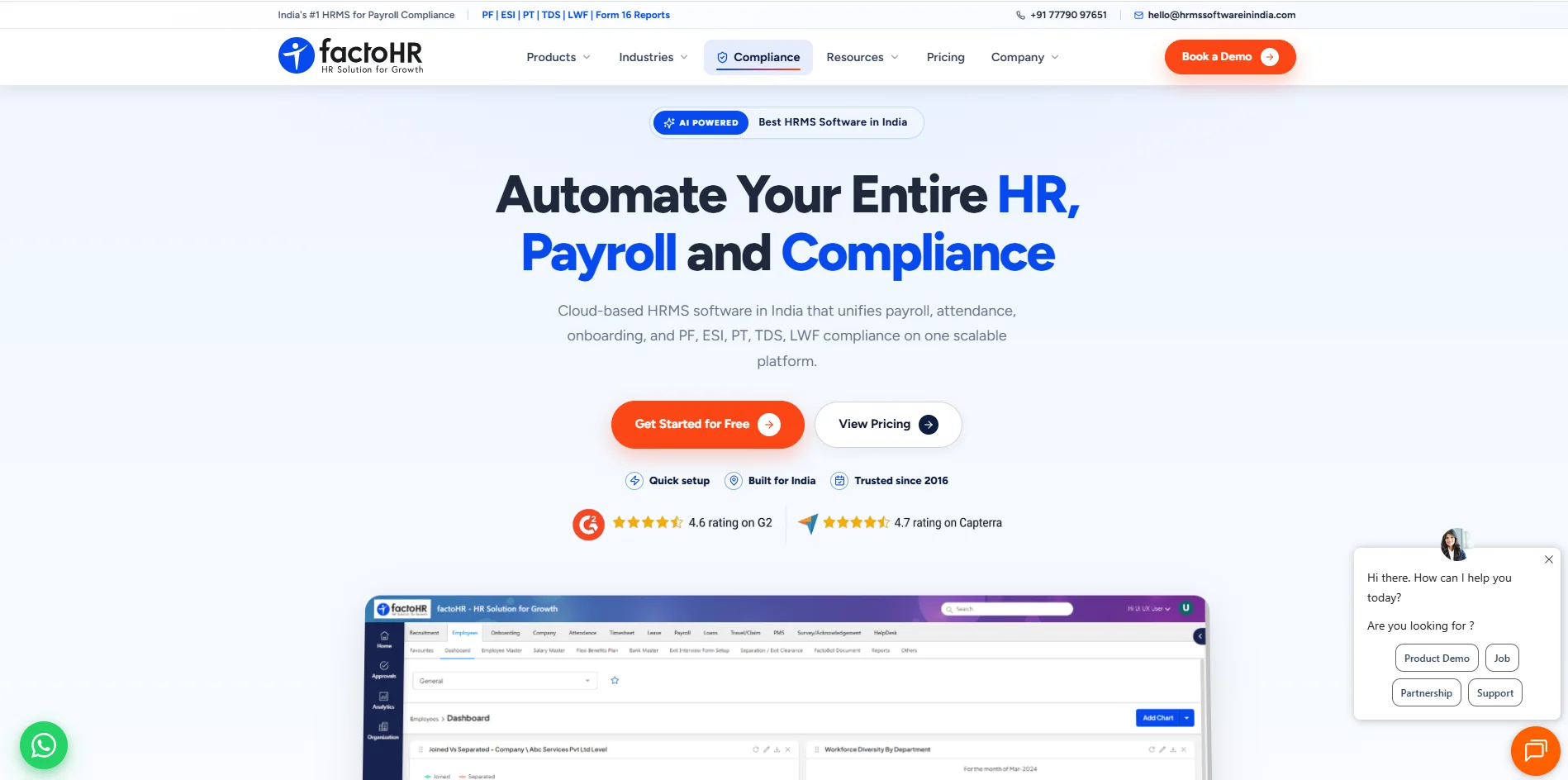
factoHR India is a biometric-first HR and payroll platform that a lean startup team can run end to end, with a free tier for small teams and transparent pricing as you scale. It covers attendance, payroll, performance and compliance in one place, so you never have to bolt on extra tools as you grow. It is a strong all-round fit for a startup that wants one platform from five to two hundred people, which is why it tops this list. See the full payroll software breakdown for module detail.
Key features:
- Geo, selfie and biometric attendance for hybrid and remote teams
- Payroll with PF, ESI, PT and TDS automated from the first hire
- Performance, OKRs and onboarding in the same platform
- Free tier for up to 20 employees, scaling to full HRMS
- Already updated for the Rs 25,000 EPF ceiling and the Labour Codes
- Clean employee mobile app with self-service
Best suited for: scaling startups that want attendance, payroll and performance on one platform.
Watch-out: some advanced analytics and recruitment modules are priced as add-ons.
Pricing: free for up to 20 employees; transparent plans from around Rs 4,999 a month.
2. Keka
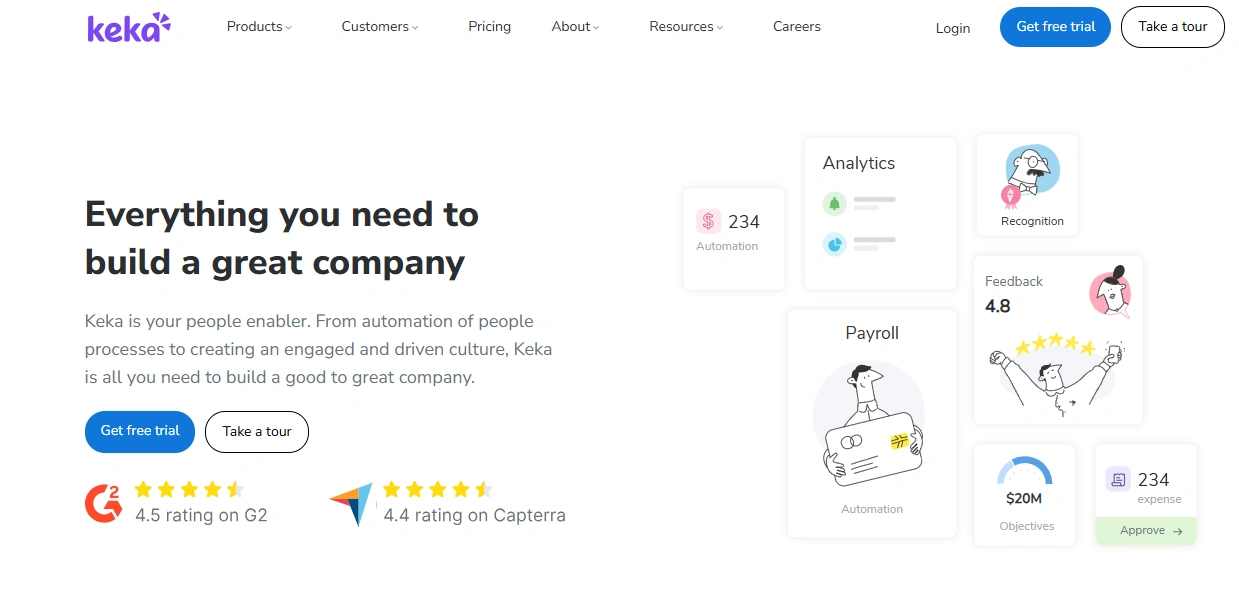
Keka is the HRMS most funded Indian product and SaaS startups reach for. Its OKRs, clean interface and solid payroll make it easy to roll out and loved by teams, which drives adoption.
Key features:
- OKRs, continuous feedback and review cycles
- Geo and kiosk attendance with scheduling
- Payroll with variable pay and expense integration
- Automated PF, ESI, PT and TDS
- Clean, modern UX with high adoption
- Good core HR, hiring and analytics
Best suited for: funded product and SaaS startups that value usability and performance culture.
Watch-out: cost per head is higher at very small headcount.
Pricing: plans start around Rs 6,999 a month for up to 100 employees.
3. Qandle
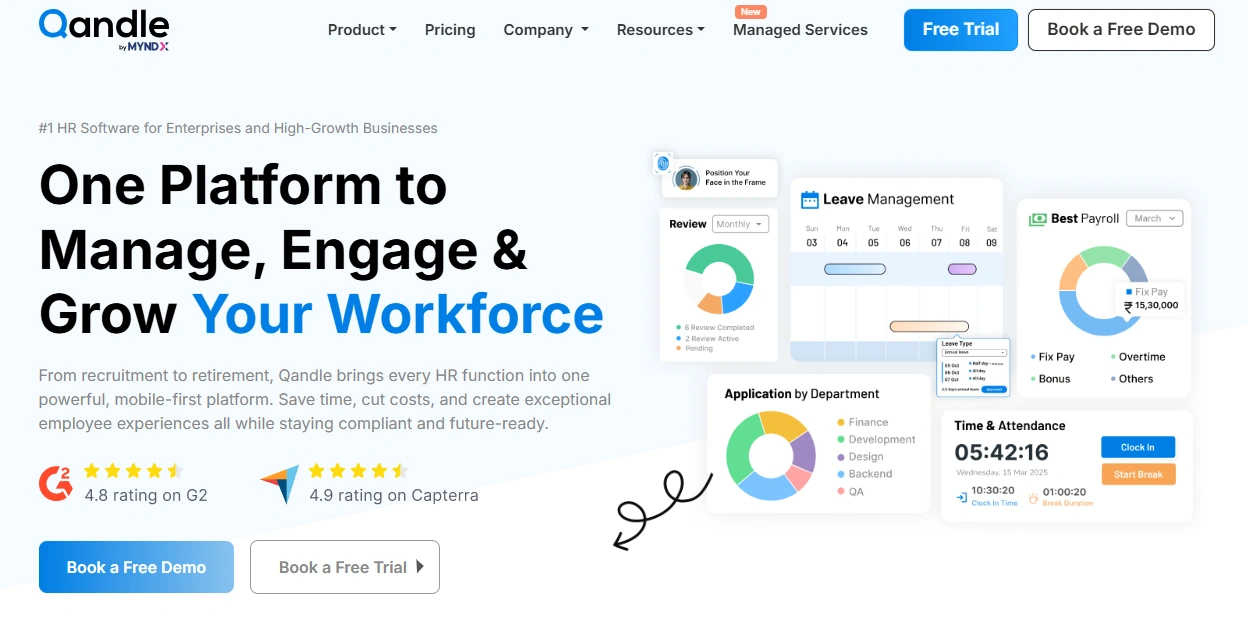
Qandle is a modern, highly configurable HRMS built for startups and growing teams. It bundles core HR, payroll, performance and engagement in a clean interface at a competitive price.
Key features:
- Configurable core HR, payroll and workflows
- OKRs, goals and performance reviews
- Geo and mobile attendance with leave
- Statutory payroll for PF, ESI, PT and TDS
- Onboarding, engagement and surveys
- Competitive per-employee pricing
Best suited for: early and mid-stage tech teams wanting modern, configurable HR without enterprise cost.
Watch-out: smaller brand footprint than Keka or Zoho.
Pricing: around Rs 49 to Rs 100 per employee per month.
4. RazorpayX Payroll
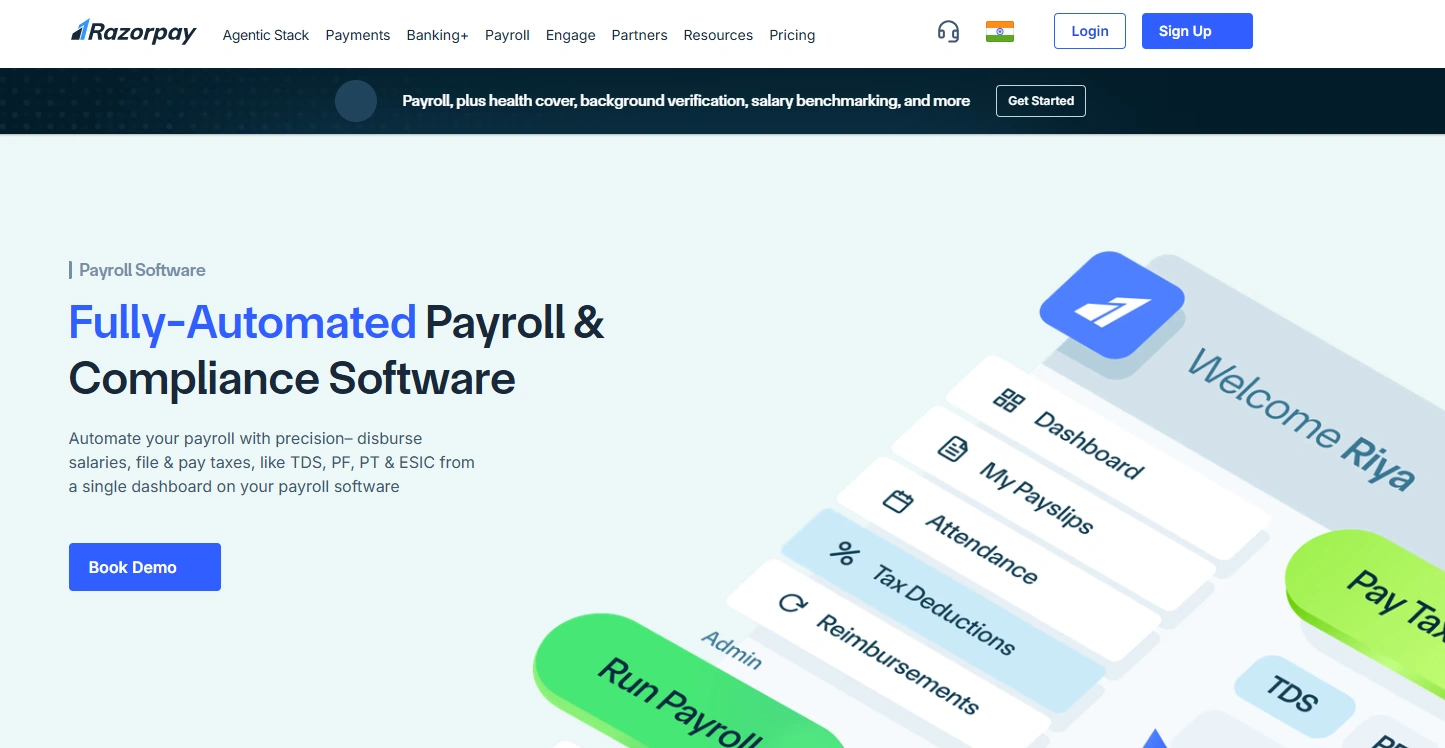
RazorpayX Payroll is a payroll-first tool from the Razorpay stack, popular with startups that want automated salary payouts and compliance with minimal effort. It runs payroll, PF, ESI, PT and TDS and pays salaries directly, with a free core tier.
Key features:
- Automated salary payouts and payslips
- PF, ESI, PT and TDS computed and filed
- Direct bank disbursal from the dashboard
- Employee self-onboarding and self-service
- Integrates with the Razorpay financial stack
- Free core plan for small teams
Best suited for: startups that want automated, hands-off payroll and compliance.
Watch-out: it is payroll-first, so full HRMS depth like performance is lighter.
Pricing: free core plan; paid plans priced per employee.
5. Kredily
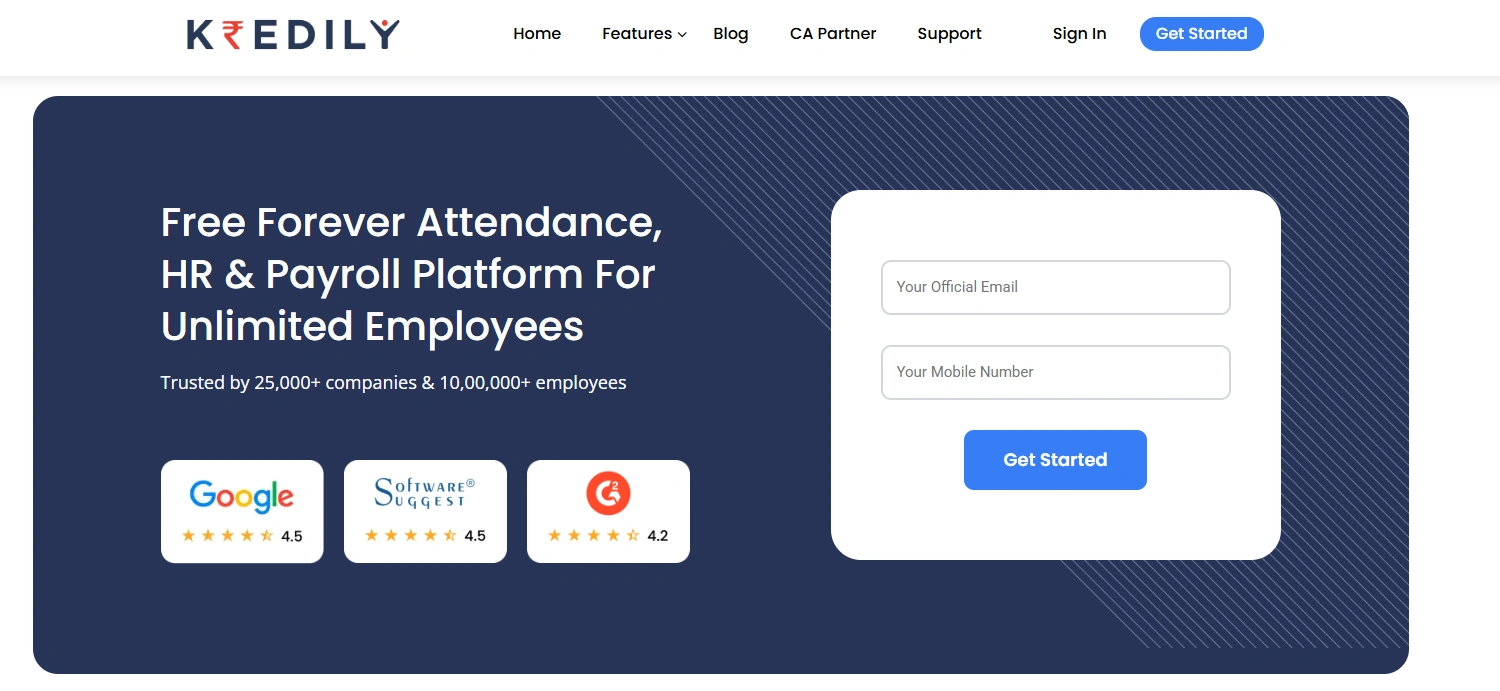
Kredily offers one of the strongest free-forever plans in India, covering unlimited employees with PF, ESI, PT and TDS calculations, attendance, leave and self-service. It is a genuine option for the earliest, cash-tight teams.
Key features:
- Free-forever plan for unlimited employees
- PF, ESI, PT and TDS statutory calculations
- Attendance, leave and employee self-service
- Core HR and document management
- Paid add-ons for challans, Form 16 and payouts
- Low-cost upgrade path as you grow
Best suited for: the earliest startups wanting free, compliant basics.
Watch-out: challan generation, Form 16, NEFT payouts and analytics sit on paid plans, and free storage is capped.
Pricing: free core plan; paid add-ons and plans for advanced features.
6. Zoho People
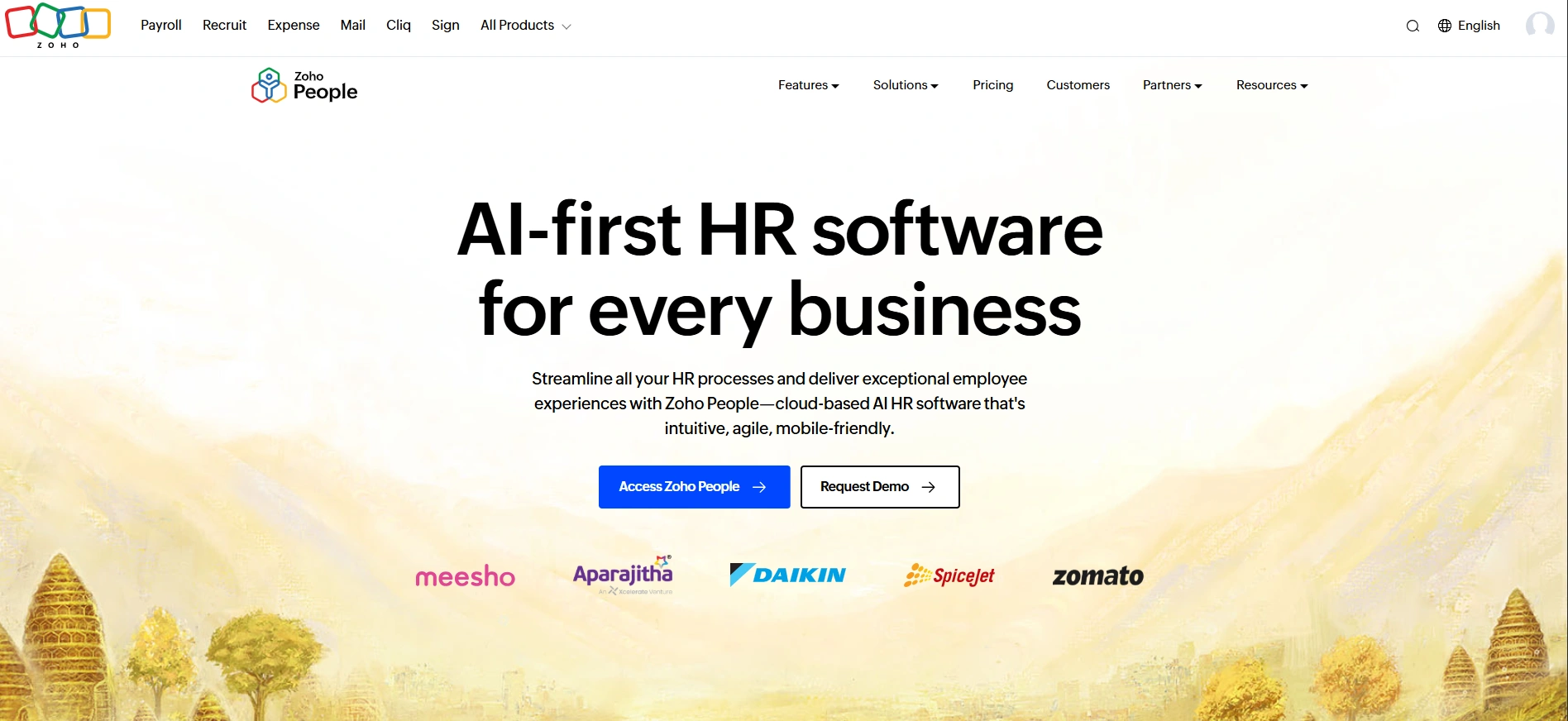
Zoho People is a low-cost, flexible HRMS with a free tier for very small teams, ideal for startups already using the Zoho ecosystem. It covers core HR, attendance, leave and performance, and connects to the wider Zoho suite.
Key features:
- Free plan for up to 10 employees
- Core HR, attendance, leave and performance
- Low per-employee pricing on annual plans
- Tight integration with the Zoho suite
- Customisable workflows and forms
- Employee self-service on web and mobile
Best suited for: startups already on Zoho who want HR in the same ecosystem.
Watch-out: Indian statutory payroll needs the separate Zoho Payroll add-on.
Pricing: free up to 10 employees; around Rs 48 to Rs 230 per employee per month after, payroll add-on extra.
7. Zimyo

Zimyo is a modern, value-focused HRMS that suits fast-growing startups. It offers a broad feature set, including attendance, payroll, performance and engagement, at a competitive per-head price.
Key features:
- Geo and biometric attendance with scheduling
- Statutory payroll for PF, ESI, PT and TDS
- Core HR, onboarding and performance
- OKRs and engagement surveys
- Employee self-service and mobile app
- Competitive per-employee pricing
Best suited for: value-focused scaling startups that want modern features at a fair price.
Watch-out: smaller partner network than the larger names.
Pricing: around Rs 60 to Rs 160 per employee per month.
8. Pocket HRMS
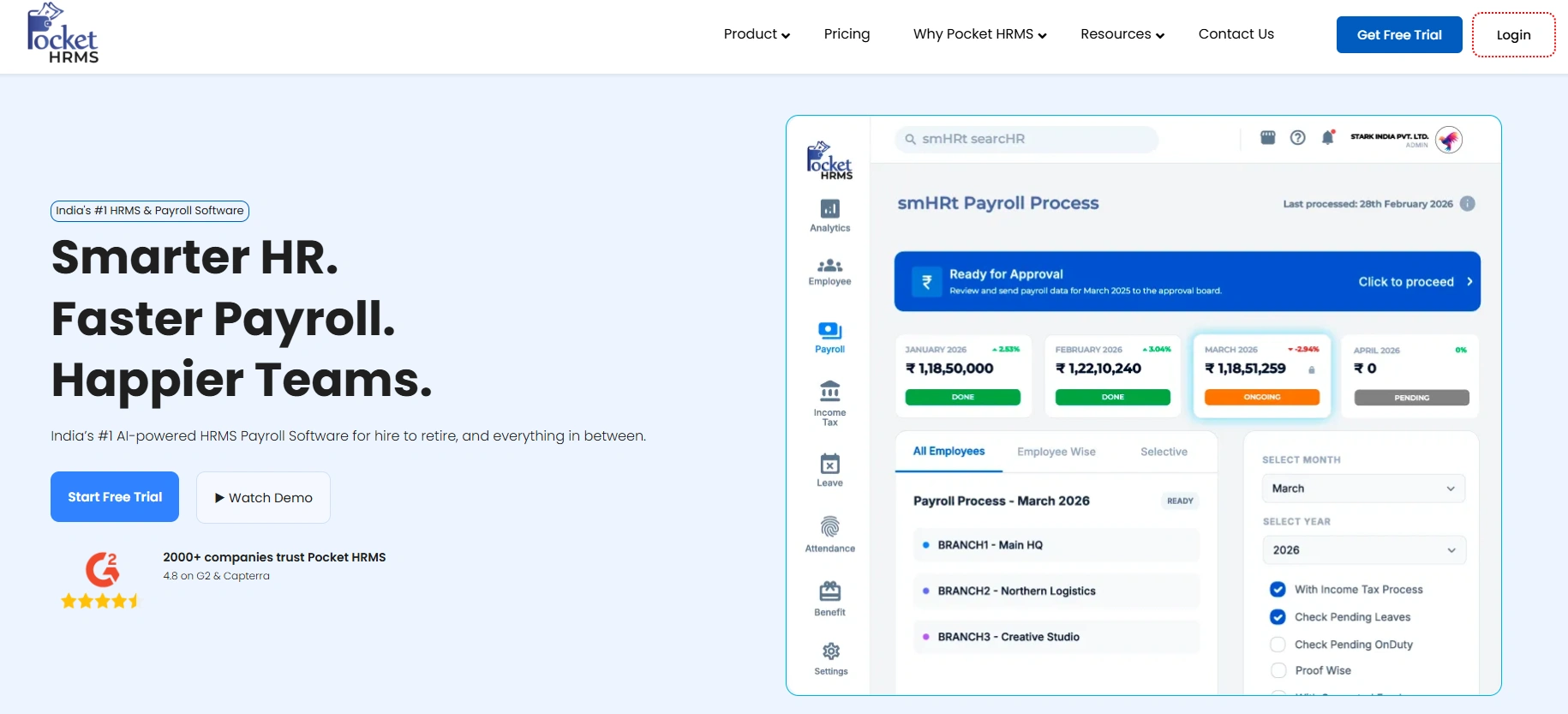
Pocket HRMS is a straightforward cloud HR and payroll tool for small startups that want clean payroll without complexity. Its selfie and geofenced attendance suit distributed and remote teams.
Key features:
- Selfie, geofenced and biometric attendance
- Simple multi-shift scheduling
- Automated PF, ESI, PT and TDS
- Bulk processing for staff uploads
- Mobile ESS for remote teams
- Quick, low-effort setup
Best suited for: small startups wanting simple, reliable payroll.
Watch-out: thinner for later-stage performance and analytics needs.
Pricing: plans start around Rs 2,495 a month for up to 50 employees.
9. sumHR
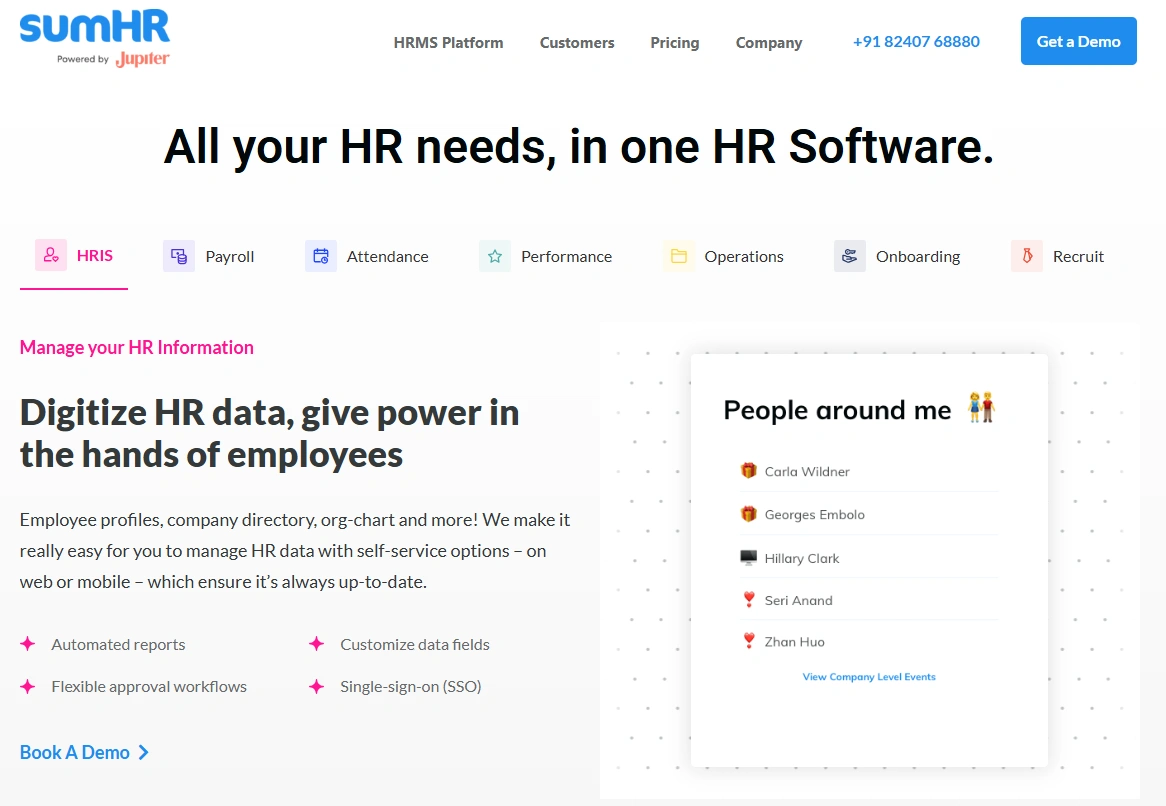
sumHR is a simple, affordable cloud HR and payroll tool built for lean startups. It covers core HR, attendance, leave and payroll without the weight or cost of an enterprise suite, and an ops lead can run it alone.
Key features:
- Core HR, attendance and leave management
- Payroll with PF, ESI, PT and TDS
- Employee self-service and mobile access
- Simple onboarding and documents
- Affordable per-employee pricing
- Quick, low-effort setup
Best suited for: lean startups wanting affordable, no-fuss HR and payroll.
Watch-out: lighter on performance and enterprise depth.
Pricing: low per-employee pricing; confirm current plans with the vendor.
10. HROne
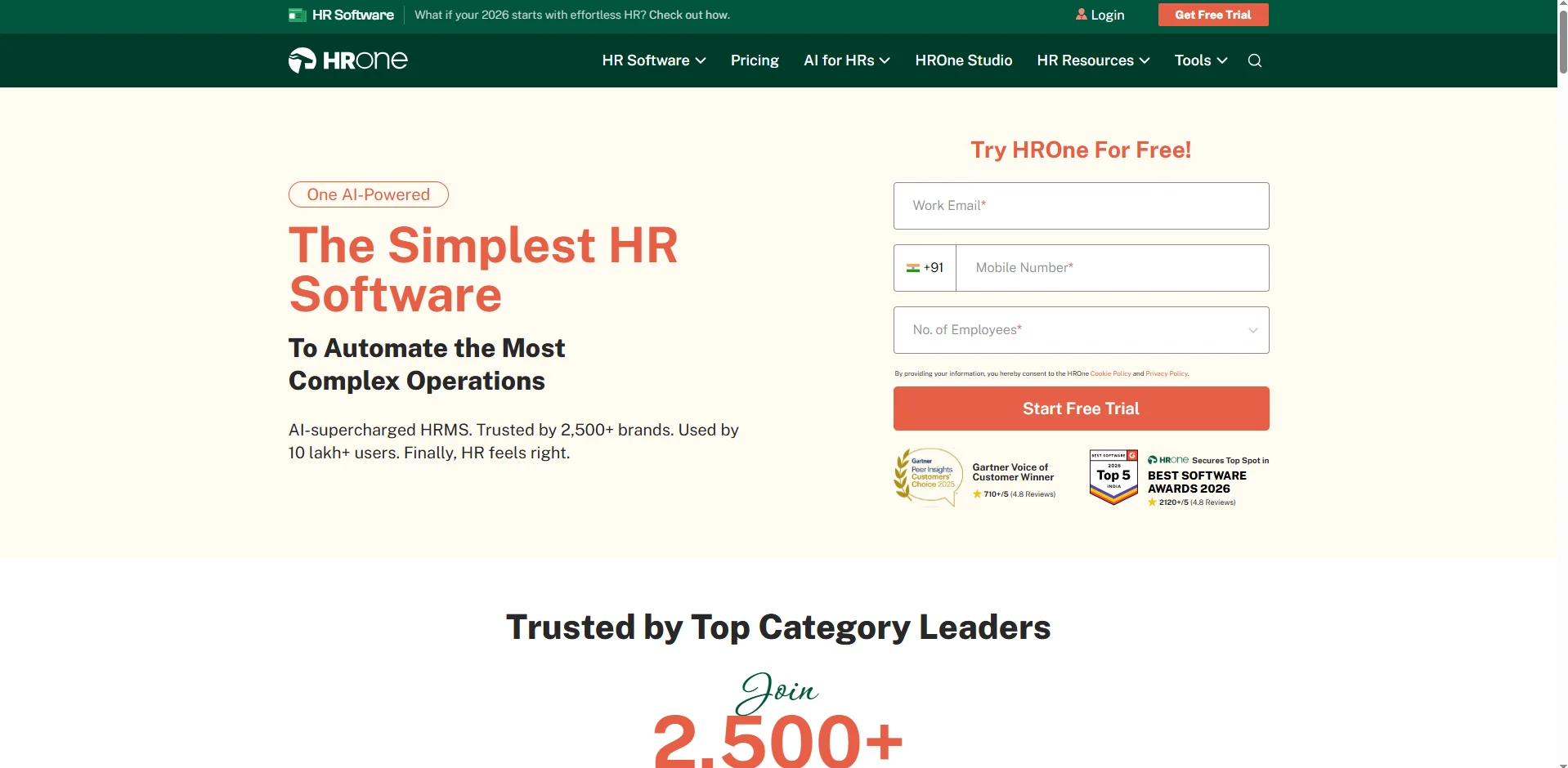
HROne is a hire-to-retire HRMS that grows with a startup from its first entity to several, with a standout claim of unlimited legal entities in a single instance at no extra charge. That suits startups that spin up a second company, a GIFT City unit or a US parent and still want one HR rollup.
Key features:
- Unlimited legal entities in one instance for group structures
- Payroll with ESOP, variable pay, arrears and final settlements
- Automated PF, ESI, PT and TDS across states
- Field and remote attendance with geo-tagging
- Offer-to-onboarding workflows for fast hiring
- Well-adopted employee mobile app
Best suited for: funded startups that expect to add entities or locations within a year or two.
Watch-out: published per-head pricing covers the core tiers; the top enterprise tier is quote-based.
Pricing: roughly Rs 85 to Rs 130 per employee per month by tier.
11. Jibble
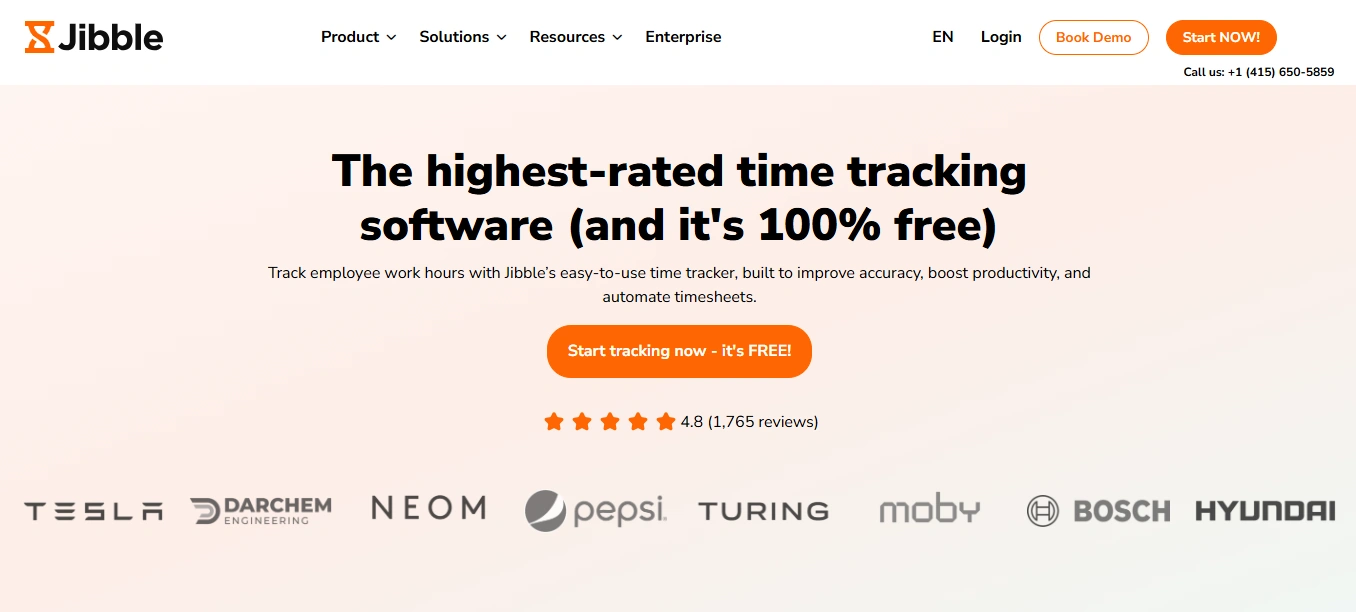
Jibble is a free, accurate time-tracking and attendance tool that remote-first startups use before they need a full HRMS. It is not a payroll suite, but it nails clock-in, timesheets and project time for distributed teams, and exports cleanly to whichever payroll tool you pick.
Key features:
- Free time tracking with selfie and GPS clock-in
- Web, mobile, Slack and Microsoft Teams clock-in
- Project and client time tracking with timesheets
- Facial-recognition kiosk mode for a small office
- Overtime and leave reports that export to payroll
- Rollout in a day for remote teams
Best suited for: remote-first and early-stage startups that need free, reliable attendance alongside a separate payroll tool.
Watch-out: it is time tracking and attendance, not an Indian payroll and compliance suite.
Pricing: free core plan; paid plans from about Rs 200 to Rs 420 per user per month.
12. greytHR
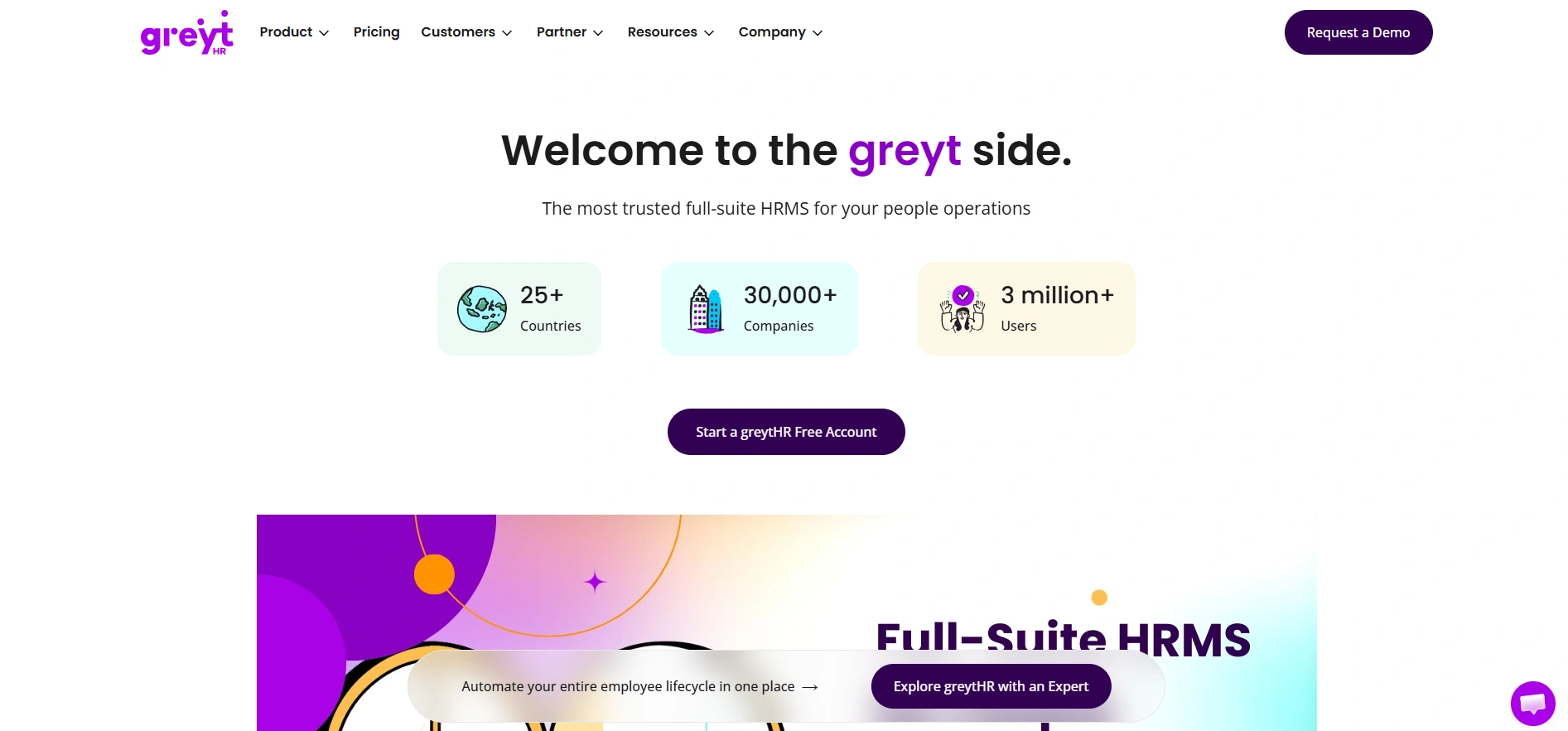
greytHR is a compliance-first payroll platform trusted by thousands of Indian SMEs, with a free tier that fits an early startup. Its standout is statutory accuracy that keeps a founder audit-ready from day one.
Key features:
- State-wise statutory compliance calendar for PF, ESI, PT and TDS
- Reliable core payroll with high accuracy
- Free tier for up to 25 employees
- Attendance and leave management included
- Multi-state payroll support
- Large partner and support network in India
Best suited for: compliance-first early startups that want clean, accurate payroll.
Watch-out: performance and advanced attendance are lighter, often paid add-ons.
Pricing: free up to 25 employees; paid plans from about Rs 1,495 a month.
What Startup Payroll Really Costs in 2026
Even a five-person startup must run PF, ESI, PT and TDS correctly, because penalties start early and do not wait for scale. Most early employees earn above the Rs 21,000 ESI ceiling, so PF, Professional Tax and TDS drive cost, while interns and support staff under the ceiling trigger ESI. The EPF wage ceiling rose to Rs 25,000 from 17 September 2026, and the new Labour Codes require defined wages to be at least 50 percent of total pay.
Here is a worked example for an early employee earning Rs 30,000 gross a month, with basic of Rs 15,000, showing employer statutory cost:
| Item (per employee) | Rate | Monthly |
|---|---|---|
| Employer EPF plus EPS | 12% of basic | Rs 1,800 |
| EDLI plus admin | ~1% of basic | Rs 150 |
| Professional Tax | State slab | Rs 200 |
| Employer ESI | Not applicable above Rs 21,000 | Rs 0 |
| Employer statutory outgo | Total of the above | Rs 2,150 |
| For 15 such employees | Total × 15 | Rs 32,250 a month |
That is before salaries and any variable pay. Get this wrong in year one and the penalties and founder time cost far more than any software. This is exactly why a startup should automate PF, ESI, PT and TDS from the first hire rather than track them in a spreadsheet. Follow every change on the India payroll compliance hub.
How to Choose by Startup Stage
The right tool depends on stage and funding:
- Pre-seed and bootstrapped, under 20 staff: prioritise free or near-free and correct compliance. Kredily, the free tiers of greytHR and Zoho People, or factoHR India fit well.
- Seed to Series A, 20 to 100 staff: you need self-serve payroll, OKRs and a clean mobile app. factoHR India, Keka, Qandle or RazorpayX Payroll are the sweet spot.
- Growth-stage or global, 100-plus staff: you need scale, performance and multi-entity growth. factoHR India, Keka or HROne are built for this.
Whatever the stage, weight self-serve setup, compliance from day one and a tool that scales without a migration. Read the deeper buyer checklist on our HR software for startups page.
Implementation: What to Expect
Rollout for a startup is fast if the tool is self-serve. Plan for four things:
- Payroll setup: enter your salary structures, PF and ESI registrations and opening balances. A good startup tool makes this a self-serve task, not a project.
- Attendance policy: set up geo, selfie or web clock-in for your remote and hybrid team.
- Compliance check: confirm PF, ESI, PT and TDS are computed correctly for your first payroll, and that challans and Form 16 are covered.
- Pilot then go live: run one full payroll on your current team, reconcile, then make it your system of record. Most startups are live in days, not weeks.
Frequently Asked Questions
Which HR Software Is Best for Startups in India?
For most Indian startups, factoHR India, Keka and Qandle are strong all-round choices because they are self-serve, affordable and compliant, and scale as you grow. Kredily and the free tiers of Zoho People and greytHR suit the earliest teams, RazorpayX Payroll and sumHR suit payroll-first startups, and HROne or Jibble cover multi-entity growth and remote attendance. The best pick depends on your stage and whether you hire abroad.
Is There Free HR Software for a Startup in India?
Yes. Kredily offers a free-forever plan for unlimited employees with PF, ESI, PT and TDS calculations, greytHR is free up to 25 employees, factoHR India up to 20, and Zoho People up to 10. Advanced features like challan generation, Form 16 and analytics usually sit on paid plans.
Does Startup HR Software Handle PF, ESI, PT and TDS?
The stronger tools do, from the first hire. factoHR India, Keka, RazorpayX Payroll, Kredily and greytHR all compute PF, ESI, PT and TDS and generate statutory output, which matters because compliance penalties start early regardless of team size.
Can It Scale as the Startup Grows?
Yes, the better platforms are built to scale. factoHR India, Keka, Qandle and Zimyo carry a team from a handful of people to a few hundred without a migration, so you add modules and headcount rather than ripping and replacing.
How Much Does Startup HR Software Cost in India?
You can start free with Kredily or the free tiers of greytHR, factoHR India and Zoho People. Paid plans run from about Rs 1,495 a month for greytHR, Rs 2,495 for Pocket HRMS and Rs 4,999 for factoHR India, while Qandle, Zimyo and Zoho People are priced per head. Jibble has a free core plan with paid tiers per user.
What About Hiring Employees or Contractors Abroad?
For global hiring, a funded startup usually pairs an Indian payroll tool for local staff with a global employer of record service, which handles compliant contracts, payments and taxes in other countries without setting up local entities.
Do I Need an HR Team to Run It?
No. The startup-focused tools are designed so a founder or an operations lead can set them up and run payroll without a consultant or a dedicated HR team. Self-serve setup is the single most important factor for an early-stage company.
How Quickly Can a Startup Go Live?
Most startups go live in days, not weeks, because the tools are self-serve and the team is small. The main tasks are entering salary structures, registrations and opening balances, then running one parallel payroll to confirm the numbers before cutover.
Final Word
Startup HR software earns its keep by being self-serve, affordable and compliant from the first hire, and by scaling without a migration. factoHR India, Keka and Qandle lead for all-round fit, with Kredily and the free tiers of greytHR and Zoho People for the earliest teams, RazorpayX Payroll and sumHR for payroll-first setups, and HROne or Jibble for multi-entity growth and remote attendance. Shortlist two or three, run one live payroll, and pick the one your ops lead can operate alone. Want to see self-serve payroll and attendance work for your startup? Book a free factoHR India demo.