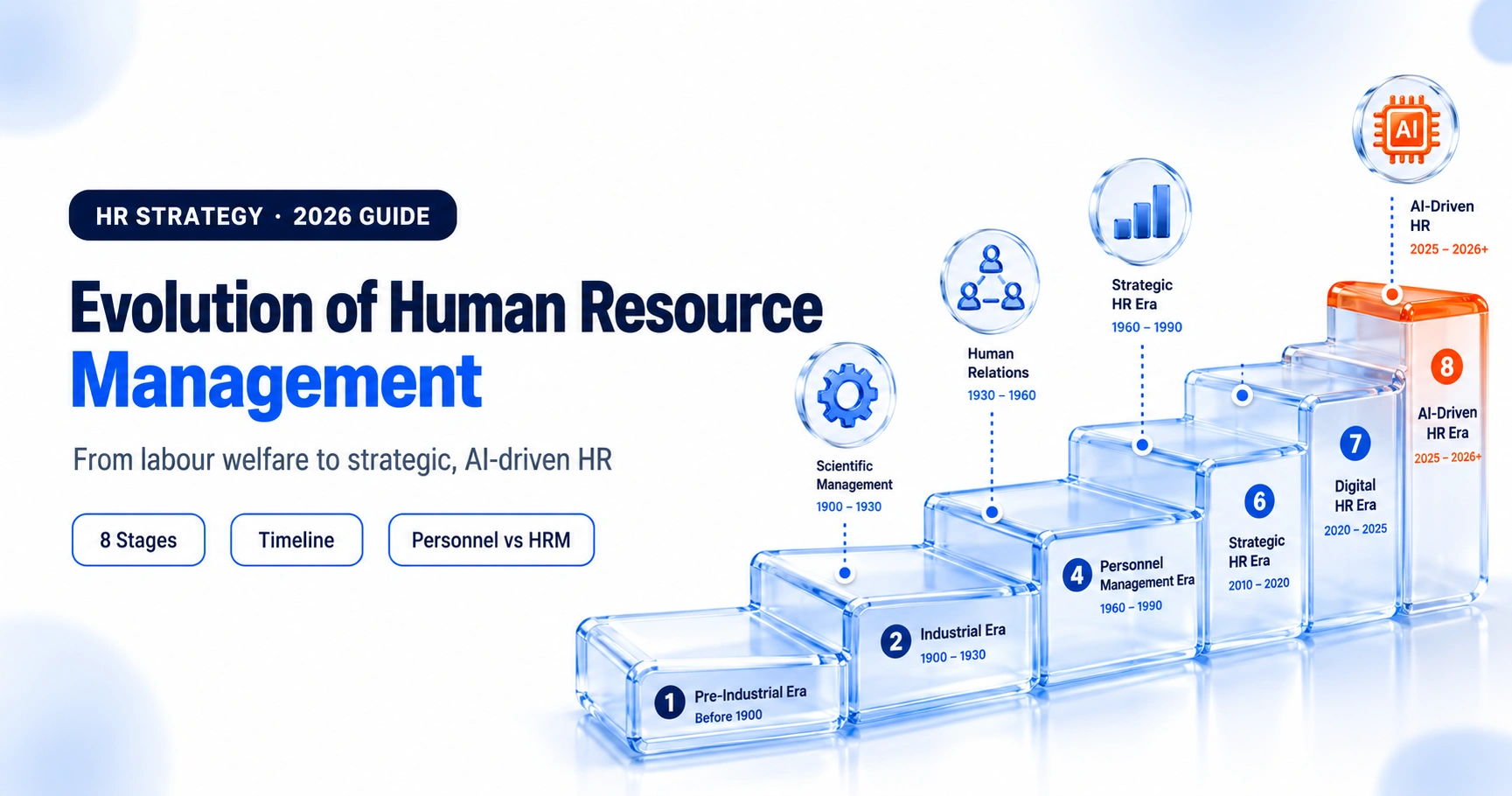
The evolution of human resource management is the shift of the HR function from basic labour welfare and record-keeping into a strategic, technology-driven part of the business. Over roughly a century it moved through scientific management, the human relations movement, personnel management, and modern HRM, and today it runs on HR software, data, and a focus on employee experience.
- HRM evolved from simple labour welfare into a strategic, technology-driven business function.
- Key stages: labour welfare, scientific management, human relations, personnel management, HRM, and strategic HRM.
- The shift from personnel management to HRM moved HR from admin and record-keeping to people strategy.
- Digital HR and HRMS platforms now automate payroll, attendance, and compliance so HR can focus on people.
- The next stage is AI, people analytics, and employee experience at the centre of HR decisions.
What Is Human Resource Management?
Human resource management, or HRM, is the practice of hiring, developing, paying, and supporting the people in an organisation so both the employees and the business succeed. What HRM covers has widened over time, from wages and welfare in its early days to talent, culture, compliance, and strategy today. Understanding how it evolved explains why modern HR looks the way it does.
The Stages in the Evolution of HRM
1. Labour welfare and the industrial era
HRM began during the industrial revolution, when factories needed large workforces and basic welfare. Early welfare officers handled wages, working hours, safety, and grievances. The focus was on keeping workers healthy and present, not on strategy or development.
2. Scientific management
In the early twentieth century, scientific management, led by Frederick Taylor, treated work as a set of measurable tasks. It brought time studies, standard methods, and pay linked to output. It raised productivity but treated people largely as parts of a machine, which created its own problems.
3. The human relations movement
The Hawthorne studies of the 1920s and 30s showed that attention, morale, and group dynamics affect output as much as physical conditions. This human relations movement put employee motivation and satisfaction on the map and pushed HR to think about people, not just processes.
4. Personnel management
By the mid twentieth century, personnel management became a defined function. It handled recruitment, records, pay, welfare, and industrial relations. It was largely administrative and reactive, focused on rules, files, and compliance rather than on business strategy.
5. Human resource management
From the 1980s, personnel management evolved into HRM. The change was more than a new name. HR started to be seen as a driver of performance, linking people practices to business goals, and treating employees as assets to develop rather than costs to control.
6. Strategic HRM
Strategic HRM took the next step, putting HR at the leadership table. Workforce planning, talent management, culture, and capability became part of business strategy. HR leaders began to be measured on outcomes like retention, productivity, and engagement.
7. Globalisation and international HRM
As Indian firms hired across borders and global companies set up here, HR had to manage multiple countries, cultures, and labour laws at once. International HRM added expatriate management, cross-border payroll, and consistent policies across locations, while still respecting local rules in each market.
8. Digital HR and HRMS
Technology reshaped HR again. HRMS software automated payroll, attendance, leave, onboarding, and statutory compliance, moving HR off spreadsheets and freeing time for higher-value work. Self-service put routine tasks in employees' hands and gave HR clean data to act on.
This digital stage is where the shift from HRIS to HRMS to HCM takes shape.
9. AI, analytics, and employee experience
The current stage is data-led. People analytics, AI-assisted hiring, and a strong focus on employee experience are shaping decisions. HR now uses evidence to predict attrition, personalise development, and design work for hybrid and distributed teams.
Personnel Management vs HRM
The move from personnel management to HRM is the clearest turning point in this evolution. Here is how the two differ.
| Aspect | Personnel Management | Human Resource Management |
|---|---|---|
| View of people | Cost to control | Asset to develop |
| Focus | Administration and records | Strategy and performance |
| Approach | Reactive, rule-based | Proactive, goal-linked |
| Role of HR | Support function | Business partner |
| Measure of success | Compliance and process | Outcomes like retention and productivity |
HRM Evolution Timeline at a Glance
| Era | Stage | Focus |
|---|---|---|
| 1900 to 1940 | Scientific management | Efficiency and output |
| 1930 to 1950 | Human relations | Morale and motivation |
| 1950 to 1970 | Personnel management | Records and welfare |
| 1980s | Human resource management | People as assets |
| 1990s | Strategic HRM | HR as business partner |
| 1995 to 2010 | International HRM | Cross-border workforce |
| 2010 onwards | Digital and AI-driven HR | Automation and analytics |
The 3, 4, and 5-Stage Frameworks of HRM Evolution
Different textbooks group the evolution differently. The three most common frameworks are worth knowing because exam questions and interviews often ask for them.
- 3 stages: Labour welfare, personnel management, and human resource management.
- 4 waves: Administrative HR, then people-focused HR, then strategic HR, then digital and analytics-led HR.
- 5 stages: Industrial welfare, scientific management, human relations, personnel management, and strategic HRM.
Frequently Asked Questions
What is the evolution of human resource management?
It is the shift of HR from basic labour welfare and administration into a strategic, technology-driven function. It moved through scientific management, human relations, personnel management, HRM, strategic HRM, and today's digital, data-led HR.
What are the main stages of HRM evolution?
The main stages are labour welfare in the industrial era, scientific management, the human relations movement, personnel management, human resource management, strategic HRM, and the current digital and AI-driven phase.
What is the difference between personnel management and HRM?
Personnel management is administrative and reactive, focused on records, pay, and compliance. HRM is strategic and proactive, treating employees as assets to develop and linking people practices to business goals through performance management.
How has technology changed HRM?
HR technology and HRMS platforms automated payroll, attendance, leave, and compliance, moved HR off spreadsheets, and added self-service and analytics. This freed HR to focus on strategy, talent, and employee experience.
What are the 3 stages of HRM evolution?
The three broad stages are the labour welfare stage, the personnel management stage, and the human resource management stage. This is the simplest and most widely taught framework for how HR grew.
What are the 4 waves of HR evolution?
The four waves are administrative HR focused on records and pay, people-focused HR built on motivation and relations, strategic HR linked to business goals, and today's digital HR driven by automation and people analytics.
What is the future of HRM?
The future is data-led and human-centred, with AI in hiring and support, people analytics guiding decisions, and a strong focus on employee experience, wellbeing, and skills for hybrid teams.
The evolution of human resource management points in one direction: HR that is connected, data-led, and strategic. That shift shows up day to day in modern core HR, performance management, and payroll platforms. For wider context on the field, see this overview of human resource management.
Bring your HR into the modern era
factoHR India unifies payroll, attendance, leave, onboarding, and compliance in one platform, so your HR team can move from admin to strategy.