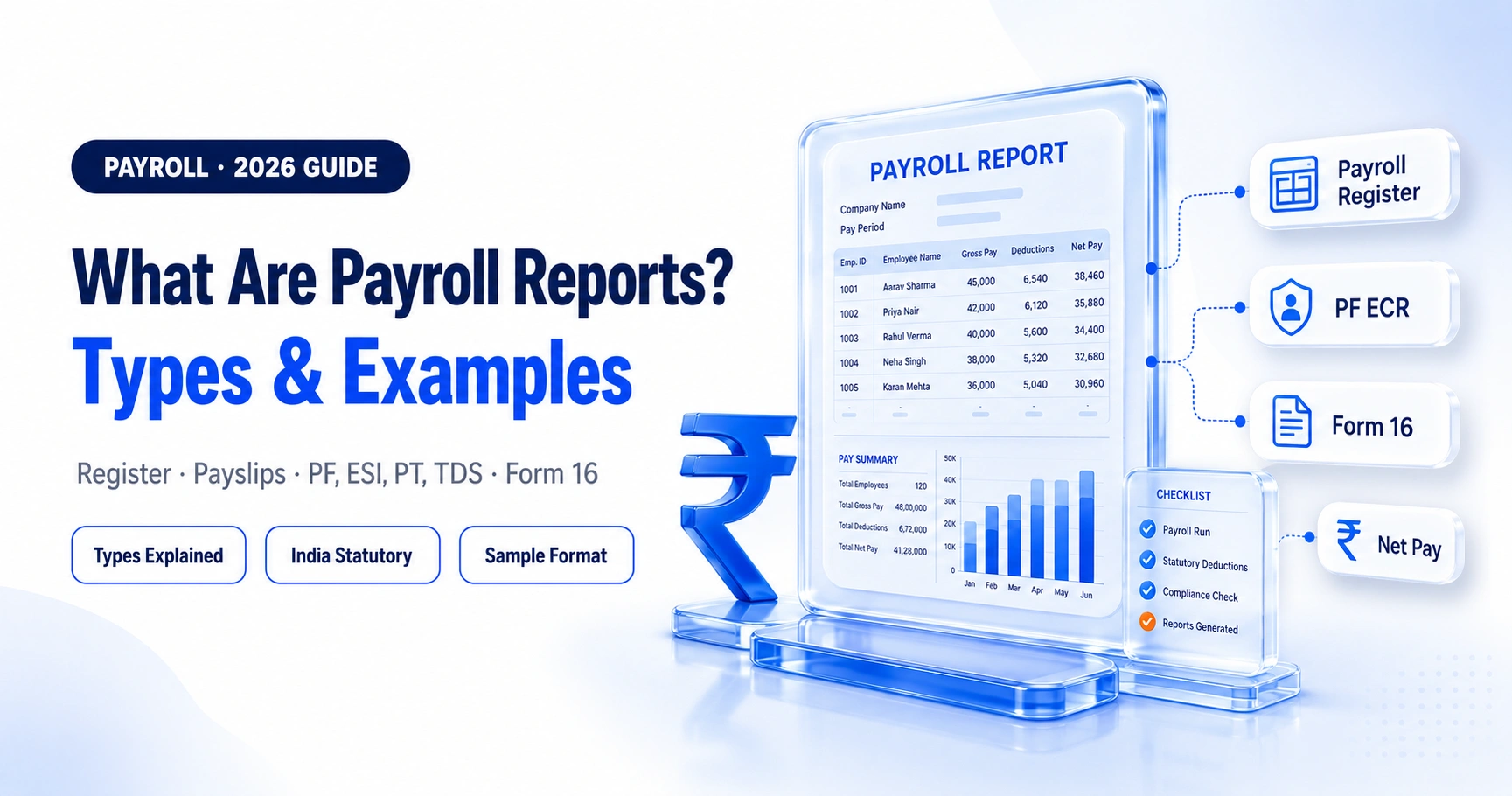
Payroll reports are structured summaries that show how each employee is paid in a given pay cycle, covering earnings, deductions, statutory contributions, and net pay. Finance and HR teams use them to run salaries, file statutory returns, answer audits, and understand where the salary budget is going. In India, they also double as the source for PF, ESI, Professional Tax, and TDS filings.
- Payroll reports are summaries of salary, deductions, and statutory data generated each pay cycle.
- Core reports include the payroll register, payslips, and the salary disbursement or bank advice report.
- India-specific statutory reports cover PF ECR, ESI, Professional Tax, LWF, TDS Form 138, and Form 16.
- Management reports like CTC, cost-centre, variance, and arrears help finance and HR make decisions.
- An HRMS generates these automatically from attendance and payroll data, cutting errors and month-end time.
What Is a Payroll Report?
A payroll report is a document, or a set of documents, that records the details of employee compensation for a chosen period, usually one month. It pulls together attendance, salary structure, earnings, deductions, employer contributions, and net payable, and presents them in a format that finance, HR, auditors, and government portals can use. Some reports are for internal decisions, others are formatted to file directly with statutory bodies.
If you run payroll in India, these reports are also your audit trail. When a PF or income tax query lands, the register and the statutory reports are what prove that every rupee was calculated and deposited correctly.
Why Payroll Reports Matter
- Compliance: They produce the exact files and figures needed for PF ECR, ESI, PT, LWF, and TDS filings.
- Accuracy: A register and a variance report catch errors before salaries hit bank accounts.
- Audit readiness: Clean, dated reports answer auditor and inspector queries without a scramble.
- Cost control: Cost-centre and CTC reports show where the salary spend sits and how it is trending.
- Transparency: Payslips give employees a clear breakdown, which cuts payroll queries to HR.
Types of Payroll Reports
Most Indian payroll teams work with three groups of reports: core payroll reports, India statutory reports, and management or MIS reports.
Core payroll reports
- Payroll register (salary register): The master sheet listing every employee with earnings, deductions, employer contributions, and net pay for the cycle.
- Payslip (salary slip): An individual breakdown of gross, deductions, and net pay issued to each employee, often as a password-protected PDF.
- Salary disbursement or bank advice report: The bank transfer file listing net pay per employee for NEFT or bank API payout.
- Earnings and deductions summary: A component-wise total of basic, HRA, allowances, and each deduction across the company.
India statutory reports
- PF ECR report: The Electronic Challan cum Return file uploaded to the EPFO portal each month.
- ESI contribution report: Employee and employer ESI contributions for filing on the ESIC portal.
- Professional Tax report: State-wise PT deductions, since slabs and rules differ by state.
- Labour Welfare Fund report: LWF deductions, which apply in some states once or twice a year.
- TDS and Form 138: Salary TDS deducted and deposited, and the quarterly Form 138 return.
- Form 16: The annual TDS certificate issued to employees, generated from the year's payroll data.
Management and MIS reports
- CTC report: Full cost to company per employee, including employer contributions.
- Cost-centre or department-wise report: Salary cost split by team, location, or entity.
- Payroll variance report: Month-on-month change per employee, which usually flags a data issue rather than a real change.
- Arrears report: Backdated pay from revisions or corrections settled in the current cycle.
- Full and final settlement report: Dues and recoveries for exiting employees.
- Overtime, reimbursement, and loan or advance reports: Supporting summaries that feed net pay.
How to Generate Payroll Reports
You can build payroll reports manually in spreadsheets, but that gets slow and error-prone as headcount grows, especially with multi-state PT and changing PF or ESI rules. Most Indian teams move to payroll software that pulls attendance and leave, applies the salary structure and statutory rules, and generates every report above in the exact filing format. When attendance, leave, and payroll live in one system with a hard cut-off date, the reports come out clean the first time.
Analytical and year-to-date reports
- Year-to-date (YTD) report: Cumulative earnings, deductions, and tax for each employee from the start of the financial year, essential for TDS projection and Form 16.
- Salary distribution analysis: How pay is spread across bands, grades, and departments, useful for benchmarking and budgeting.
- Attrition cost report: The payroll cost tied to exits and replacements, so HR can see the real price of churn.
- Budget vs actual report: Planned salary spend against what was actually paid, so finance can catch overruns early.
- Tax computation sheet: A per-employee breakdown of taxable income, exemptions, and TDS, the working behind every salary TDS figure.
Payroll Report Format: A Simple Example
Most payroll registers follow a similar column layout. Here is a simplified example of what a monthly payroll report looks like.
| Employee | Gross | PF | PT | TDS | Net Pay |
|---|---|---|---|---|---|
| Employee A | Rs. 60,000 | Rs. 1,800 | Rs. 200 | Rs. 2,500 | Rs. 55,500 |
| Employee B | Rs. 45,000 | Rs. 1,800 | Rs. 200 | Rs. 1,000 | Rs. 42,000 |
| Employee C | Rs. 90,000 | Rs. 1,800 | Rs. 200 | Rs. 6,000 | Rs. 82,000 |
A full register adds columns for basic, HRA, other allowances, ESI, reimbursements, and employer contributions, but the core flow is always gross minus deductions equals net pay.
Best Practices for Payroll Reporting
- Lock attendance and leave before you run payroll, so reports are built on final data.
- Review the variance report before releasing the bank file. Big swings usually mean an input error.
- Keep statutory report formats current, since PF, ESI, PT, and TDS rules change often.
- Store dated copies of every report for at least the statutory retention period.
- Restrict who can view salary reports with role-based access.
Frequently Asked Questions
What are payroll reports?
Payroll reports are summaries of employee pay for a period, showing earnings, deductions, statutory contributions, and net pay. Teams use them to run salaries, file PF, ESI, PT, and TDS returns, answer audits, and track salary cost.
What are the main types of payroll reports in India?
The main ones are the payroll register, payslips, and bank disbursement report, plus statutory reports for PF ECR, ESI, Professional Tax, LWF, TDS Form 138, and Form 16. Management reports like CTC, cost-centre, and variance help finance and HR decide.
What is a payroll register?
A payroll register, also called a salary register, is the master report that lists every employee with their earnings, deductions, employer contributions, and net pay for the cycle. It is the backbone document for both salary processing and audits.
Which payroll reports are needed for statutory compliance in India?
You need the PF ECR file, ESI contribution report, Professional Tax report by state, LWF report where applicable, TDS with Form 138, and annual Form 16. These feed the EPFO, ESIC, state, and income tax portals.
What is the format of a payroll report?
A payroll report is usually a table with one row per employee and columns for gross pay, each earning component, statutory deductions like PF, ESI, PT, and TDS, other deductions, and net pay. Statutory reports follow the fixed format each government portal accepts.
What is a monthly payroll report?
A monthly payroll report summarises all salary payments and deductions for one month. It typically includes the payroll register, payslips, the bank disbursement file, and the statutory reports needed for that month's PF, ESI, PT, and TDS filings.
How often are payroll reports generated?
Core reports like the register, payslips, and statutory filings are generated every pay cycle, usually monthly. TDS Form 138 is quarterly, and Form 16 is annual. Management reports can be pulled on demand.
Get every payroll report in one click
factoHR India generates the payroll register, payslips, PF ECR, ESI, PT, TDS, and Form 16 straight from your attendance and payroll data, in the exact formats Indian portals accept.