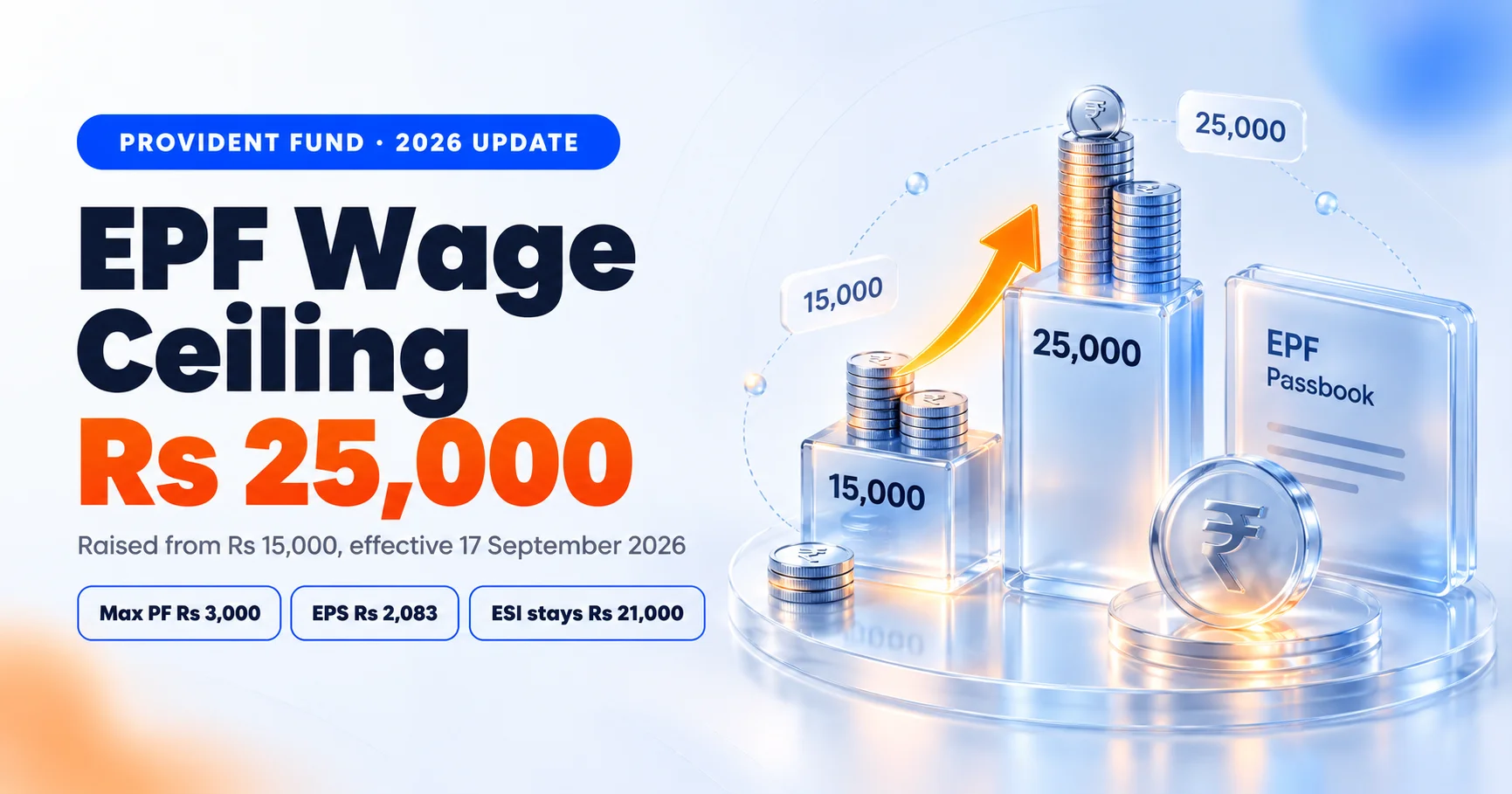
The EPF wage ceiling has moved for the first time in over a decade. From 17 September 2026, the mandatory provident fund wage ceiling rises from Rs 15,000 to Rs 25,000 a month, notified under the Code on Social Security. The contribution rates do not change, but the capped wage they apply to does, so PF balances, employer cost and your September payroll all shift. Here is exactly what changed and what your payroll team must do.
Key Takeaways
- The EPF wage ceiling rose from Rs 15,000 to Rs 25,000 per month, effective 17 September 2026.
- Contribution rates are unchanged at 12 percent each; only the capped wage base is higher.
- Maximum employee PF rises to Rs 3,000 and maximum employer EPS to Rs 2,083 per month.
- Employer statutory outgo per capped employee rises from about Rs 1,950 to Rs 3,250.
- September 2026 is split: the Rs 15,000 ceiling applies to 16 September and Rs 25,000 from 17 September, in one ECR.
- Employees earning above Rs 25,000 stay excluded unless they are covered voluntarily by joint request.
- The ESI wage ceiling is unchanged at Rs 21,000, so do not confuse the two.
What exactly changed
The Ministry of Labour and Employment, by Notification S.O. 5109(E) dated 17 September 2026, raised the EPF wage ceiling from Rs 15,000 to Rs 25,000 per month under the Code on Social Security. This is the first revision since September 2014, when the ceiling last went up to Rs 15,000.
The rates themselves do not change. Both employee and employer still contribute 12 percent of Basic plus Dearness Allowance. The employer 12 percent still splits as 8.33 percent to the Employees Pension Scheme (EPS) and 3.67 percent to EPF. What changes is the maximum wage on which these are mandatorily computed, which moves from Rs 15,000 to Rs 25,000.
The new contribution numbers at a glance
Here is how the monthly figures change for an employee at or above the ceiling. You can check your own numbers with our EPF calculator, now updated to the Rs 25,000 ceiling.
| Component | At Rs 15,000 ceiling | At Rs 25,000 ceiling |
|---|---|---|
| Employee PF (12%) | Rs 1,800 | Rs 3,000 |
| Employer EPS (8.33%) | Rs 1,250 | Rs 2,083 |
| Employer EPF (3.67%) | Rs 550 | Rs 917 |
| EDLI (0.5%) | Rs 75 | Rs 125 |
| Admin charges (0.5%) | Rs 75 | Rs 125 |
| Total employer outgo | Rs 1,950 | Rs 3,250 |
So the employer statutory cost per capped employee rises by about Rs 1,300 a month, and the maximum employee deduction rises from Rs 1,800 to Rs 3,000.
September 2026 is a split month
Because the change takes effect mid-month, September 2026 wages are computed on two ceilings in a single ECR: the Rs 15,000 ceiling for 1 to 16 September, and the Rs 25,000 ceiling for 17 to 30 September. File this combined ECR by the usual due date of 15 October 2026. From October onward, the full Rs 25,000 ceiling applies for the whole month. Every other monthly deadline stays as it is in the payroll compliance calendar.
Who is affected
- Employees earning Rs 15,001 to Rs 25,000: now mandatorily covered on their actual wages, where earlier they could be capped at Rs 15,000. The government expects more than 51 lakh additional employees to come under mandatory EPF.
- Employees already above Rs 25,000: still "excluded employees". You are not obliged to enrol them, and they can be covered only voluntarily through a joint request between employee and employer.
- Employees on or below Rs 15,000: no change.
Impact on employees and employers
For employees in the covered band, more of the salary now flows into provident fund, so retirement savings and the EPS pension base grow, while monthly take-home can dip slightly because the PF deduction is higher. For employers, contribution and gratuity-linked cost per head rises, and companies that had restricted PF to the Rs 15,000 ceiling will see the sharpest increase. Model the new cost before the next cycle and brief finance early. Manufacturers with large shift workforces feel this most, so see our guide to the best HR software for manufacturing.
Do not confuse this with ESI
Only the EPF ceiling changed. The ESI wage ceiling stays at Rs 21,000 of gross wages, with contributions of 0.75 percent from the employee and 3.25 percent from the employer. Keep the two thresholds separate in your payroll setup.
What employers must do now
- Update your payroll or HRMS so PF and EPS compute on the Rs 25,000 ceiling from 17 September 2026.
- Run the September ECR on the split basis and file it by 15 October 2026.
- Recompute cost to company for employees in the Rs 15,000 to Rs 25,000 band and update CTC models.
- Decide your policy for employees above Rs 25,000: restrict to the ceiling or extend voluntarily.
- Communicate the take-home change to affected employees before payday.
A system that applies the ceiling automatically removes the manual risk. Our India payroll compliance hub tracks each of these statutory changes as they land.
Frequently asked questions
What is the new EPF wage ceiling in 2026?
The EPF wage ceiling is Rs 25,000 per month, raised from Rs 15,000 with effect from 17 September 2026 under the Code on Social Security. It is the first revision since 2014.
Did the EPF contribution rate change?
No. Employee and employer both still contribute 12 percent of Basic plus DA. Only the maximum wage on which it is mandatorily calculated moved from Rs 15,000 to Rs 25,000.
What is the maximum PF deduction now?
At the ceiling, the maximum employee PF is Rs 3,000 a month, the maximum employer EPS is Rs 2,083, and the maximum employer EPF is Rs 917.
How is September 2026 PF calculated?
September is split in one ECR: the Rs 15,000 ceiling for 1 to 16 September and the Rs 25,000 ceiling for 17 to 30 September. File it by 15 October 2026.
Did the ESI ceiling also change?
No. The ESI wage ceiling remains Rs 21,000 of gross wages. Only the EPF ceiling was revised.
Are employees earning above Rs 25,000 covered?
They remain excluded employees. Coverage above the ceiling is voluntary and needs a joint request between the employee and employer.
Final word
The headline is simple: same 12 percent rates, a higher Rs 25,000 wage base from 17 September 2026. The work is in the detail, the split September ECR, the recomputed cost to company, and a clear policy for high earners. Get your payroll configuration right once and the rest follows. Want a payroll system that applies the new ceiling and files the ECR for you? Book a free factoHR India demo.