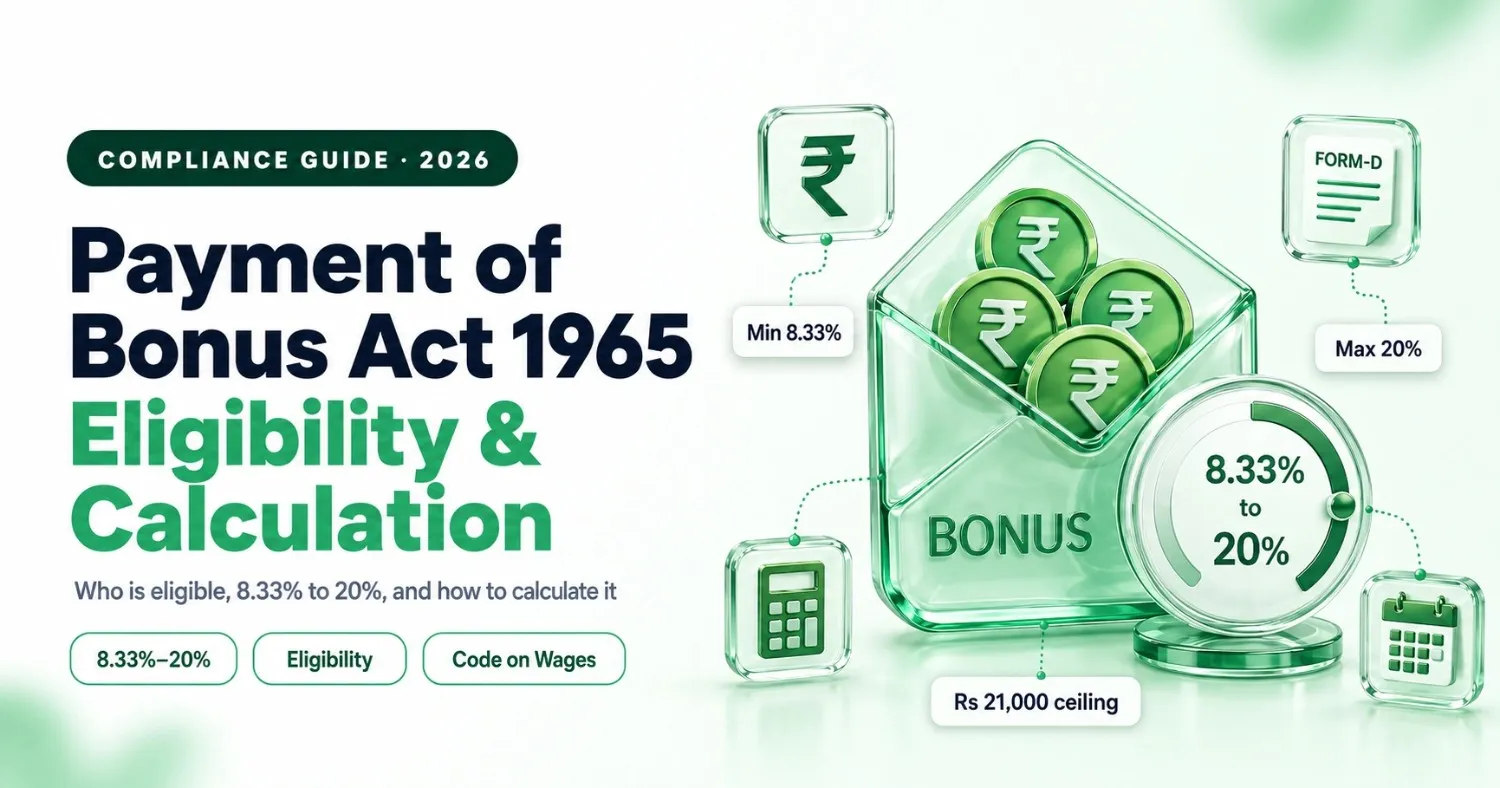
The Payment of Bonus Act 1965 makes statutory bonus a legal right for eligible employees, not a goodwill gift. If your establishment qualifies, you must pay a minimum bonus of 8.33 percent every year, even in a loss-making year, and up to 20 percent in a good one.
This guide explains who the Act covers, who is eligible, how to calculate the bonus, the tax on it, and the deadlines. It also covers a major 2026 update: the Code on Wages, 2019 has now absorbed these bonus rules.
- The Act applies to every factory and to establishments with 20 or more employees, and once it applies, it keeps applying.
- Employees earning up to Rs 21,000 a month who work at least 30 days in the year are eligible.
- The bonus ranges from a minimum of 8.33 percent to a maximum of 20 percent of annual wages.
- Bonus is calculated on Rs 7,000 or the minimum wage, whichever is higher, not the full salary.
- Statutory bonus is fully taxable as salary, and you must pay it within 8 months of the year-end.
- The Code on Wages, 2019 now governs bonus, and its 50 percent wages rule changes the calculation base.
What is the Payment of Bonus Act 1965?
The Payment of Bonus Act 1965 is an Indian law that requires covered employers to share part of their profits with employees as an annual bonus. It fixes a minimum bonus of 8.33 percent and a maximum of 20 percent of an employee's yearly wages.
The logic is simple. When a business does well, eligible staff receive a fixed share. When it does not, the law still protects a minimum payout. So bonus is a statutory cost you plan for, not a discretionary perk.
Which Establishments Does the Act Apply To?
The Act applies to two groups under Section 1:
- Every factory, and
- Every other establishment with 20 or more persons employed on any day during the accounting year.
Some states extend it to establishments with 10 or more employees through a notification. Check your state rule before you decide.
One point trips up many employers. Once the Act applies to your establishment, it keeps applying even if your headcount later drops below 20. The coverage does not switch off on its own.
Which Establishments Are Exempt?
Section 32 keeps some employers outside the Act, even above 20 employees. These include:
- The Life Insurance Corporation and general insurers
- The Reserve Bank of India and notified bodies like NABARD, SIDBI, IDBI and UTI
- Hospitals, chambers of commerce, universities and other institutions run not for profit
- The Indian Red Cross and similar charitable organisations
- Inland water transport establishments on routes that pass through another country
If you run a not-for-profit, confirm your status under Section 32 before you assume the bonus rules bind you.
Who Is Eligible for Statutory Bonus?
An employee is eligible when both conditions are met:
- Wage ceiling. The employee draws wages of up to Rs 21,000 a month, counting basic plus dearness allowance (Section 2(13)).
- Minimum service. The employee has worked at least 30 working days in that accounting year (Section 8).
So a worker who joins late still earns a pro-rata bonus, as long as they clock 30 working days.
An employee earning above Rs 21,000 a month has no statutory right to bonus. Many employers still pay them an ex-gratia amount as policy, but that is a choice, not a legal duty.
How Much Bonus Must You Pay? Minimum and Maximum
The Act fixes a clear band:
- Minimum bonus: 8.33 percent of annual wages, payable even in a loss year (Section 10).
- Maximum bonus: 20 percent of annual wages, when the allocable surplus allows it (Section 11).
There is also a calculation cap. If an employee earns more than Rs 7,000 a month, you calculate the bonus on Rs 7,000 or the minimum wage for that work, whichever is higher (Section 12). You do not calculate on the full higher salary.
This is where the minimum wage rates for your state matter, because they often set the real calculation base.
How to Calculate Statutory Bonus (Worked Example)
Take an employee in a role where the state minimum wage is Rs 15,000 a month, and the employee draws Rs 16,000 in basic plus DA.
- The employee earns under Rs 21,000, so they are eligible.
- The salary is above the Rs 7,000 cap, so you use the higher of Rs 7,000 or the minimum wage. That is Rs 15,000.
- Annual wage base: Rs 15,000 x 12 = Rs 1,80,000.
- Minimum bonus at 8.33 percent: Rs 14,994 for the year.
- Maximum bonus at 20 percent: Rs 36,000 for the year.
So this employee must receive between Rs 14,994 and Rs 36,000, based on your allocable surplus. To work out the exact figure for any salary in seconds, use the bonus calculator instead of building a spreadsheet.
Set-On and Set-Off: How Good and Bad Years Balance Out
The Act smooths bonus across years (Section 15). In a strong year, surplus above the 20 percent ceiling carries forward as a "set-on", up to the 20 percent limit, for the next 4 years. In a weak year, the shortfall below 8.33 percent carries forward as a "set-off". This is why your allocable surplus looks both back and forward.
Pay Only for Days Worked
Bonus tracks attendance. Where an employee has not worked the full year, you reduce the bonus in proportion to the days actually worked (Section 13). The 30-day rule decides eligibility, but the amount still scales with presence.
Adjusting Customary and Interim Bonus
If you already pay a festival or puja bonus by custom, or an interim bonus during the year, you can adjust it against the statutory bonus due (Section 17). The employee receives the higher figure, not both amounts stacked.
When You Can Deduct From Bonus
If an employee is found guilty of misconduct that causes the company a financial loss in that year, you may deduct that loss from the bonus payable for the same year (Section 18). Keep the finding and the loss documented.
Is Statutory Bonus Taxable?
Yes. Statutory bonus is fully taxable as salary income in the year you receive it. There is no separate exemption for it, and your employer deducts TDS on it like any other salary component.
So a Rs 36,000 bonus adds to your taxable pay for that year. To see how it changes your in-hand amount, check it against your take-home salary.
When Must Bonus Be Paid? Deadline and Returns
Timing is a common compliance gap. The rules:
- Pay the bonus within 8 months of the close of the accounting year (Section 19). For a year ending 31 March, that means by 30 November.
- Maintain Form A (allocable surplus), Form B (set-on and set-off), and Form C (bonus paid to each employee).
- File the annual return in Form D within 30 days of paying the bonus.
This 30 November bonus deadline sits alongside your other filings in the payroll compliance calendar for FY 2026-27.
If a dispute is pending, the deadline can extend to one month from the date the award becomes enforceable.
New Companies: The 5-Year Infancy Rule
A new establishment gets relief in its early years. For the first 5 accounting years, you pay bonus only in the years you actually earn a profit (Section 16).
The set-on and set-off mechanism does not apply during this infancy period. From the sixth year, the normal rules begin.
Disqualification and Penalties
An employee loses the bonus for that year if dismissed for fraud, riotous or violent behaviour at work, or theft, misappropriation or sabotage of company property (Section 9).
For employers, non-compliance is a criminal matter. A breach can attract imprisonment of up to 6 months, a fine of up to Rs 1,000, or both (Section 28). The cost of an adverse inspection finding is usually far higher than the fine.
What If Your Bonus Is Not Paid?
If a due bonus is not paid, you do not lose it quietly. You can apply to the appropriate government for recovery within one year of it falling due (Section 21). The government then issues a recovery certificate, and the amount is recovered as arrears of land revenue.
Bonus disputes also count as industrial disputes, so they can go before a labour court or tribunal (Section 22).
How the Code on Wages 2019 Changes This
Here is the update every payroll team needs in 2026. The Code on Wages, 2019 has been notified and now subsumes the Payment of Bonus Act 1965, along with three other wage laws. The central government notified the four labour codes effective 21 November 2025, with rollout from 1 April 2026.
What stays the same:
- The 8.33 percent minimum and 20 percent maximum bonus band continues.
- Eligibility based on a wage threshold and minimum service continues.
What changes:
- The definition of "wages" is standardised. Allowances are capped, so basic wages must be at least 50 percent of total pay. This 50 percent rule lifts the base used for bonus, provident fund and gratuity, which raises both employee payouts and employer cost. The same wage definition decides your payout under the Payment of Gratuity Act, 1972.
- The exact bonus eligibility threshold is set by government notification, so confirm the current figure for your state.
Central and state rules are still being finalised, and uniform enforcement is rolling out in stages. For the structured view, see the Code on Wages 2019 guide. It is also worth revisiting your salary structure, because the 50 percent rule reshapes CTC.
Quick Recap
| Rule | Position under the Act |
|---|---|
| Applies to | Factories and establishments with 20+ employees (10+ in some states) |
| Exempt bodies | LIC, RBI, not-for-profits and others (Section 32) |
| Eligibility | Wages up to Rs 21,000 a month, 30+ working days |
| Minimum bonus | 8.33 percent of annual wages |
| Maximum bonus | 20 percent of annual wages |
| Calculation base | Higher of Rs 7,000 or the minimum wage |
| Taxability | Fully taxable as salary, TDS applies |
| Payment deadline | Within 8 months of year-end |
| Annual return | Form D, within 30 days of payment |
| Now governed by | Code on Wages, 2019 |
Frequently Asked Questions
Is paying statutory bonus mandatory?
Yes. If the Act or the Code on Wages applies to your establishment and the employee is eligible, the minimum 8.33 percent bonus is a legal duty. You must pay it even in a loss-making year.
On what salary is bonus calculated?
On basic wages plus dearness allowance. If that figure is above Rs 7,000 a month, you calculate on Rs 7,000 or the applicable minimum wage, whichever is higher.
Is an employee earning above Rs 21,000 entitled to bonus?
Not as a statutory right under the Act. You may still pay an ex-gratia bonus as company policy, but the law does not compel it.
Is statutory bonus taxable in India?
Yes. It is taxed as part of your salary in the year you receive it, with TDS deducted. There is no special bonus exemption under the Income Tax Act.
Do new companies have to pay bonus?
In the first 5 years, a new establishment pays bonus only in the accounting years where it earns a profit. After that, the standard rules with set-on and set-off apply.
What happens if bonus is paid late?
You breach the 8-month deadline under Section 19. That can lead to penalties and weakens your position in any dispute or inspection. Pay on time and file Form D.
Make Statutory Bonus Effortless
Statutory bonus looks simple until you handle eligibility checks, the calculation cap, set-on and set-off, and Form C and Form D across locations. factoHR India applies the correct rate automatically, generates the registers and returns, and posts the bonus straight to each payslip. So your year-end stays clean and audit-ready.