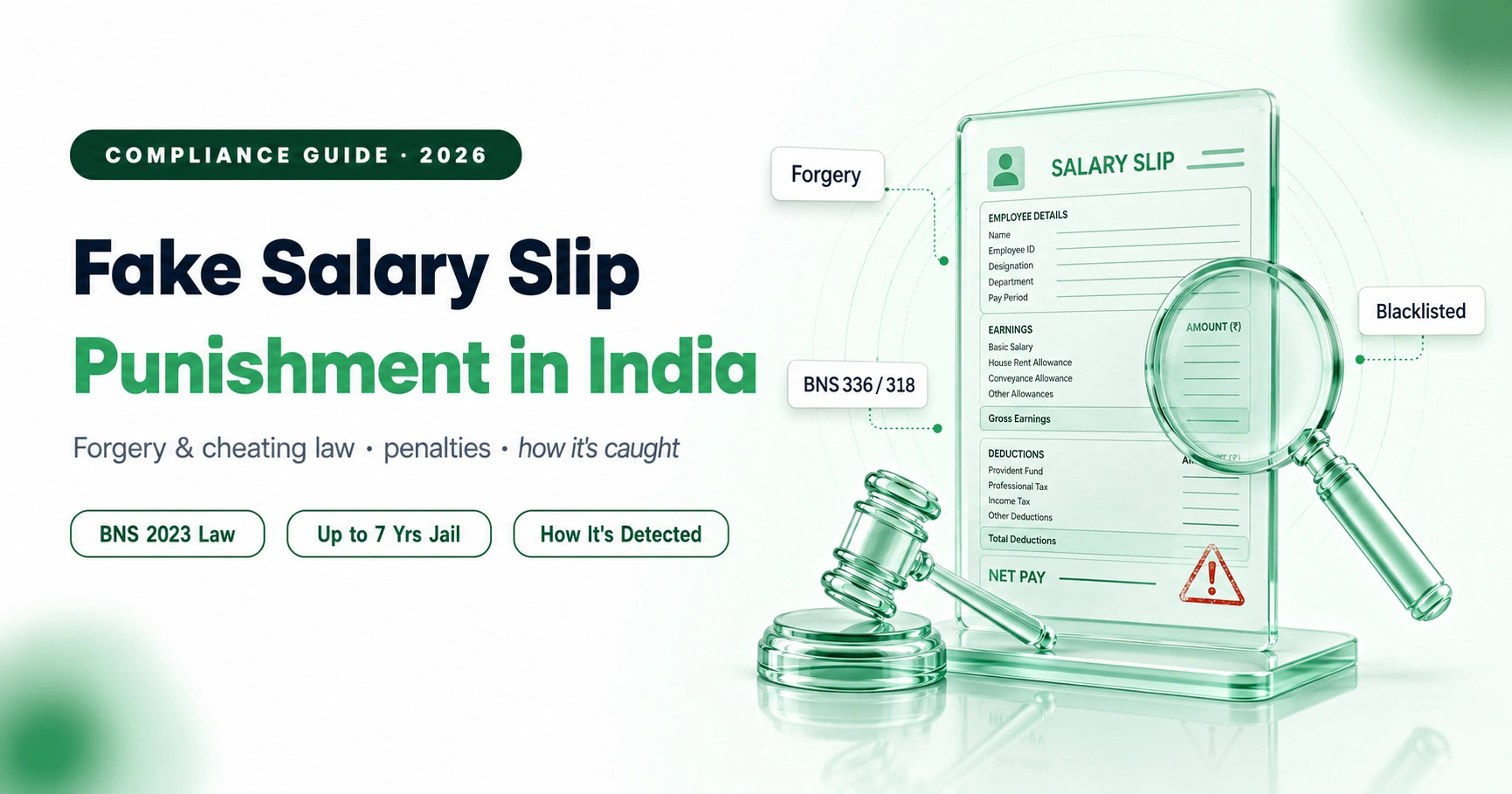
Submitting a fake salary slip to get a job or a loan is a criminal offence in India, not a harmless exaggeration. It counts as forgery and cheating, and it can lead to jail of up to seven years, immediate job loss, and blacklisting that follows you for years.
This guide explains what counts as a fake salary slip, the exact law and punishment under the Bharatiya Nyaya Sanhita, 2023, the career and financial fallout, and how employers and banks detect fakes. It is general information, not legal advice.
Key Takeaways
- Submitting a fake salary slip is a criminal offence in India, not a minor lie.
- It falls under forgery (BNS Section 336) and cheating (BNS Section 318), with jail up to seven years plus a fine.
- Using a fake slip made by someone else is equally punishable under BNS Section 340 (the old IPC Section 471).
- Career fallout: immediate termination, cancelled offers, and blacklisting in background-check databases.
- Financial fallout: loan rejection, loan recall, and tagging in bank fraud databases.
- Employers detect fakes through UAN, Form 16, bank credits, and background checks, so the risk rarely pays off.
What is a Fake Salary Slip?
A fake salary slip is any payslip that has been altered, fabricated, or misrepresented to show false financial information. It includes inflating basic pay, changing deductions, using a company letterhead without authority, or creating a slip for a job you never held.
People usually create fake slips to clear a salary bar in a new job or to qualify for a higher loan. Both uses are illegal, because the slip is presented as a genuine document to deceive an employer or a bank.
Is a Fake Salary Slip Illegal in India?
Yes. A salary slip is a document, so faking one is forgery, and using it to gain a job or a loan is cheating. Under Indian law both are punishable with imprisonment and a fine, whether you created the slip or only submitted one made by someone else.
Legal Punishment for a Fake Salary Slip in India
From 1 July 2024, the Bharatiya Nyaya Sanhita (BNS), 2023 replaced the Indian Penal Code (IPC). A forged salary slip can attract more than one section at once, because it involves both making a false document and using it to deceive.
| Offence | Law (2026) | Earlier IPC | Maximum punishment |
|---|---|---|---|
| Cheating an employer or lender | BNS Section 318 | IPC Section 420 | Up to 7 years jail + fine |
| Forgery, including forgery to cheat | BNS Section 336 | IPC Sections 465, 468 | Up to 7 years jail + fine |
| Using a forged document as genuine | BNS Section 340 | IPC Section 471 | Same as forgery, up to 7 years + fine |
| Digital forgery or identity fraud | IT Act Sections 66C, 66D | Same Act | Up to 3 years jail + fine |
The exact charge and sentence depend on the facts, the intent, and the loss caused. A court decides the outcome, and a first offence may draw a lighter penalty than a repeat or high-value fraud. The key point is simple: the risk is criminal, not just professional.
Career and Professional Consequences
Even when a case does not reach court, the career damage from a fake salary slip is severe and often permanent.
- Immediate termination: Firing for breach of trust, usually without notice or severance.
- Offer revocation: A job offer cancelled the moment a background check flags the slip.
- BGV blacklisting: A negative background verification report shared across screening databases, blocking future hires.
- Forfeiture: Loss of final settlement, pending bonuses, and notice pay.
- Reputation damage: Exclusion from Tier-1 employers and senior roles that run strict checks.
Financial and Loan Consequences
Using a fake salary slip to borrow money adds a second layer of risk, this time with the bank.
- Loan rejection or recall: The bank denies the loan, or recalls a sanctioned loan once fraud is found.
- Fraud tagging: Your record is flagged in the bank's internal fraud database, hurting future credit.
- Criminal complaint: Banks can and do file complaints for cheating and forgery on forged income documents.
Who Is Punished: Employee or Employer?
Both the person who submits a fake salary slip and the person who creates it can be prosecuted. Liability does not sit only with the maker, so submitting a slip that someone else forged is not a defence.
Employers are also on the hook if they issue false payslips. An employer or agent who creates inflated or backdated slips for a fee can be charged with forgery and abetment, and can face action from tax authorities for misreporting.
Genuine Mistake vs Deliberate Fraud: Does Intent Matter?
Intent is central to both forgery and cheating. The law targets a dishonest or fraudulent intention to deceive, so a genuine error is not the same as a fabricated document. A typo in a figure, a rounding difference, an old template, or a name mismatch between your slip and your bank record is a discrepancy to correct, not automatically a crime. Deliberately inflating pay or creating a slip for a job you never held is the offence.
If a background check flags your salary slip and the discrepancy is honest, act fast. Gather your supporting proof, such as your UAN, Form 16, Form 26AS, and bank salary credits, and share it with the employer or verification agency to close the gap. For anything serious, or if you are accused of fraud, consult a qualified lawyer before you respond. This is general guidance, not legal advice.
How Employers Detect a Fake Salary Slip
Verification is now standard practice, and for good reason. According to AuthBridge's Workforce Fraud Files 2025, employment misrepresentation, such as inflated tenure and fabricated employers, made up 29 percent of all hiring discrepancies in India, and the BFSI sector saw an overall discrepancy rate of 11.69 percent. Fakes rarely survive a proper check. HR and background-verification teams use several cross-checks that are hard to fool.
- UAN and EPFO check: The Universal Account Number reveals real employers and contribution history.
- Form 16 and Form 26AS: Tax records must match the salary claimed on the slip.
- Bank salary credits: The declared net pay should appear as a matching monthly credit.
- Direct BGV: Verification straight with the previous employer through a recruitment and ATS platform or a background-check partner.
- Salary structure realism: A structure that does not fit the role, city, or company size raises a flag.
- QR and digital signature: Genuine payslips carry tamper-evident codes and signatures that fakes lack.
- Document verification at onboarding: Cross-checking slips against appointment letters during employee onboarding catches mismatches early.
The Safe Alternative: Use a Genuine Payslip
The safe path is simple: use your real salary slip. If you do not have one, ask your employer's HR or payroll team, because every compliant employer issues authentic payslips. If a salary offer feels low, negotiate on your skills and market data, not on fabricated documents.
Employers protect themselves the same way. Issuing tamper-evident payslips from payroll software, with UAN, Form 16, and digital signatures, makes forgery easy to spot and keeps your own records audit-ready.
Final Word
A fake salary slip is a short-term shortcut with a long-term cost. Under the Bharatiya Nyaya Sanhita, 2023 it is forgery and cheating, punishable with up to seven years in jail, and the career and financial fallout can outlast any job or loan you gained. Employers and banks now cross-check UAN, Form 16, and bank credits, so fakes are caught more often than not.
If you are an employer, protect your business by issuing genuine payslips and verifying candidate documents at onboarding. If you are a job seeker, use your real slip and negotiate on merit. This article is general information and not legal advice, so consult a qualified lawyer for any specific situation.
Frequently Asked Questions
Is submitting a fake salary slip a crime in India?
Yes. A fake salary slip is a forged document, and using it to gain a job or loan is cheating. Under the Bharatiya Nyaya Sanhita, 2023, forgery falls under Section 336 and cheating under Section 318, both punishable with imprisonment and a fine.
What is the punishment for a fake salary slip in India?
Forgery to cheat and cheating can each attract up to seven years in jail plus a fine under BNS Sections 336 and 318. Using a forged slip made by someone else is covered by BNS Section 340. Beyond the law, you can face termination, blacklisting, and loan rejection.
Can I go to jail for a fake salary slip?
Yes, jail is possible. If prosecuted for forgery or cheating, the maximum sentence is up to seven years, though the actual outcome depends on the facts, intent, and loss caused, and is decided by a court.
Is using a fake salary slip for a loan illegal?
Yes. Submitting a fake salary slip to a bank is cheating under BNS Section 318 and forgery under Section 336. The bank can reject or recall the loan, flag you in its fraud database, and file a criminal complaint.
Can employers find out a salary slip is fake?
Usually, yes. Employers cross-check the UAN and EPFO history, Form 16 and Form 26AS, bank salary credits, and verify directly with the previous employer. A salary structure that does not fit the role or a missing digital signature also raises a flag.
What should I do instead of using a fake salary slip?
Use your genuine salary slip, and ask your HR or payroll team if you do not have a copy. If you feel underpaid, negotiate on your skills and market benchmarks rather than fabricated documents, which carry criminal and career risk.
Is a genuine salary discrepancy also a crime?
No, not automatically. Forgery and cheating require a dishonest intent to deceive, so an honest error like a typo, rounding, or a name mismatch is a discrepancy to correct, not a crime. Fabricating figures or documents with intent to deceive is the offence. If you are flagged over a genuine mistake, share your UAN, Form 16, and bank credits to resolve it.