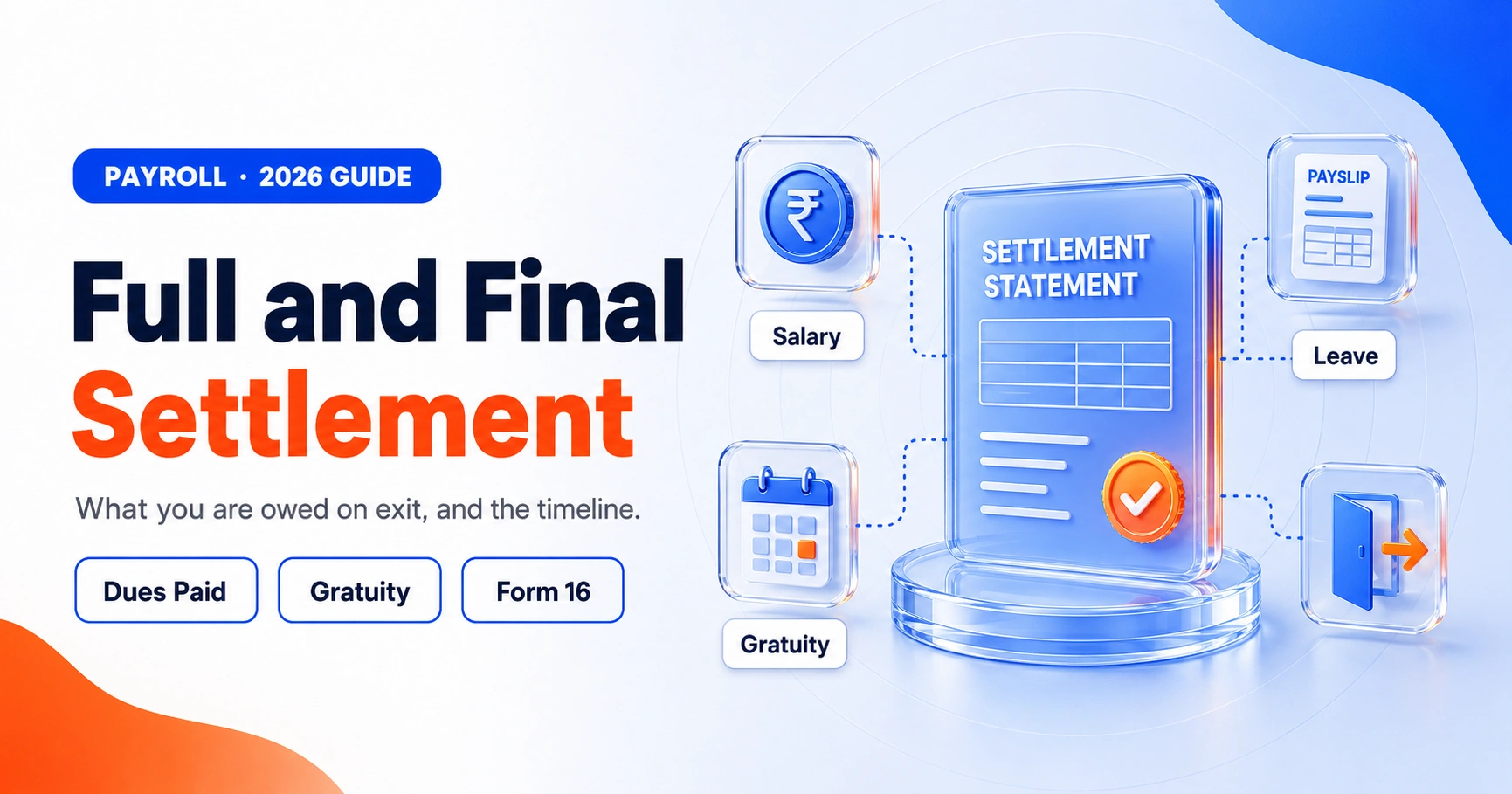
Full and final settlement (FnF) is the last payment an employer makes to an employee who leaves the company. It clears everything owed on both sides: unpaid salary, leave encashment, gratuity, bonus, and reimbursements, minus deductions like a notice-period shortfall, advances, and tax. In India it is usually completed within 30 to 45 days of the last working day.
Whether an employee resigns, retires, or is let go, the FnF is where the working relationship formally closes. Get it wrong and you get disputes, delayed relieving letters, and unhappy exits. This guide explains what goes into an FnF, what gets deducted, the timeline, and how employers stay clean.
Key Takeaways
- Full and final settlement is the final payout when an employee exits, covering all dues minus all deductions.
- It includes unpaid salary, leave encashment, gratuity (if eligible), pro-rata bonus, and pending reimbursements.
- Deductions can include notice-period shortfall, salary advances, unreturned assets, and applicable TDS.
- The Code on Wages, 2019 sets final wages within 2 working days of exit, but most Indian companies complete FnF in 30 to 45 days.
- Gratuity is due only after 5 years of continuous service, and leave encashment is paid on unused earned leave.
- The FnF comes with a settlement statement, relieving letter, and Form 16, so both sides have a clean record.
What is full and final settlement?
Full and final settlement is the process of calculating and paying everything a departing employee is owed, after subtracting anything they owe the company. It applies on resignation, termination, retirement, or the end of a contract. Once the FnF is paid and documents are issued, neither side has any further salary claim on the other for that employment.
When is FnF triggered?
- Resignation. The employee serves or settles the notice period, and FnF follows the last working day.
- Termination or layoff. The employer initiates exit and must still settle all statutory dues.
- Retirement. FnF includes retirement benefits like gratuity along with regular dues.
- Contract end. Fixed-term and project staff receive FnF at the end of the term.
What is included in a full and final settlement?
The payable side of the FnF brings together every amount the employee has earned but not yet received.
| Component | What it covers |
|---|---|
| Unpaid salary | Days worked in the final month that are not yet paid |
| Leave encashment | Unused earned or privilege leave, paid at basic plus DA |
| Gratuity | Payable after 5 years of continuous service, under the Payment of Gratuity Act |
| Statutory bonus | Pro-rata bonus due under the Payment of Bonus Act |
| Reimbursements | Pending approved expense, travel, or claim amounts |
| Other dues | Incentives, arrears, or pending allowances as per policy |
What gets deducted from FnF?
Against the dues, the employer adjusts anything the employee owes:
- Notice-period shortfall. If the full notice is not served, recovery of the unserved days as per policy.
- Salary advances and loans. Any outstanding advance or company loan balance.
- Unreturned assets. Recovery for laptops, devices, or ID cards not returned, as per policy.
- TDS. Tax deducted at source on the taxable parts of the settlement.
What is the FnF timeline in India?
There are two answers, and employers should know both. The Code on Wages, 2019 provides that when an employee resigns or is removed, their wages should be paid within 2 working days. In everyday practice, because FnF also needs leave, gratuity, tax, and clearance calculations, most Indian companies complete the settlement within 30 to 45 days of the last working day. The safest approach is to close it as fast as the clearances allow and keep the employee informed.
How the FnF process works
- The resignation or exit is approved and the last working day is fixed.
- The employee completes exit clearance, returning assets and getting no-dues sign-offs from departments.
- Payroll computes all dues and subtracts all deductions.
- An FnF statement is shared with the employee showing each line item.
- Payment is released, along with the relieving letter and Form 16.
Gratuity and leave encashment in FnF
Two components cause the most questions. Gratuity is payable only if the employee has completed at least 5 years of continuous service, calculated under the Payment of Gratuity Act, and it must be paid within 30 days of becoming due. Leave encashment covers the balance of earned or privilege leave, paid on the basic and DA components. Both feed into the FnF, so leave management and gratuity records need to be accurate before the settlement is finalised.
Is full and final settlement taxable?
Parts of the FnF are taxable and parts may be exempt. Unpaid salary and pro-rata bonus are taxed as normal income. Gratuity is exempt up to Rs 20 lakh for covered employees, and leave encashment has its own exemption limits for non-government employees. The employer deducts TDS on the taxable portion and issues Form 16, so the exit is reflected correctly in the employee's tax records. Accurate payroll processing is what keeps the FnF tax numbers right.
Common FnF disputes and employer duties
Most FnF disputes come from delay, unclear deductions, or a withheld relieving letter. An employer can adjust genuine dues, but cannot withhold the settlement or the relieving letter arbitrarily to pressure an employee. The cleanest exits share a transparent FnF statement, settle within a reasonable window, and hand over documents on time. Getting this right is part of everyday HR compliance for any Indian employer.
How HR software handles full and final settlement
FnF pulls from attendance, leave, payroll, gratuity, and tax at once, which is exactly where manual errors happen. An HRMS platform runs the exit workflow, computes dues and deductions from live data, generates the FnF statement, and issues the relieving letter and Form 16. That closes each exit cleanly and on time, without spreadsheet back-and-forth.
Key takeaways
- FnF is the final payout on exit: all dues, minus all deductions, settled in one statement.
- Dues include unpaid salary, leave encashment, gratuity, bonus, and reimbursements.
- The Code on Wages says 2 working days, but most companies settle within 30 to 45 days.
- Do not withhold the settlement or relieving letter without a genuine reason, and issue Form 16.
Frequently asked questions
How long does full and final settlement take in India?
The Code on Wages, 2019 provides for final wages within 2 working days of exit. In practice, because leave, gratuity, tax, and clearances are involved, most Indian companies complete the FnF within 30 to 45 days of the last working day.
What is included in full and final settlement?
An FnF includes unpaid salary for the final month, leave encashment, gratuity if the employee is eligible, any pro-rata statutory bonus, and pending reimbursements. From this, the employer deducts items like notice-period shortfall, advances, unreturned assets, and TDS.
Can an employer deduct the notice period from FnF?
Yes. If an employee does not serve the full notice period, the employer can recover the shortfall from the FnF as per the employment contract and policy. The recovery should be shown clearly on the settlement statement.
Is gratuity part of full and final settlement?
Yes, if the employee has completed at least 5 years of continuous service. Gratuity is calculated under the Payment of Gratuity Act and forms part of the FnF, and it must be paid within 30 days of becoming due.
Is full and final settlement taxable?
Partly. Unpaid salary and bonus are taxed as income, while gratuity is exempt up to Rs 20 lakh for covered employees and leave encashment has its own exemption limits for non-government staff. The employer deducts TDS on the taxable portion and issues Form 16.
Can a company withhold full and final settlement?
An employer can adjust genuine dues such as an unserved notice period or unreturned assets, but cannot withhold the settlement or the relieving letter arbitrarily. Doing so can expose the employer to a labour claim, so dues should be settled within a reasonable time.
What documents come with an FnF?
Along with the payment, an employee should receive the FnF settlement statement showing all dues and deductions, the relieving letter, Form 16 for tax, and usually an experience or service letter.