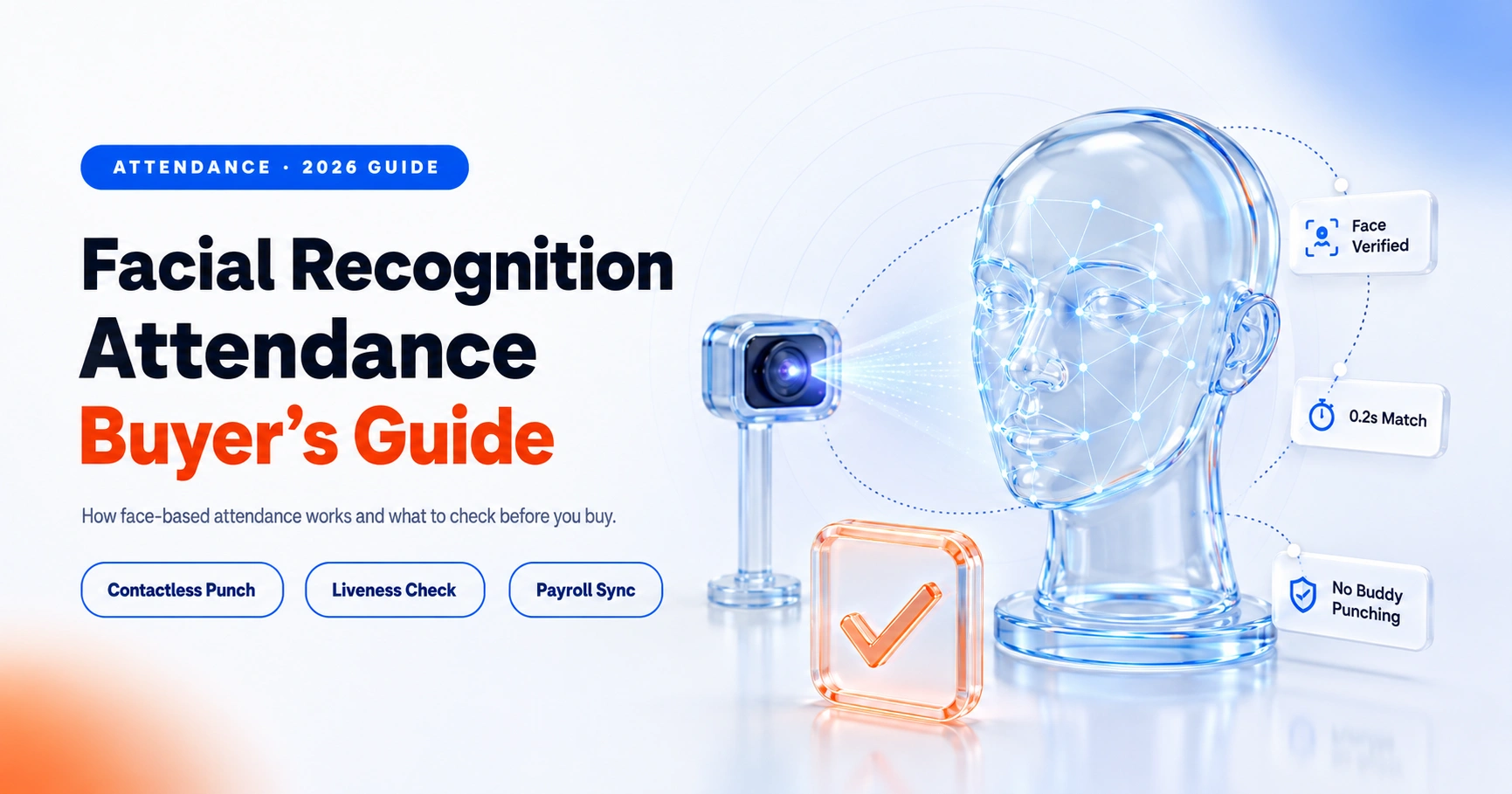
A facial recognition attendance system marks attendance by scanning an employee's face instead of a fingerprint or card. It is contactless, fast, and hard to fake, which is why it has replaced fingerprint machines in many Indian offices and factories. Choosing one well means looking past the marketing at accuracy, liveness detection, payroll integration, and data-privacy compliance.
Key Takeaways
- Facial recognition marks attendance from an employee's face, with no touch and no card.
- It stops buddy punching, the practice of one employee clocking in for another.
- Liveness detection is essential, so a photo or video cannot fool the system.
- Facial data is sensitive personal data, so consent and DPDP Act compliance matter.
- The real value comes when attendance flows straight into payroll with no manual entry.
What Is a Facial Recognition Attendance System?
A facial recognition attendance system uses a camera and software to identify an employee by their face and record their clock-in and clock-out. The employee simply looks at a tablet, kiosk, or phone camera, and the system matches the face against enrolled records to mark attendance.
It is one form of biometric attendance, alongside fingerprint and iris scanning, but it is contactless, which became a major advantage after workplaces moved away from shared touch surfaces.
How Does It Work?
The process is quick and runs in a few steps.
- Enrolment. The employee's face is captured once and stored as a mathematical template, not a photo.
- Capture. At clock-in, the camera captures the live face.
- Liveness check. The system confirms it is a real person, not a photo or video.
- Matching. The live capture is matched to the enrolled template.
- Marking. On a match, attendance is recorded with a timestamp and, on mobile, a location.
The whole process takes a second or two, which keeps queues short even at shift changes.
Benefits of Facial Recognition Attendance
- No buddy punching. A face cannot be shared like a card or a password, so proxy attendance stops.
- Contactless and hygienic. Nothing to touch, unlike fingerprint scanners.
- Fast. Employees clock in without cards, PINs, or waiting.
- Accurate records. Precise in and out times feed correct payroll and overtime.
- Remote and field use. Mobile face attendance with geo-tagging suits site, sales, and hybrid teams.
Facial Recognition vs Fingerprint Attendance
Both are biometric, but they differ in ways that matter for Indian workplaces.
| Factor | Facial Recognition | Fingerprint |
|---|---|---|
| Contact | Contactless | Requires touch |
| Speed | Very fast | Fast |
| Hygiene | High | Shared surface |
| Field use | Easy via mobile | Needs a device |
| Failure cases | Poor lighting, masks | Worn or wet fingers |
Many employers now run facial recognition as the primary method and keep a fallback such as a PIN or card for the rare cases where a face read fails.
What to Look For When Buying
Not every system is equal. These criteria separate a reliable one from a frustrating one.
- Accuracy and liveness detection. High match accuracy and anti-spoofing that rejects photos and videos.
- Mobile and kiosk options. A tablet kiosk for offices and a mobile app with geo-fencing for field staff.
- Payroll integration. Attendance should flow into payroll automatically, with no re-keying.
- Offline mode. The device should keep marking attendance and sync later if the internet drops.
- Data privacy compliance. Consent capture, encrypted templates, and alignment with the DPDP Act.
- Reports and rules. Shift handling, overtime, and late-mark rules built in.
The single biggest payoff is integration. A facial system that plugs into your attendance management system and then into payroll removes the manual step that causes most month-end errors, and it fits neatly into a wider set of HR automation tools.
Data Privacy and the DPDP Act
Facial data is biometric information, which counts as sensitive personal data. Under the Digital Personal Data Protection Act, employers should collect it with clear employee consent, use it only for attendance, store it securely as an encrypted template rather than a raw image, and delete it when an employee leaves. Choosing a vendor that stores templates, not photos, and that supports consent and deletion is not just good practice, it is the compliant way to run face attendance in India.
Frequently Asked Questions
What is a facial recognition attendance system?
It is a system that marks employee attendance by scanning the face instead of a fingerprint or card. The employee looks at a camera on a kiosk or phone, and the system matches the face to enrolled records to record clock-in and clock-out.
Can a facial recognition attendance system be fooled by a photo?
A good system cannot, because it uses liveness detection to confirm a real person is present. Always choose a system with strong anti-spoofing, since basic ones without liveness checks can be tricked.
Is facial recognition attendance legal in India?
Yes, when done with employee consent and in line with the DPDP Act. Employers should capture consent, use the data only for attendance, store encrypted templates rather than raw photos, and delete data on exit.
Is facial recognition better than fingerprint attendance?
It is contactless, faster in queues, and easy to use on mobile for field staff, which fingerprint cannot match. Fingerprint still works well as a low-cost fallback where lighting is poor.
Does facial recognition attendance work on mobile?
Yes. Most modern systems offer a mobile app with face capture and geo-tagging, which suits remote, hybrid, and field employees who do not visit a fixed office.
Face Attendance That Flows Into Payroll
Mark attendance by face on kiosk or mobile with liveness detection and geo-tagging, then send it straight to payroll, all in one compliant platform.