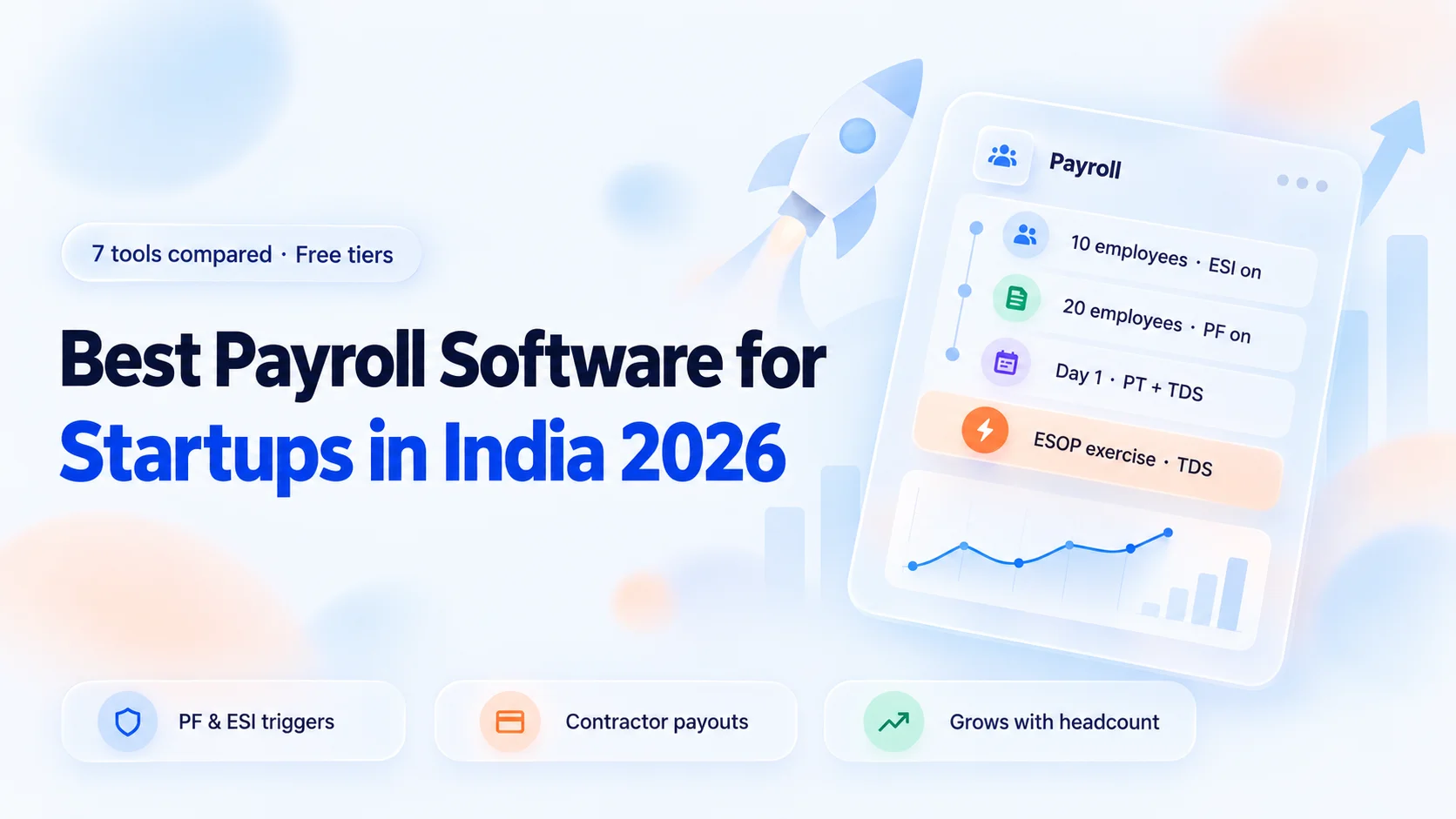
Startup payroll is small until the day it is not. The first ten hires fit on a spreadsheet. Then ESI kicks in at ten employees, PF at twenty, an investor asks for the compliance file, a remote hire in another state changes the professional tax, and the first ESOP exercise lands as taxable salary. This guide ranks the best payroll software for startups in India, seven platforms graded on what a startup actually needs between the first hire and Series B, with real pricing and the free tiers that matter when runway is the budget.
Short Answer
factoHR India and RazorpayX Payroll are the strongest picks for Indian startups because they cover statutory payroll, filings and payouts with a free or low-cost entry and room to grow. Zoho People suits teams already on Zoho, greytHR suits founders who want statutory accuracy first, Keka suits startups past 100 people that want performance and payroll together, and sumHR and Kredily suit lean teams that need HR and payroll on a tiny budget.
Key Takeaways
- Startup payroll compliance is triggered by headcount: ESI and the Gratuity Act at ten employees in most states, EPF at twenty, with Shops and Establishments, professional tax and TDS from day one.
- factoHR India and RazorpayX Payroll lead for free-to-start statutory payroll; Zoho People for Zoho users; greytHR for statutory accuracy; Keka for scaling teams; sumHR and Kredily for lean budgets.
- The EPF wage ceiling is now Rs 25,000, and voluntary PF coverage before twenty employees is a hiring signal many startups choose.
- ESOP exercise is a taxable perquisite; DPIIT-recognised startups can defer the TDS, but payroll still has to record it.
- Contractors paid under section 194J or 194C are not employees, and mixing them into the salary register breaks both the TDS return and the PF computation.
- Budget free to Rs 150 per employee per month; the real cost is a missed registration surfacing in investor due diligence.
- Set the salary structure once, with wages at least 50 percent of total pay, and let the software grow with the headcount triggers.
Why Startups Build Compliance Debt in the First 20 Hires
Not because founders ignore the law. Because the triggers are headcount-based and nobody tells you which one fires first.
- Day one: Shops and Establishments registration, professional tax registration in PT states, and TDS on salary under section 192 from the first payout, with quarterly Form 138 and Form 16 by 15 June.
- Ten employees: ESI applies in most states for staff earning up to Rs 21,000, and the Payment of Gratuity Act applies to the establishment.
- Twenty employees: EPF becomes mandatory, 12 percent from the employee and 12 percent from the employer on wages up to the Rs 25,000 ceiling. Many startups register voluntarily earlier because candidates expect PF.
- Offer letters that promise PF: a CTC that shows PF at eight employees creates a contractual duty before the statutory one.
- Remote hires: an engineer in another state attracts that state's professional tax slab, not the registered office's.
- Contractors and advisors: payments under section 194J or 194C carry their own TDS and are not payroll; the software has to keep the two populations apart.
- ESOPs: at exercise the difference between fair market value and exercise price is a perquisite taxed as salary. DPIIT-recognised eligible startups can defer the TDS under section 80-IAC rules, but the event still has to be recorded.
- Investor due diligence: the first institutional round asks for PF and ESI challans, PT returns and Form 138 acknowledgements. A gap here delays the term sheet.
The Labour Codes in force since November 2025 require wages to be at least 50 percent of total pay, which decides the PF and gratuity base from the first structure you design.
How We Graded These Platforms
- Free or low-cost entry: a tier that covers the first 10 to 25 employees without a contract.
- Statutory engine: PF at the Rs 25,000 ceiling, ESI, professional tax by state, TDS, Form 138 and Form 16, with filings handled or exported cleanly.
- Headcount-trigger readiness: switching on ESI and PF when the thresholds hit, without re-implementation.
- Contractor and ESOP handling: contractor payouts with TDS, perquisite recording for ESOP exercise.
- Payouts and finance: bank transfer files or built-in payouts, accounting integration.
- Room to grow: attendance, leave and performance modules when the team crosses 50 and 100.
Quick Comparison: Payroll Software for Startups
| Tool | Best for | Standout strength | Watch-out | Starting price |
|---|---|---|---|---|
| factoHR India | Startups that want payroll plus HR that scales | Free up to 20, full statutory and attendance | Advanced analytics are add-ons | Free up to 20; from Rs 4,999/mo |
| RazorpayX Payroll | Founders who want payouts and filings automated | Salary, TDS, PF, ESI filed and paid from one place | Thin HR features beyond payroll | Free core plan |
| Zoho People | Teams on Zoho Books and Zoho CRM | Low cost, native Zoho integration | Payroll is a separate add-on | Free up to 10; Rs 48 to 230 per emp/mo |
| greytHR | Founders who want statutory accuracy first | State-wise PT, PF and TDS depth | Lighter on engagement features | Free up to 25; paid from Rs 1,495/mo |
| Keka | Startups past 100 people | Payroll, performance and OKRs together | Priced per 100 employees | Around Rs 6,999/mo (up to 100) |
| sumHR | Lean teams wanting HR plus payroll | Quick setup, low per-employee price | Smaller ecosystem | Low per-employee pricing |
| Kredily | Bootstrapped teams | Free core payroll and attendance | Limited depth as you scale | Free core plan |
Prices are indicative for 2026 and depend on headcount, modules and contract term. Confirm a live quote. One thing to settle before the tool: the salary structure you give the first ten hires becomes the default for the next hundred, and its basic-to-allowance split fixes PF, gratuity and tax for all of them.
The 7 Best Payroll Software for Startups in India (2026)
1. factoHR India
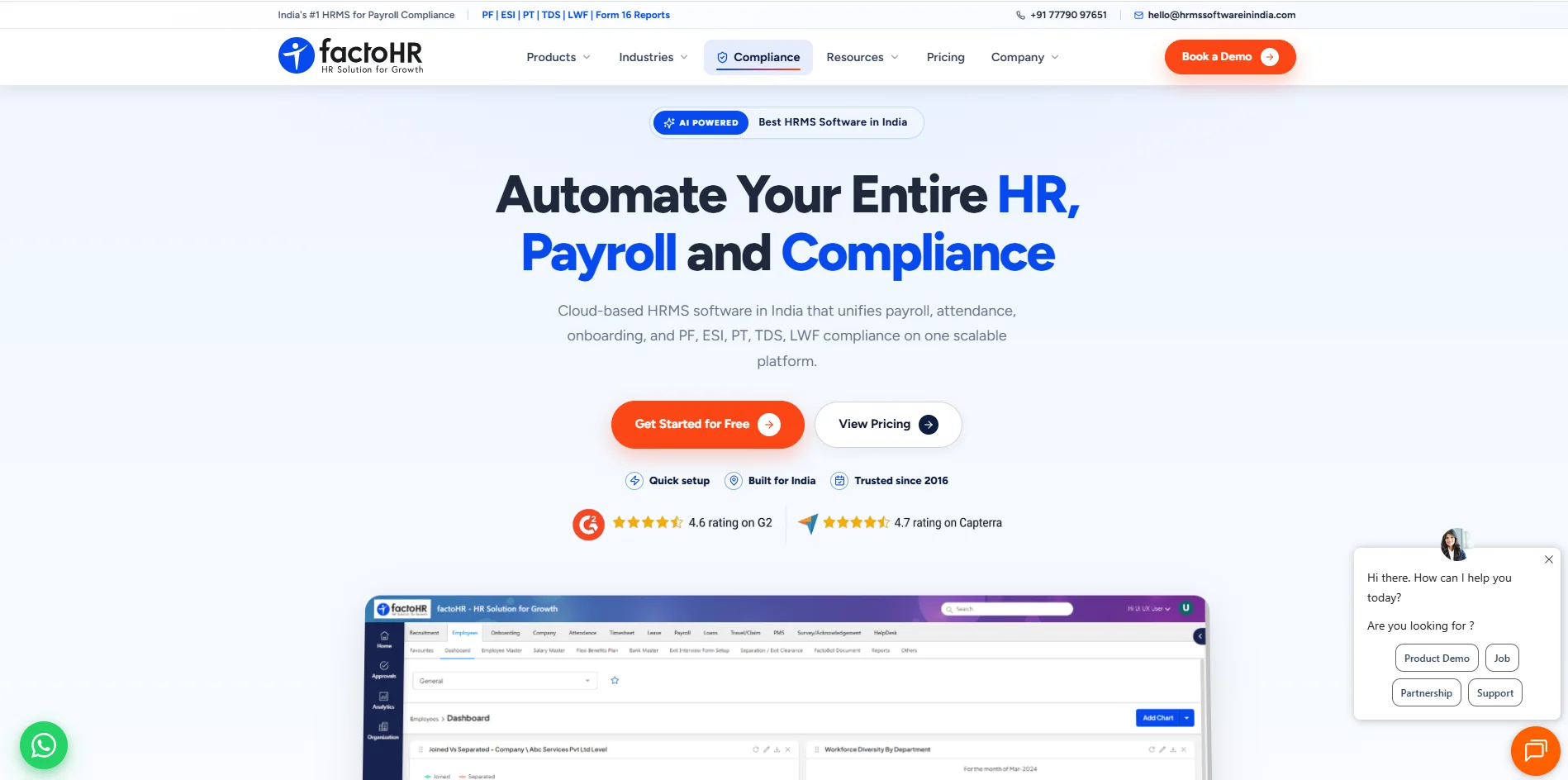
factoHR India is free for up to 20 employees with the full statutory engine switched on, which means a startup can run compliant payroll from the first hire and simply keep going when ESI and PF triggers fire. Professional tax is applied per employee by work state for remote hires, contractors are paid with their own TDS outside the salary register, and ESOP perquisites are recorded in the month of exercise. Attendance, leave and expenses are on the same platform, so the tool does not have to be replaced at 50 or 100 people. It is the strongest fit for a startup that wants payroll and HR to grow with the headcount, which is why it tops this list. The payroll engine that files PF, ESI, professional tax and TDS for its 500-person customers is the same one a 20-person startup gets here; nothing is switched off in the free tier.
Key features:
- Free tier up to 20 employees with full statutory payroll
- PF at the Rs 25,000 ceiling, ESI, PT by work state, TDS, Form 138 and Form 16
- Headcount triggers for ESI and PF without re-implementation
- Contractor payouts under 194J and 194C kept separate from salary
- ESOP perquisite recording and regime-wise TDS projection
- Attendance, leave, expenses and onboarding on the same platform
- Bank transfer files and Tally or accounting export
- Employee mobile app with payslips and declarations
Best suited for: startups from the first hire to several hundred employees that want one platform through the growth stages.
Watch-out: some advanced analytics and recruitment modules are priced as add-ons.
Pricing: free for up to 20 employees; transparent plans from around Rs 4,999 a month for up to 50 employees.
2. RazorpayX Payroll
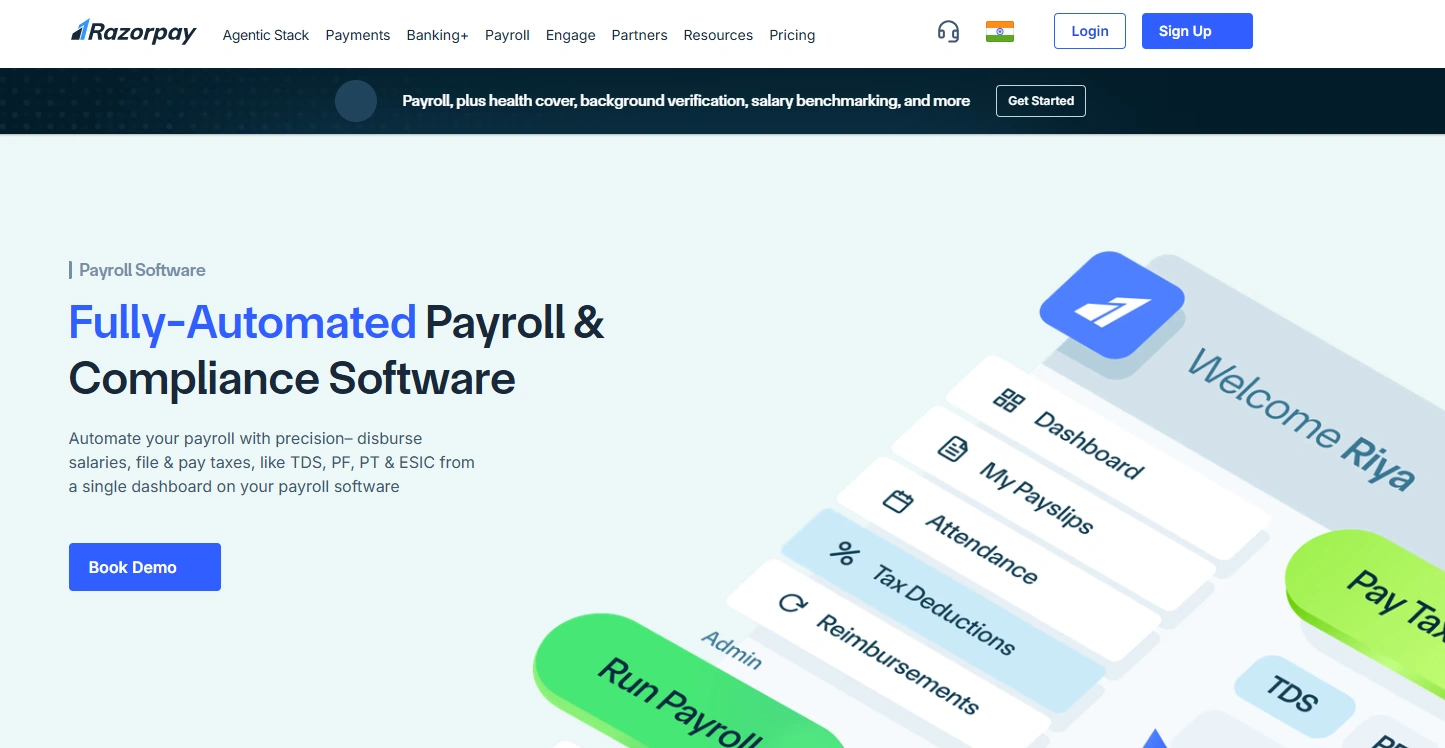
RazorpayX Payroll is built around the founder's wish list: compute salaries, deduct TDS, PF and ESI, deposit them, file the returns and pay the employees, all from one place. The free core plan covers a small team, and contractor payouts with TDS are handled too. It is a payroll and compliance engine rather than an HR suite, so leave, attendance and performance need other tools as the team grows.
Key features:
- Salary computation with one-click payouts to employee accounts
- TDS, PF, ESI and PT deposits and returns handled
- Form 16 and payslips for employees
- Contractor payouts with TDS
- Free core plan
Best suited for: early-stage startups under 100 employees that want filings and payouts off the founder's plate.
Watch-out: thin HR features beyond payroll.
Pricing: free core plan; paid plans priced per employee.
3. Zoho People
Zoho People with the Zoho Payroll add-on is the natural choice for a startup already running finance on Zoho Books and sales on Zoho CRM. Payroll covers PF, PT, TDS and Form 138, salary journals post straight to Books, and the HR side covers leave, attendance and onboarding. The free tier for tiny teams makes it easy to start.
Key features:
- Free tier for up to 10 employees
- Zoho Payroll add-on with PF, PT, TDS and Form 138
- Native sync with Zoho Books
- Leave, attendance and onboarding workflows
- Employee self-service and mobile app
Best suited for: startups on the Zoho ecosystem under 100 employees.
Watch-out: payroll is a separate add-on.
Pricing: free up to 10 employees; around Rs 48 to Rs 230 per employee per month after, payroll add-on extra.
4. greytHR
greytHR is the statutory-first choice: two decades of Indian payroll show in how it handles state-wise professional tax, PF, ESI and TDS, and the free plan covers up to 25 employees. Investment declarations, Form 138 and Form 16 are routine. It suits a founder or finance lead who wants compliance done right before thinking about HR features.
Key features:
- Free plan up to 25 employees
- State-wise PT, PF, ESI and TDS with rate updates
- Form 138, Form 16 and challan-ready reports
- Leave, attendance and full-and-final
- Employee portal and mobile app
Best suited for: startups that want statutory accuracy first.
Watch-out: lighter on performance and engagement.
Pricing: free for up to 25 employees; paid plans from about Rs 1,495 a month.
5. Keka
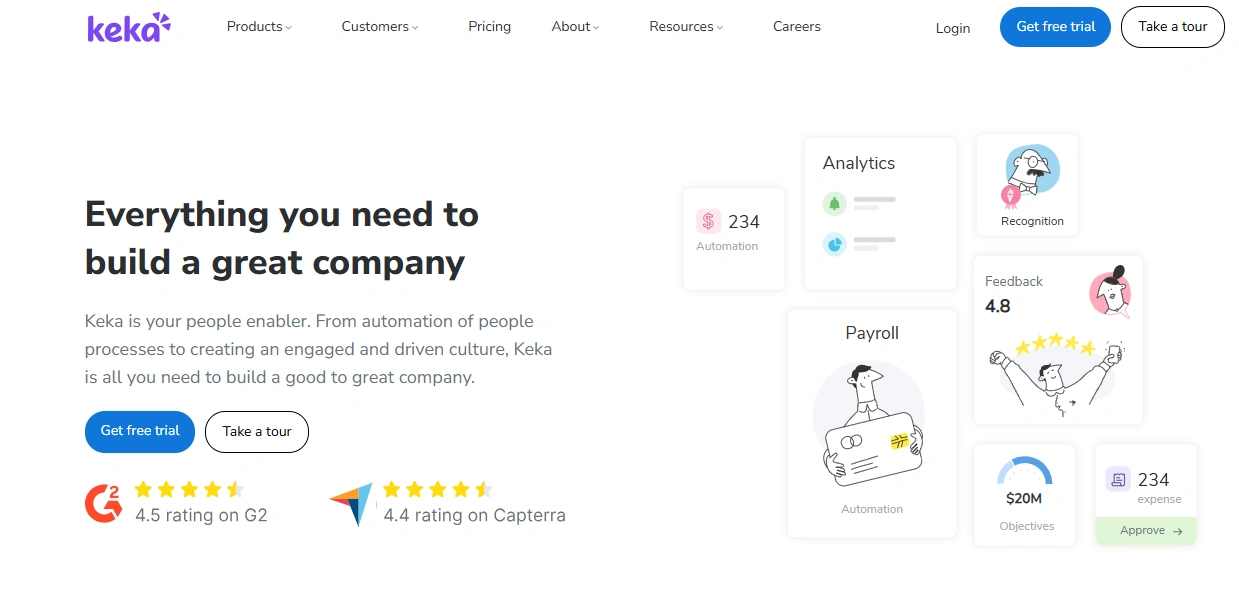
Keka makes sense once a startup crosses 100 people and wants payroll, performance reviews, OKRs and engagement on one platform with an app employees actually open. The payroll review screen catches variances before the bank file, and flexible benefits and tax regimes are handled per employee. Pricing in blocks of 100 means it is rarely the first tool, but often the second.
Key features:
- Payroll review with variance highlights
- Performance, OKRs and engagement
- Flexible benefits and regime selection
- PF, ESI, PT, TDS and Form 138
- Hybrid attendance and leave
Best suited for: startups with 100 to 1,000 employees.
Watch-out: priced per 100 employees.
Pricing: plans start around Rs 6,999 a month for up to 100 employees.
6. sumHR
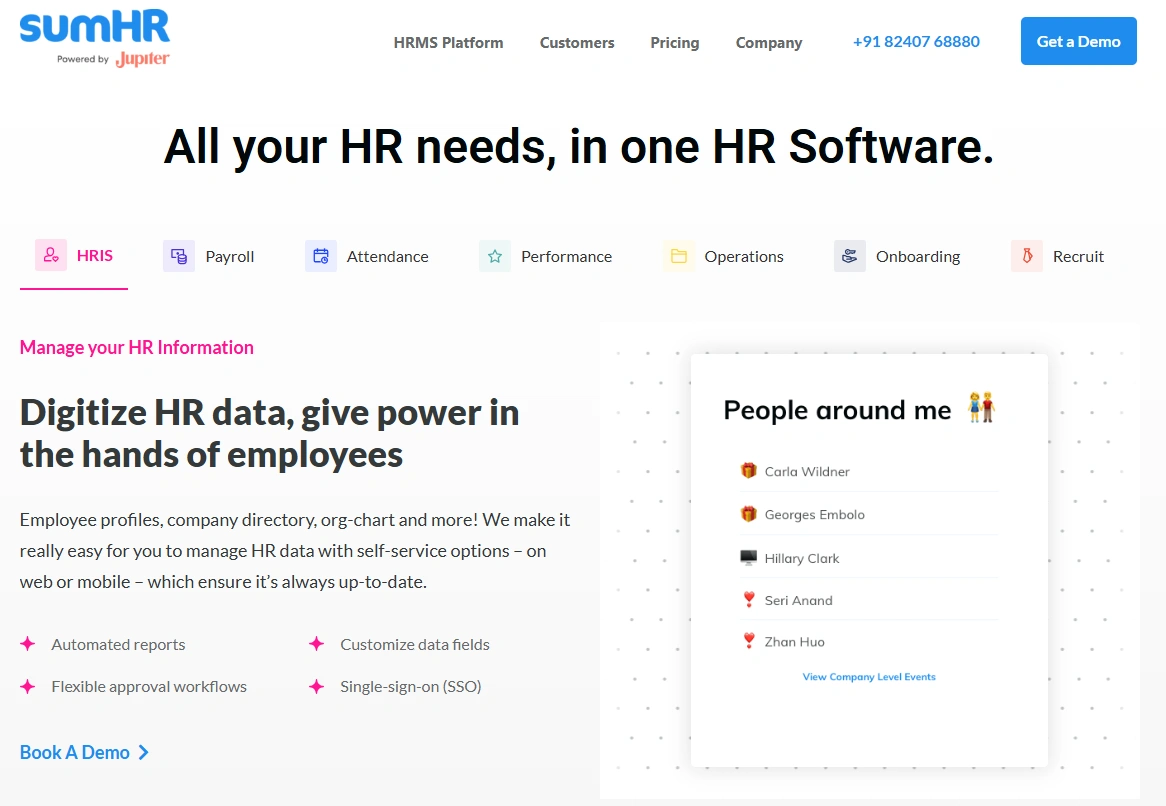
sumHR gives a lean startup HR and payroll together at a low per-employee price with a quick setup. Statutory payroll, leave, attendance and onboarding are covered, and the employee app is simple. It suits a 20 to 150 person team that wants more than a payroll engine without enterprise pricing.
Key features:
- Payroll with PF, ESI, PT, TDS and Form 138
- Leave, attendance and onboarding
- Employee app with payslips and declarations
- Low per-employee pricing
Best suited for: lean teams of 20 to 150 employees.
Watch-out: smaller ecosystem.
Pricing: low per-employee pricing; confirm current plans with the vendor.
7. Kredily
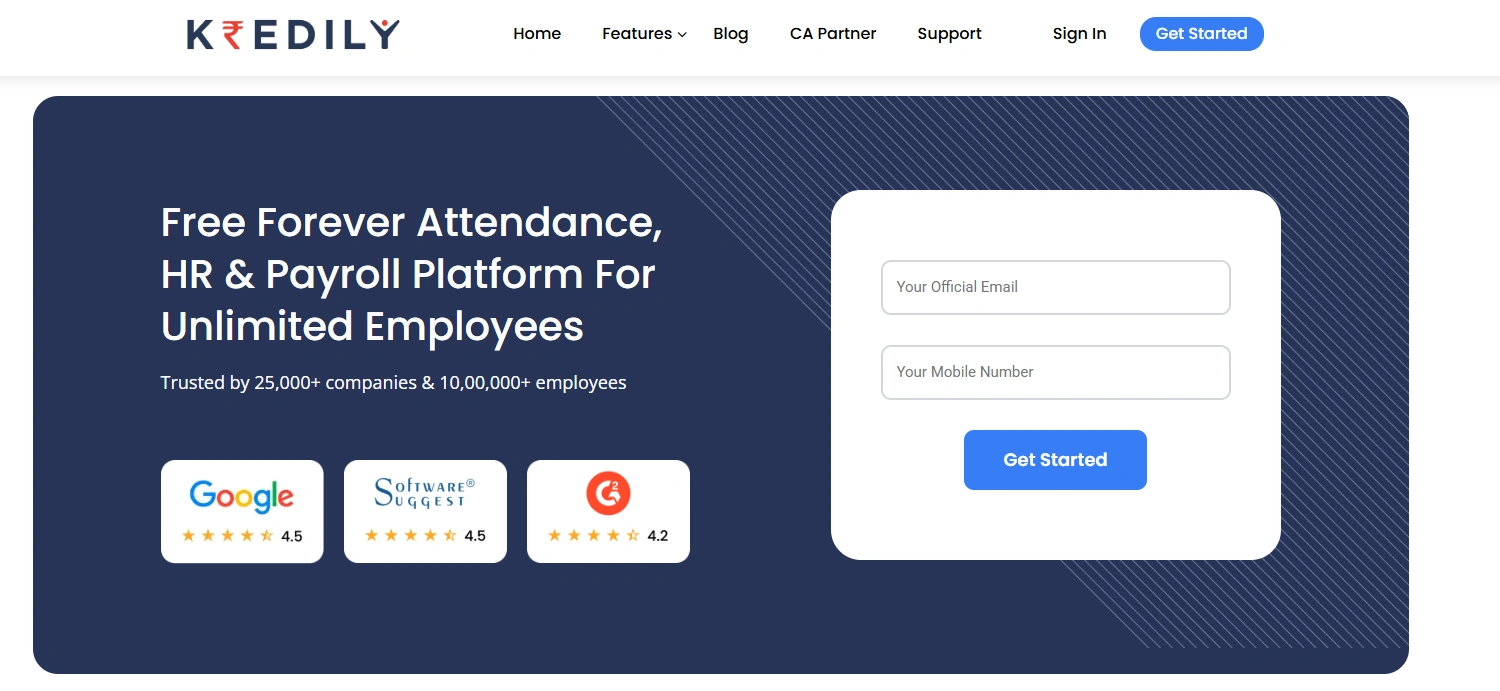
Kredily is free at the core for payroll and attendance, which is why bootstrapped teams start here. Statutory basics and payslips are covered, and paid add-ons unlock more. Expect to outgrow it when ESOPs, multi-state hires and performance reviews arrive.
Key features:
- Free core payroll with PF, ESI, PT and TDS
- Mobile attendance and leave
- Payslips and bank files
- Paid add-ons for advanced features
Best suited for: bootstrapped teams under 50 employees.
Watch-out: limited depth as you scale.
Pricing: free core plan; paid add-ons for advanced features.
What Startup Payroll Really Costs in 2026
Most startup salaries sit above the Rs 21,000 ESI ceiling, so ESI applies mainly to support staff. PF is the line that matters, and it is mandatory from twenty employees, or earlier by choice. A start-up that restricts PF to the Rs 25,000 wage ceiling contributes on that figure, not on full basic, and because the ceiling only moved up from Rs 15,000 in September 2026, older CTC sheets understate the cost. Here is a worked example for an early employee earning Rs 50,000 gross a month with a basic of Rs 25,000, showing the employer statutory cost once PF applies:
| Item (per employee) | Rate | Monthly |
|---|---|---|
| Employer EPF plus EPS | 12% of basic (at the ceiling) | Rs 3,000 |
| Employer ESI | Not applicable above Rs 21,000 | Rs 0 |
| EDLI plus admin | ~1% of PF wages | Rs 250 |
| Professional Tax | State slab | Rs 200 |
| Employer statutory outgo | Total of the above | Rs 3,450 |
| For 15 such employees | Total x 15 | Rs 51,750 a month |
Gratuity starts accruing at roughly 4.81 percent of basic once the Gratuity Act applies, and ESOP exercises add a TDS event in the month they happen. Founders usually discover in month one that the CTC on the offer letter and the net on the payslip disagree; working the CTC back to take-home before the offer goes out is the cheap fix.
How to Choose by Stage
- Pre-seed to seed, under 20 employees: prioritise a free tier and clean filings. factoHR India, RazorpayX Payroll, Zoho People, greytHR or Kredily fit well.
- Seed to Series A, 20 to 100 employees: PF and ESI are live, remote hires are in other states, and the first ESOPs are vesting. factoHR India, greytHR, sumHR or Zoho People are the sweet spot.
- Series A to B, 100 to 500 employees: you need performance, attendance and payroll together, with audit-ready records for diligence. factoHR India or Keka are built for this.
Whatever the stage, the right payroll software for startups is decided by statutory accuracy and the ability to grow without re-implementation, not app polish. Payroll is usually the first system a startup buys and the last it replaces, so it is worth knowing what a startup needs from HR software beyond payroll, and which HR platforms suit a startup once hiring, reviews and policies need a home too.
Implementation: What to Expect
- Registrations first: Shops and Establishments, professional tax, TAN, and PF and ESI codes when the triggers hit, or earlier by choice. The software cannot file what is not registered.
- Salary template: set basic, HRA and allowances once, with wages at least 50 percent of total pay, and reuse it for every offer letter.
- Populations: separate employees, contractors and advisors so TDS sections and PF coverage are right from the first run.
- Go-live: a startup under 50 people is usually live within a week; keep the first two months' challans and acknowledgements in a diligence folder from day one.
Frequently Asked Questions
Which Payroll Software Is Best for Startups in India?
For most Indian startups, factoHR India and RazorpayX Payroll are the strongest choices because they cover statutory payroll, filings and payouts with a free or low-cost entry. Zoho People suits Zoho users, greytHR suits statutory-first founders, Keka suits teams past 100 people, and sumHR and Kredily suit lean budgets.
When Does PF Become Mandatory for a Startup?
EPF applies once the establishment employs 20 or more persons, with contributions of 12 percent each from employee and employer on wages up to Rs 25,000. A startup can register voluntarily earlier, and many do because candidates expect PF and because an offer letter that shows PF in the CTC creates a contractual duty anyway.
When Does ESI Apply to a Startup?
ESI applies in most states once ten or more persons are employed, for staff earning gross wages up to Rs 21,000 a month, at 3.25 percent from the employer and 0.75 percent from the employee. For a typical startup that covers office support staff and junior roles rather than engineers.
How Are ESOPs Handled in Payroll?
At exercise, the perquisite value is taxed as salary with TDS. DPIIT-recognised eligible startups can defer that TDS to the earliest of 48 months after the end of the relevant assessment year, the sale of the shares, or the employee leaving. The payroll tool still has to record the exercise and the valuation so the deferred tax is tracked.
Should Contractors Be Paid Through Payroll?
No. Contractors and advisors are paid under section 194J or 194C with their own TDS and are not on the salary register. The better tools handle contractor payouts in a separate population so the TDS returns and the PF computation stay clean.
How Much Does Startup Payroll Software Cost?
Free for the first 10 to 25 employees on most of these tools, then roughly Rs 48 to Rs 150 per employee per month. The expensive outcome is not the subscription; it is a missing registration found during investor due diligence.
Does Professional Tax Apply to Remote Hires?
Yes, in the state where the employee works. A remote engineer in Maharashtra attracts Maharashtra slabs even if the startup is registered in Karnataka, so payroll has to hold the work state per employee. Maharashtra deducts Rs 200 a month with Rs 300 in February, Karnataka Rs 200 only above Rs 25,000, and several states charge nothing, so professional tax slabs change with every state a remote hire sits in.
How Long Does It Take to Go Live?
Under a week for a team below 50 with registrations in hand. The slow part is the registrations themselves, so start those before you pick the tool.
Final Word
A spreadsheet survives the first five hires and rarely survives the twentieth. factoHR India and RazorpayX Payroll lead for free-to-start statutory payroll, Zoho People for Zoho users, greytHR for statutory accuracy, Keka for scaling teams, and sumHR and Kredily for lean budgets. Register first, fix the salary template once, pick a tool that switches on ESI and PF when the headcount triggers hit, and keep every challan in a diligence folder from month one. If you want the hire-one-to-hire-five-hundred claim tested on your own salary sheet, book a free factoHR India demo and bring the sheet.