Every December, Indian payroll teams send out the same email asking employees to declare their investments and submit proof. For the financial year 2026-27 that email needs rewriting, because the form it has always referred to no longer exists.
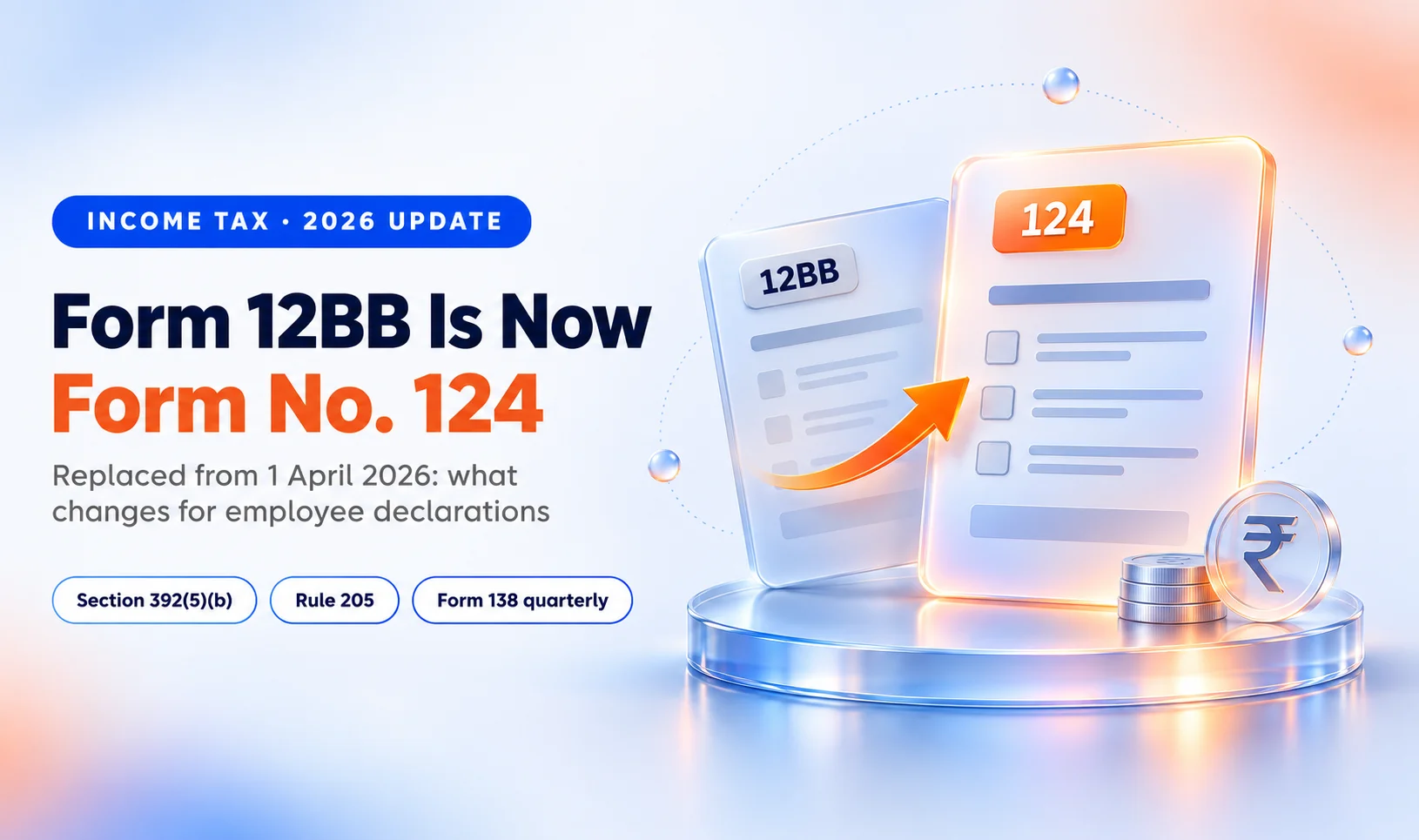
Form 12BB was replaced by Form No. 124 with effect from 1 April 2026. The information an employee has to give has barely changed. The statutory reference underneath it has changed completely, and so has the quarterly return that sits downstream of it.
Key Takeaways
- Form 12BB was replaced by Form No. 124 for employee declarations from 1 April 2026.
- The authority is section 392(5)(b) of the Income-tax Act, 2025, read with Rule 205 of the Income-tax Rules, 2026.
- Salary tax deduction at source moved from section 192 of the 1961 Act to section 392 of the 2025 Act.
- The quarterly salary statement moved from Form 24Q to Form 138. Filing dates are unchanged.
- Rule 26C, which carried the old declaration requirement, is no longer in the rule book.
- What employees declare is unchanged: house rent allowance, leave travel concession, housing loan interest, and Chapter VIII-A and VIII-B deductions.
- Filing the declaration is optional, but an employee who files nothing has tax deducted with no exemptions applied.
- The standard deduction applies whether or not the declaration is filed.
- Form 124 goes to the employer. It is never uploaded to the tax portal.
What changed on 1 April 2026
The Income-tax Act, 2025 replaced the Income-tax Act, 1961, and with it the numbering that Indian payroll has used for decades. Three changes matter for the declaration season.
The employee declaration of claims for tax deduction at source on salary is now made in Form No. 124. It is made under section 392(5)(b) of the Income-tax Act, 2025, read with Rule 205 of the Income-tax Rules, 2026. The old Rule 26C, which carried that requirement under the 1961 Act, has gone.
Salary tax deduction at source itself moved from section 192 to section 392. Any policy document, offer letter annexure or payroll screen that cites section 192 for salary TDS is now citing a repealed provision.
The quarterly salary statement moved from Form 24Q to Form 138. The filing calendar did not move with it. Quarterly returns remain due on 31 July, 31 October, 31 January and 31 May, and Form 16 remains due by 15 June.
What Form 124 actually asks for
This is the part that reassures most payroll teams. The heads of claim are the same as they were under Form 12BB, so the proof-collection process does not need redesigning.
- House rent allowance. Rent receipts or the rent agreement, and the landlord's permanent account number once annual rent crosses Rs 1,00,000.
- Leave travel concession. Evidence of the travel undertaken.
- Interest on a housing loan. The lender's name, address and permanent account number, with the interest certificate.
- Deductions under Chapter VIII-A and Chapter VIII-B. Claimed as before, with the usual supporting proof.
If your declaration template already collects these four categories cleanly, the substantive work is done. What needs changing is the heading on the form and the statutory references printed beneath it.
Two things employers get wrong every year
Filing is optional, but not filing is expensive. An employee is not obliged to submit the declaration. An employee who submits nothing, however, has tax deducted with no exemptions or deductions applied at all. In practice that means a visibly heavier deduction in the closing months of the financial year and a refund claimed much later. It is worth saying that plainly in the circular rather than leaving people to discover it in February.
The standard deduction is not something anyone declares. It applies whether or not a declaration is filed. Employees sometimes ask how to claim it on the form, and the answer is that they do not need to.
Where the form goes, and where it does not
Form 124 is submitted to the employer. It is not uploaded to the income tax portal, and there is no filing acknowledgement for the employee to chase. The employer retains it as the basis for the tax it computes and deducts each month, and it is the employer who has to be able to produce it if the deduction is ever questioned.
That makes retention a real obligation rather than an administrative habit. A declaration pack collected on paper and never scanned is a problem waiting for an assessment.
The December circular problem
The practical risk this season is not legal, it is clerical. Declaration templates, employee circulars, intranet help pages, proof-submission checklists and payroll system screen labels were all written when Form 12BB was current. Most of them still say so.
The quarterly statement for October to December 2026 falls due on 31 January 2027, in the same weeks that proofs are being collected, so both the old form number and the old return number tend to surface at once. Our payroll compliance calendar for FY 2026-27 sets out the quarterly and annual dates on the current numbering if you want to check the sequence against your own schedule.
Before this year's circular goes out, search your declaration template, the circular text, the intranet page and your payroll system's screen labels for four strings: 12BB, 24Q, 192 and 26C. Replace each with the current reference. It takes an afternoon and removes the most visible source of doubt in the whole pack.
The reason it matters is credibility rather than penalty. An employee handed a form that cites a repealed rule has little reason to trust the rest of the document, and the questions that follow land on the payroll team.
What this means for the monthly deduction
Nothing in this change alters how the monthly tax is computed. The employer still estimates the year's salary income, applies the exemptions and deductions the employee has declared, works out the annual liability and spreads it across the remaining months.
What changes is the confidence with which that estimate is made. A declaration received in December with proof following in January gives a far better estimate than a blank form and a correction in March. If you want to show employees what a declared exemption actually does to their monthly figure, a take home salary calculator is usually more persuasive than a paragraph of explanation.
A short checklist for this season
- Reissue the declaration template as Form No. 124, with the section 392(5)(b) and Rule 205 reference.
- Remove section 192 and Rule 26C from every employee-facing document.
- Update payroll screen labels and report names from Form 24Q to Form 138.
- State in the circular that filing is optional and what happens if nothing is filed.
- Set the proof-submission cut-off far enough before the March payroll to allow corrections.
- Confirm that collected declarations are being retained in a form you could produce on request.
If you are reviewing the wider statutory position at the same time, the India payroll compliance reference carries the current form and section numbering across provident fund, employee state insurance, professional tax and salary tax deduction in one place.
Frequently asked questions
Is Form 12BB still valid for FY 2026-27?
No. Form 12BB was replaced by Form No. 124 from 1 April 2026. A declaration collected on the old form still contains the information you need, because the heads of claim are unchanged, but the form itself cites a rule that no longer exists and should be reissued.
Does an employee have to submit Form 124?
No, it is optional. An employee who submits nothing simply has tax deducted without any exemptions or deductions applied, and claims the difference as a refund later.
Where is Form 124 filed?
With the employer. It is not uploaded to the income tax portal. The employer keeps it as the basis for the monthly deduction.
Has the landlord PAN requirement changed?
No. The landlord's permanent account number is still required once annual rent crosses Rs 1,00,000.
What replaced Form 24Q?
Form 138. The quarterly salary statement is now filed in Form 138, with the filing dates unchanged at 31 July, 31 October, 31 January and 31 May.
Does the standard deduction need to be declared?
No. It applies whether or not a declaration is filed.
Getting the season right
The substance of the declaration season has not changed. The references have, and they have changed in a way that is easy to miss precisely because the underlying process still works. An afternoon spent replacing four strings across your templates is the whole of the work, and it is better done before the circular goes out than after an employee asks why the form cites a repealed rule.
factoHR India keeps declaration, deduction and quarterly statement handling aligned to the current numbering, so payroll teams are not maintaining the references by hand each year.