Every growing Indian company reaches the same fork. Payroll has outgrown the spreadsheet, and the choice is between buying software and handing the whole thing to a service provider. Most advice answers it with a feature list.
The honest answer turns on three numbers and one legal fact. The numbers are your headcount, the number of states you pay in, and the rate a vendor actually quotes once filing is included. The legal fact is that statutory liability for provident fund, employee state insurance and tax deducted at source stays with the employer in both models. Outsourcing moves the work. It does not move the prosecution.
This guide prices both models at 30, 100 and 250 employees using published 2026 rates, shows where the crossover really sits, and sets out exactly which sections of the law still name you after you sign a vendor contract.
Key Takeaways
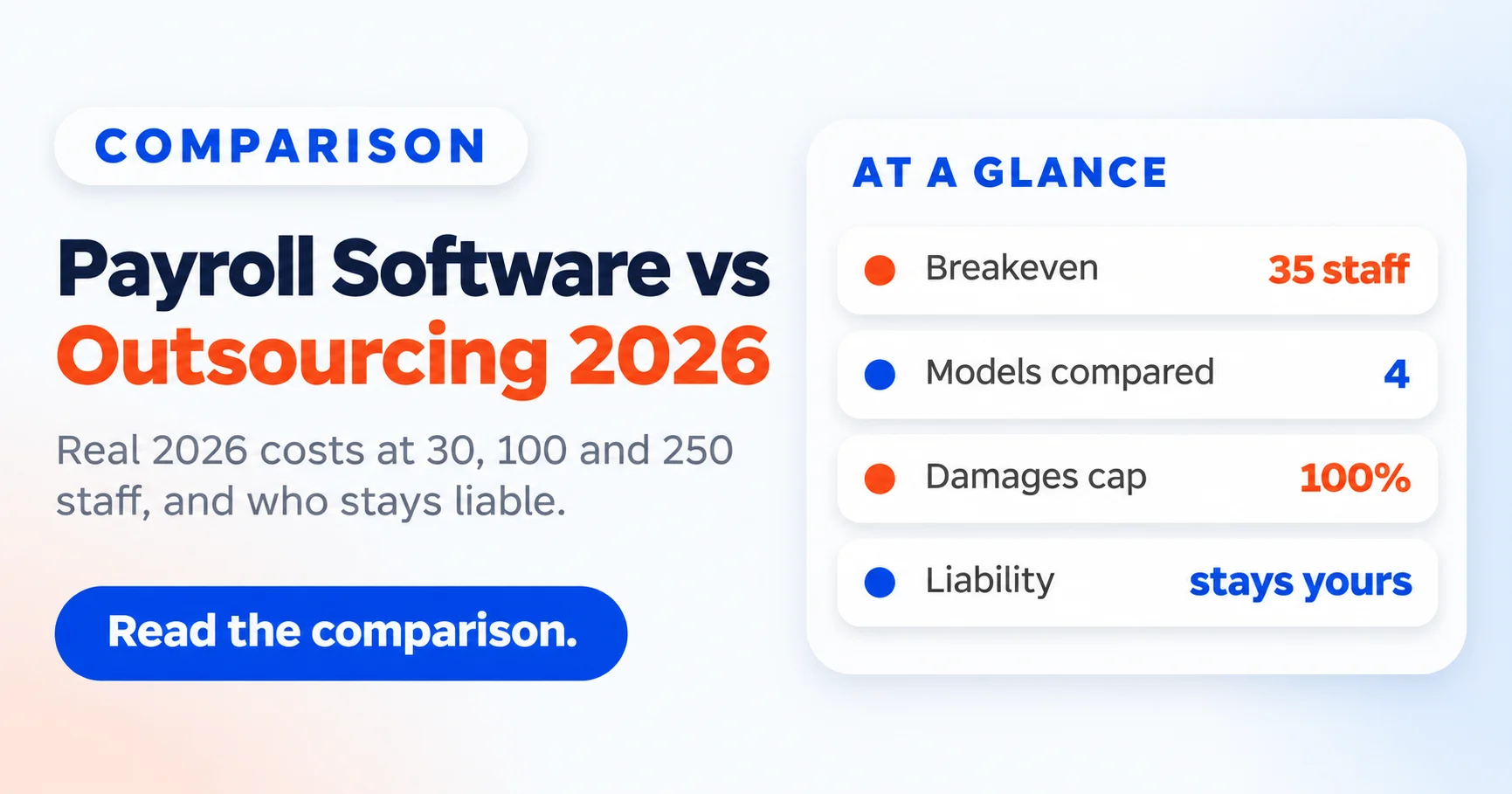
- Below roughly 35 employees a low-tier outsourcing contract is usually cheaper. Above it, software wins and the gap widens with every hire.
- Software cost per head falls as you grow, from about Rs 167 per employee per month at 30 people to Rs 99 at 250. A vendor rate stays flat.
- Indian outsourcing rates run Rs 150 to 400 per employee per month for processing alone, and Rs 300 to 800 once statutory filing is included.
- Statutory liability does not transfer. Sections 127, 128 and 133 of the Code on Social Security name the employer, and Section 135 names the people in charge of the business.
- Damages for arrears can now reach the full amount outstanding. The old 25 per cent a year ceiling is gone.
- You stay the data fiduciary under the Digital Personal Data Protection Act, 2023 whoever processes the payroll.
- Outsourcing removes the calculation and the filing. Attendance, leave, declarations, exits and employee queries all stay with you.
What payroll software actually is
Payroll software is a system your own team operates. It holds the employee master, applies your salary structures, and calculates gross to net with provident fund, employee state insurance, professional tax and tax deducted at source applied by rule rather than by memory. It produces payslips, the salary register and the files you need for filing. Your team presses the button and reviews the output.
The defining characteristic is not automation. It is custody. The data sits in one system you control, with your own access rules and audit trail, and a correction can be made the moment somebody spots it.
What payroll outsourcing actually is
Outsourcing is a service, and it is sold at very different depths. Treating it as one thing is the most common costing mistake Indian buyers make.
A payroll bureau is the shallow tier. You send attendance and changes in a template every month, and the vendor returns a salary register and payslips. Filing may or may not be included, and that single detail is where most disputes begin.
Fully managed payroll is the deep tier. The vendor owns the cycle end to end: processing, challans, returns, Form 16, registers, and often employee query handling. You approve and you fund. This is the tier that genuinely removes work, and it is priced accordingly.
Between them sits the hybrid, where you keep India payroll software and the data in house and retain a consultant or firm to review output and handle filings. More growing Indian companies land here than on either pure model.
What each model costs in India in 2026
Published Indian outsourcing rates sit in wide bands because providers define their tiers differently. These are the ranges quoted across provider price guides in 2026, set against transparent software pricing.
| Service tier | Typical rate | Usually includes | Usually excludes |
|---|---|---|---|
| Payroll bureau, processing only | Rs 150 to 400 per employee per month | Salary calculation, payslips, salary register | Challans, returns, Form 16, registers |
| Processing plus compliance filing | Rs 300 to 800 per employee per month | The above plus PF, ESI, PT and TDS filing | Employee query handling, exit settlement |
| Fully managed payroll | Rs 800 to 2,500 per employee per month | End to end cycle, filings, queries, audit support | Attendance capture, policy decisions |
| Small team flat retainer | Rs 5,000 to 15,000 per month | Whole payroll for a team under about 20 | Scales badly past the headcount cap |
| Payroll software, factoHR India Core | Rs 4,999 per month to 50, then Rs 99 per extra employee | Onboarding, core HR, attendance and leave, payroll, self service | You review and approve the output |
Goods and services tax at 18 per cent applies to both software subscriptions and outsourcing fees, so it does not move the comparison either way. Most vendors also hold a minimum monthly retainer, which means a quoted per-employee rate is theoretical below roughly 30 people.
Where the breakeven actually sits
Direct annual cost only, excluding tax and internal time. Outsourcing is shown at the bottom, middle and top of the published bands.
| Annual direct cost | 30 employees | 100 employees | 250 employees |
|---|---|---|---|
| Payroll software, Core plan | Rs 59,988 | Rs 1,19,388 | Rs 2,97,588 |
| Outsourcing at Rs 150 per employee | Rs 54,000 | Rs 1,80,000 | Rs 4,50,000 |
| Outsourcing at Rs 300 per employee | Rs 1,08,000 | Rs 3,60,000 | Rs 9,00,000 |
| Outsourcing at Rs 800 per employee | Rs 2,88,000 | Rs 9,60,000 | Rs 24,00,000 |
Three things fall out of that table, and the third is the one that decides most cases.
Software gets cheaper per head. The same plan works out to about Rs 167 per employee per month at 30 people, Rs 100 at 100 people and Rs 99 at 250. A flat base spread over more employees pulls the effective rate down as you grow.
Outsourcing does not. A per-employee service rate stays flat or tapers slightly with volume. At 250 employees even the cheapest bureau tier costs about Rs 1.5 lakh a year more than the software, and a mid-band contract costs three times as much.
The crossover is near 35 employees. Measured against the cheapest processing-only rate, the two models meet at roughly 35. Against a compliance-inclusive contract, software is already cheaper at 30. Below about 20 people a vendor flat retainer can still win.
Add your own internal time before deciding
Neither model is effort free. Take the loaded annual cost of whoever handles payroll, divide by about 250 working days, and multiply by the days each model actually consumes. At a Rs 6,00,000 salary that is roughly Rs 2,400 a day, so two days a month in house is about Rs 57,600 a year, while three quarters of a day a month on vendor coordination is about Rs 21,600.
That difference is real, and it favours outsourcing. It is also a fraction of the per-employee gap once you pass 100 employees, which is why it rarely changes the answer at scale.
Outsourcing moves the work, not the prosecution
This is the part most comparisons skip. The Code on Social Security replaced the Employees' Provident Funds Act 1952 and the Employees' State Insurance Act 1948 from 21 November 2025. Its penalty sections name the employer. Not one of them names a service provider.
| What went wrong | Section | Consequence | Who carries it |
|---|---|---|---|
| Contribution paid after the due date | Section 127 | Simple interest from the due date to actual payment, at the rate notified by the Central Government | Employer |
| Arrears still outstanding | Section 128 | Damages of an amount not exceeding the amount of arrears, so up to 100 per cent. The old 25 per cent a year cap under Section 14B is gone | Employer |
| Dues not recovered after assessment | Section 129 | Attachment and sale of property, appointment of a receiver, and arrest and detention of the employer | Employer, personally |
| Employee share deducted but not deposited | Section 133(a) | Imprisonment of not less than one year and up to three years, with a fine of Rs 1,00,000. Cannot be compounded | Employer and persons in charge |
| Any other failure to pay contributions | Section 133 | Imprisonment of two to six months with a fine of Rs 50,000 | Employer |
| The same contribution default again | Section 134 | Imprisonment of not less than two years and up to three years, with a fine of Rs 3,00,000 | Employer |
| Offence committed by a company | Section 135 | Every person in charge of and responsible to the company for its business is deemed guilty along with the company | Directors, CFO, HR head |
Section 137 gives you one escape, and it runs on your clock
Before prosecution for a contribution default, the authority issues a written direction with a period to comply. Comply inside that period and no prosecution starts. Miss it and the escape closes. The direction is not available at all if a violation of the same nature repeats within three years.
That notice arrives at your registered office, not at the vendor's. If your provider takes three weeks to pull the challan history and explain the gap, you can lose the only statutory exit the Code offers while having done nothing wrong yourself. Speed of vendor response is therefore a compliance control, not a service nicety, and it belongs in the contract with a defined turnaround.
Under Section 135 your defence is diligence, and diligence needs paper
A person in charge escapes liability by showing the offence happened without their knowledge, or that they exercised all due diligence to prevent it. The burden sits on the individual, not on the department.
Hiring a vendor helps only if you can produce the monthly reconciliation, the challans and your own sign off. An unreviewed vendor is the worst position available. You cannot claim ignorance, because payroll was your obligation, and you cannot show diligence, because nobody checked.
A service agreement can make a vendor reimburse you for a penalty, and a good one should. It cannot move the offence. Whichever model you pick, the monthly due dates in the India compliance calendar are yours to hit.
Who is responsible for employee data once payroll leaves the building
Payroll is the most sensitive data set an Indian employer holds: salaries, bank accounts, permanent account numbers, medical claims. The Digital Personal Data Protection Act, 2023 decides who answers for it, and the answer does not change when you outsource.
You are the data fiduciary, because you decide why and how employee data is processed. Section 8(1) makes a data fiduciary responsible for compliance in respect of processing undertaken by it or on its behalf by a data processor, irrespective of any agreement to the contrary. Your vendor is the data processor, and Section 8(2) permits engaging one only under a valid contract. An outsourcing agreement without data protection terms is therefore not merely poor practice. It fails the condition the Act attaches to using a processor at all.
The Act reserves its highest penalty, up to Rs 250 crore, for failing to take reasonable security safeguards, and the schedule is aimed at fiduciaries. Rules notified in November 2025 phase the obligations in through 2027.
In practice, software keeps the data inside one system with your own access rules and audit trail. Outsourcing adds a second full copy of your payroll outside your perimeter, usually travelling by email attachment every month. That is a legitimate choice, and plenty of well run companies make it. It just means the contract has to carry deletion timelines and breach notification windows, and somebody has to check they are honoured. Ask where the data sits, who can open it, and what happens to it when the contract ends.
Six jobs that stay with you after you outsource
A vendor takes the calculation and, at the right tier, the filing. Everything that produces the inputs, and everything an employee asks afterwards, stays in your building.
- Attendance and overtime capture. Somebody still collects punches, fixes missed ones, approves overtime and closes the month. A wrong input produces a correctly calculated wrong salary.
- Leave balances and approvals. Policy, carry forward, encashment and the approval chain are yours. Vendors consume a balance figure, they do not run your leave workflow.
- Investment declarations. Form 124, which replaced Form 12BB from 1 April 2026, is collected by the employer and never uploaded to the portal. Chasing proofs before the cut off stays internal.
- Employee payroll queries. Why is my PF different, where is my payslip, why did tax jump in February. Unless you bought the fully managed tier these land on HR, who then have to ask the vendor.
- Exits and full and final settlement. Notice recovery, leave encashment, gratuity eligibility and clearance sign off need decisions only you can make.
- Reviewing the output. Someone compares the register against last month, checks challan totals and confirms the return was filed. Skip it and you lose the diligence defence under Section 135.
Payroll software vs outsourcing vs hybrid, side by side
| Criterion | Payroll software | Outsourcing | Hybrid |
|---|---|---|---|
| Cost under 35 employees | Higher per head | Usually cheaper | Highest |
| Cost above 100 employees | Clearly cheapest | Rises with every hire | Middle |
| Statutory liability | Yours | Still yours | Still yours |
| Who holds the data | You, in one system | You and the vendor | You, vendor sees extracts |
| Speed of a mid-month correction | Same day, in house | Vendor turnaround time | Same day if you edit |
| Multi state PT and LWF | By rule, once configured | Vendor dependent, ask for the state list | By rule, reviewed externally |
| Employee self service and payslips | Built in, always available | Often email only | Built in |
| Attendance to payroll link | Native | Manual template every month | Native |
| Expertise for an unusual case | Your team plus vendor support | Strong, that is what you bought | Strong |
| Audit trail quality | System logged | Depends on vendor reporting | System logged plus review notes |
| Setup effort | Configuration up front | Lightest to start | Configuration plus onboarding a firm |
| Exit cost | Export and move | Data and knowledge sit outside | Low, you keep the system |
What similar Indian companies pick
Startup, under 25 people, one state. A flat vendor retainer or a free software tier both work. The deciding factor is whether anyone wants to own the monthly cycle. Revisit the moment you cross 35 heads or add a second state, because the arithmetic flips quickly.
Growing business, 50 to 200 people. This is where software wins hardest. Effective cost per employee falls, attendance and leave feed payroll directly, and the data stays in one place. Most companies that outsource at this size do so because nobody re-ran the numbers after the last twenty hires.
Multi state, factories or branches. Professional tax, labour welfare fund and shop and establishment rules vary by state, and the statutory register formats vary with them. Keep the engine in house so rules apply automatically, and buy an external review rather than external processing.
Foreign parent, new Indian entity. With no local HR, buy the expertise while you learn which filings exist. Set a review date at month twelve. Once the cycle is understood and headcount passes 50, moving to software usually cuts the bill by more than half.
How to split a hybrid model so it survives an inspection
Keep inside: the payroll system and every employee master record, attendance and leave approval, salary structure and policy decisions, investment declarations and proof collection, payslip release and self service, and the final approval before salary is funded.
Buy from outside: a monthly review of the salary register against the previous cycle, challan and return filing with proof of filing returned to you, annual Form 16 issue and reconciliation, register formats kept current with each state, representation if an inspection or notice arrives, and a yearly health check on salary structure against the wage definition.
One caution on that last item. The four labour codes have been in force since 21 November 2025, and the single definition of wages requires wages to be at least half of total pay. That reshapes the provident fund, employee state insurance and gratuity base for most allowance-heavy structures. Check your own numbers with the EPF calculator before assuming either model has handled it.
What it costs to switch, in either direction
Both moves are easiest at the start of a financial year, because year to date tax figures carry cleanly.
Moving from outsourcing to software. Get the employee master, salary structures and year to date tax figures from the vendor as data, not as PDF reports. Configure salary heads, leave rules and the states your establishments actually cover. Run one full parallel cycle and reconcile line by line against the vendor register. Confirm the provident fund, employee state insurance and professional tax challan totals match before cutover, and serve contractual notice only after the parallel cycle is clean.
Moving from software to outsourcing. Export everything, including historical payslips and filing proofs, and keep your own copy permanently. Agree the monthly input template and the cut off date in writing. Pin down who files what, with proof of filing returned every month. Put data protection, deletion and breach notification terms in the contract, which Section 8(2) requires for using a processor. Keep an internal reviewer, because the liability does not travel with the data.
If you want to sanity check a single salary before committing either way, run it through the take home salary calculator and compare the result against your current register.
Frequently asked questions
What is the difference between payroll software and payroll outsourcing?
Payroll software is a system your own team runs. It calculates gross to net, applies provident fund, employee state insurance, professional tax and tax deducted at source by rule, and produces payslips and filing files, while the data stays inside your account. Payroll outsourcing is a service: you send inputs to a provider every month and receive processed output back, and depending on the tier the provider may also file your returns. Software is a subscription. Outsourcing is a per-employee service fee.
Is payroll outsourcing cheaper than payroll software in India?
Only at small headcounts. Indian outsourcing rates run about Rs 150 to 400 per employee per month for processing alone, and Rs 300 to 800 once statutory filing is included. Software pricing has a flat base plus a per-employee rate, so the effective cost per head falls as you grow. At 30 employees the two are close. At 100 employees software is typically cheaper by Rs 60,000 or more a year, and at 250 the gap runs to several lakh.
If my outsourcing vendor files PF late, who is liable?
You are. Under the Code on Social Security, 2020, Section 127 charges interest on late contributions and Section 128 allows damages of up to the full amount of the arrears, which replaced the older 25 per cent a year cap. Section 135 deems every person in charge of the company guilty along with the company. A service agreement can make the vendor reimburse you, but it cannot move the offence or the prosecution.
Can an outsourcing provider go to jail instead of the employer?
No. The prosecution sections name the employer and the persons in charge of the company. Section 133(a) carries imprisonment of not less than one year where an employee share was deducted and not deposited, and that limb cannot be compounded. Section 129 allows the arrest and detention of the employer during recovery. A vendor faces contractual consequences from you, not these consequences from the state.
How many employees do I need before payroll software makes sense?
Around 35 on pure cost, measured against the cheapest processing-only outsourcing rate. Against a compliance-inclusive contract it makes sense earlier. Two other triggers matter as much as headcount: paying in more than one state, because professional tax and labour welfare fund rules differ, and wanting attendance and leave to feed payroll without a monthly template.
Does outsourcing payroll remove the work from my HR team?
It removes the calculation and, at the right tier, the filing. It does not remove attendance capture, leave approvals, salary structure decisions, investment declaration collection on Form 124, exit settlements or employee questions. Expect to keep well over half the payroll touchpoints, plus a monthly coordination load that software does not have.
Who is responsible for employee data if payroll is outsourced?
You remain the data fiduciary under the Digital Personal Data Protection Act, 2023. Section 8(1) makes a data fiduciary responsible for compliance for processing carried out by a data processor on its behalf, irrespective of any agreement to the contrary, and Section 8(2) permits engaging a processor only under a valid contract. The Act puts its highest penalty, up to Rs 250 crore, on failing to take reasonable security safeguards.
What is a hybrid payroll model and who should use it?
You keep the software and the data in house, and retain a consultant or firm for monthly review, filing and inspection support. It suits multi state companies and anyone whose HR team can run a cycle but should not be the last word on a statutory question. It costs a subscription plus a retainer, and it preserves the diligence evidence that Section 135 asks for.
Choosing between the two
If you are under 35 employees in a single state with no HR headcount, outsource and set a calendar reminder to re-run the numbers in six months. If you are past 50, paying across states, or already irritated by the monthly input template, software is both cheaper and faster, and it keeps the data where the liability already sits.
Whichever you choose, keep one person on your side who reads the register, checks the challan totals and confirms the return was filed. That person is not overhead. Under Section 135 they are your defence.
This guide is general information and not legal advice. Check the current position for your own establishment before acting.