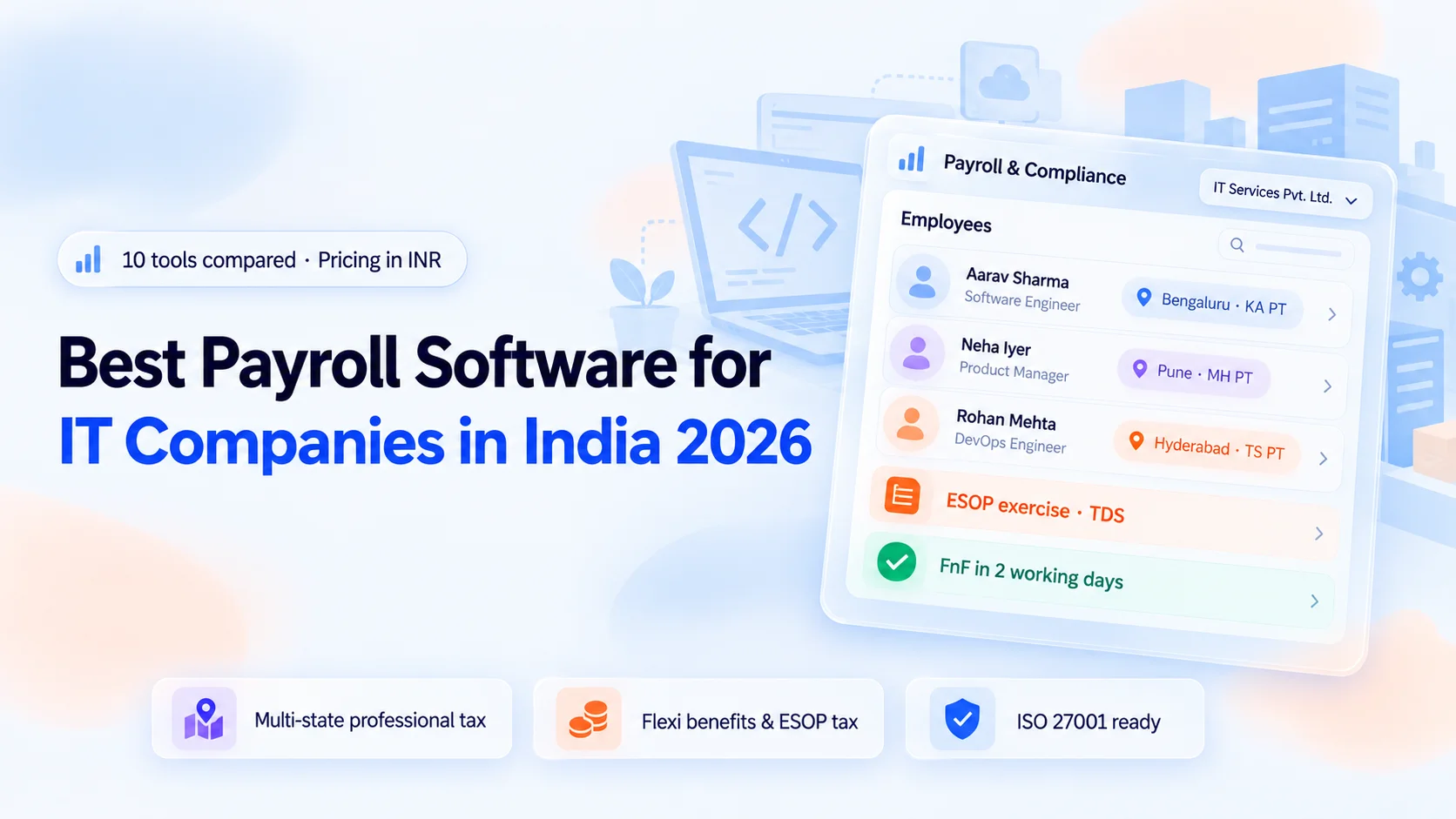
IT and ITES payroll looks simple from the outside: salaried staff, no shifts to speak of, everyone above the ESI ceiling. In practice it is one of the hardest payrolls in India to get right. Engineers work from three states, variable pay and ESOPs land as taxable salary in random months, every employee picks a tax regime, attrition makes final settlement a weekly event, and enterprise clients audit how you store employee data. This guide ranks the best payroll software for IT companies in India, ten platforms graded on what an IT or ITES business actually needs, with real pricing.
Short Answer
factoHR India and Keka are the strongest all-round picks for Indian IT companies because they handle multi-state professional tax, flexible benefit plans, variable pay and fast final settlement in one run. HROne and Darwinbox fit mid to large IT services firms, greytHR fits statutory-first teams, Zoho People and RazorpayX Payroll fit small firms on a budget, PeopleStrong fits enterprise scale, and sumHR and Qandle fit lean teams that want HR and payroll together.
Key Takeaways
- IT payroll needs multi-state professional tax, flexible benefits, variable pay and ESOP tax handling, regime-wise TDS projection and fast final settlement, not just a monthly salary run.
- factoHR India and Keka lead for all-round fit; HROne and Darwinbox for mid to large services firms; greytHR for statutory accuracy; Zoho People and RazorpayX Payroll for small firms; PeopleStrong for enterprise; sumHR and Qandle for lean teams.
- Professional tax follows the employee's work location, so remote and hybrid teams need state-wise PT at the employee level.
- The EPF wage ceiling is now Rs 25,000, and most IT salaries sit above it, so the PF restriction policy decides employer cost.
- Under the Code on Wages, wages due at exit are payable within two working days of resignation, which makes same-system leave, expense and payroll data essential.
- Budget roughly Rs 50 to Rs 200 per employee per month; enterprise tiers are quote-based.
- Ask every vendor for ISO 27001 or SOC 2 evidence, single sign-on and role-based access before the demo, because your clients will ask you.
Why Generic Payroll Software Breaks in IT and ITES
An office payroll tool assumes one location, one tax computation and a stable headcount. An IT business breaks all three.
- Professional tax by work location: a developer hired in Bengaluru who now works from Pune is a Maharashtra professional tax case. Each state has its own slabs and filing calendar, and the location changes when the employee relocates.
- Flexible benefit plans: meal, fuel, telephone, books and leave travel components change the taxable salary employee by employee and need declaration and proof workflows.
- Variable pay, RSUs and ESOPs: quarterly variable pay, retention bonuses and ESOP exercises are salary income taxed in the month they are paid or exercised. A flat monthly projection under-deducts in the bonus month.
- Tax regime choice: the new regime is the default, but employees can opt for the old regime with proofs, and the TDS projection has to be regime-aware per person.
- Attrition and final settlement: the Code on Wages requires wages due at exit to be paid within two working days of resignation. Leave encashment, notice-pay recovery and reimbursements have to be computed the day the exit is approved.
- Shops and Establishments compliance: IT units sit under state Shops and Establishments Acts. Night-shift exemptions for ITES come with conditions on overtime pay, transport for women and attendance records that can be produced on demand.
- Client security audits: enterprise clients increasingly ask vendors for ISO 27001 or SOC 2 evidence, and employee data is in scope.
The Labour Codes in force since November 2025 also require wages to be at least 50 percent of total pay, which changes the PF and gratuity base for IT salary structures that were allowance-heavy. See what to adjust in our guide to the new Labour Codes.
How We Graded These Platforms
- Multi-state statutory: professional tax at the employee level, PF at the Rs 25,000 ceiling, ESI for support staff under Rs 21,000, labour welfare fund and Shops and Establishments registers.
- Tax engine: regime-wise TDS projection, flexible benefits, perquisite valuation for ESOPs, investment proofs, Form 138 and Form 16.
- Variable pay and exits: one-off components, arrears, notice-pay recovery and two-day final settlement.
- Hybrid attendance and leave: web and mobile punches, comp-off, work-from-home policies and leave encashment.
- Security and integrations: SSO, role-based access, audit logs, and connectors to accounting and HR tools.
- Price and support: transparent India pricing and responsive support.
Quick Comparison: Payroll Software for IT Companies
| Tool | Best for | Standout strength | Watch-out | Starting price |
|---|---|---|---|---|
| factoHR India | IT firms wanting payroll, attendance and compliance in one | Multi-state PT, flexi benefits and fast FnF | Advanced analytics are add-ons | Around Rs 4,999/mo (up to 50 staff) |
| Keka | Product and services firms that value UX | Clean payroll review and performance on one platform | Priced per 100 employees | Around Rs 6,999/mo (up to 100) |
| HROne | Mid to large IT services firms | Multi-entity payroll, project and bench reporting | Enterprise tier is quote-based | Around Rs 85 to 130 per emp/mo |
| Darwinbox | Large IT enterprises | Enterprise HCM depth and analytics | Costly for small firms | Custom quote |
| greytHR | Statutory-first finance teams | State-wise PT, PF and TDS accuracy | Lighter on performance and engagement | Free up to 25; paid from Rs 1,495/mo |
| Zoho People | Small firms on the Zoho stack | Low cost with Zoho Books integration | Payroll is a separate add-on | Rs 48 to Rs 230 per emp/mo |
| RazorpayX Payroll | Small firms wanting payouts automated | Salary, TDS, PF and ESI filed from one place | Thin HR features beyond payroll | Free core plan |
| PeopleStrong | Enterprise IT and ITES | India enterprise HCM and workforce analytics | Quote-based, enterprise-focused | Custom quote |
| sumHR | Lean teams wanting HR plus payroll | Simple setup, low per-employee pricing | Smaller ecosystem | Low per-employee pricing |
| Qandle | Growing firms wanting modular HR | Modular pricing, good employee app | Advanced modules add up | Rs 49 to Rs 100 per emp/mo |
Prices are indicative for 2026 and depend on headcount, modules and contract term. Confirm a live quote. If your team is hybrid, the payroll result is only as good as the attendance feeding it, so review our guide to an attendance management system for remote teams.
The 10 Best Payroll Software for IT Companies in India (2026)
1. factoHR India
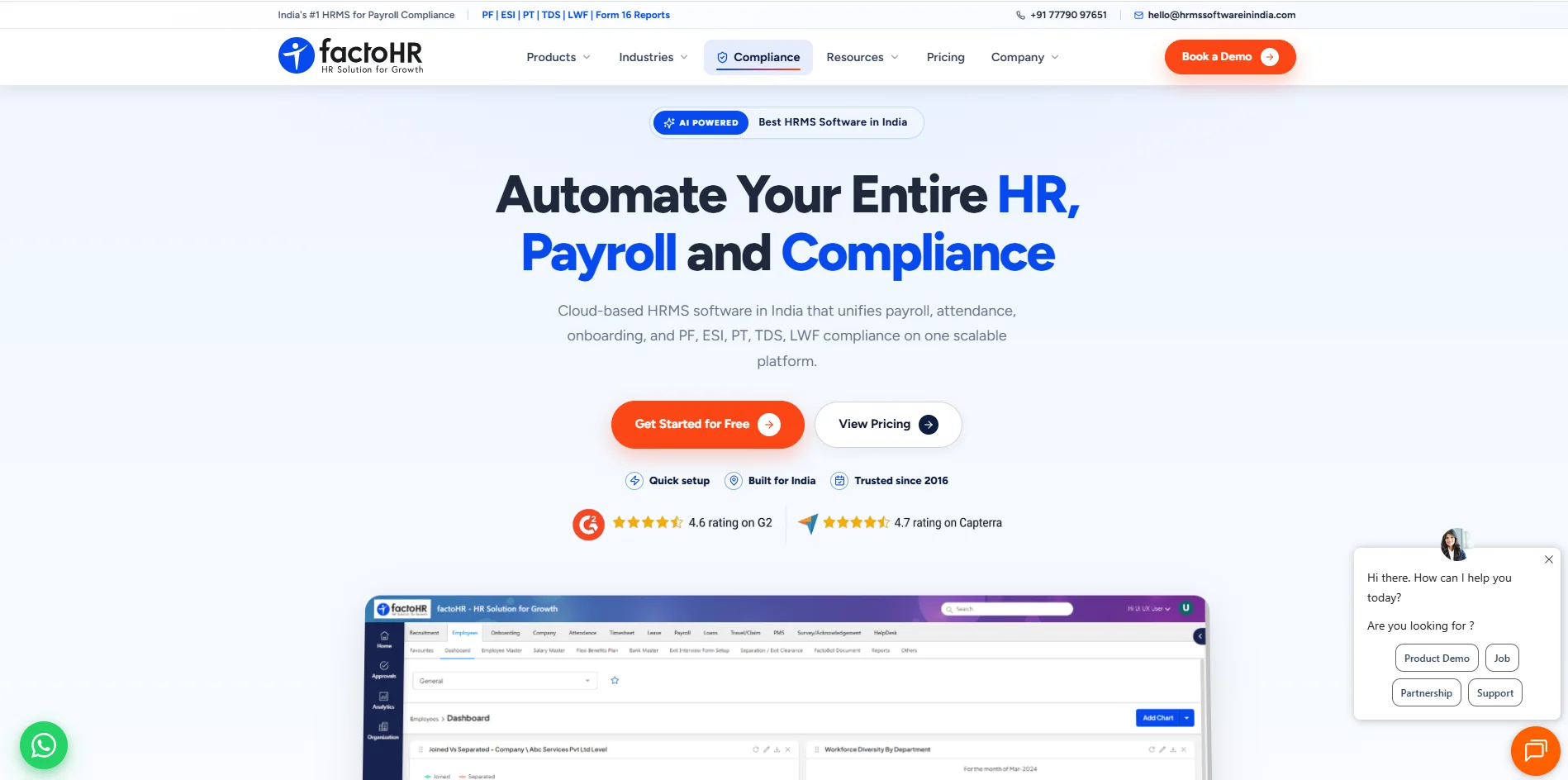
factoHR India is a payroll and HR platform built for distributed teams, which maps neatly onto an IT company with engineers in several states and clients that audit vendor security. Professional tax is applied at the employee's work location, flexible benefit plans run with declaration and proof workflows, and variable pay or ESOP perquisites recompute the tax projection in the month they land. Leave, attendance and expense data sit in the same system as payroll, so a two-day final settlement is routine rather than heroic. It is the strongest fit for an IT or ITES company that wants payroll, attendance and compliance in one audited platform, which is why it tops this list. Module detail is on the payroll software page.
Key features:
- Employee-level professional tax by work state, editable on relocation
- Flexible benefit plans with declarations, proofs and perquisite valuation
- Regime-wise TDS projection that recomputes on variable pay and ESOP exercise
- Final settlement with leave encashment, notice-pay recovery and reimbursements in one run
- PF at the Rs 25,000 ceiling, ESI for support staff, LWF, Form 138 and Form 16
- Hybrid attendance with web, mobile and geo punch, comp-off and WFH policies
- Role-based access, audit logs and India data residency for client audits
- Employee mobile app with payslips, tax sheet and investment declarations
Best suited for: IT services, product and ITES companies from 50 to several thousand employees across multiple states.
Watch-out: some advanced analytics and recruitment modules are priced as add-ons.
Pricing: free for up to 20 employees; transparent plans from around Rs 4,999 a month for up to 50 employees.
2. Keka
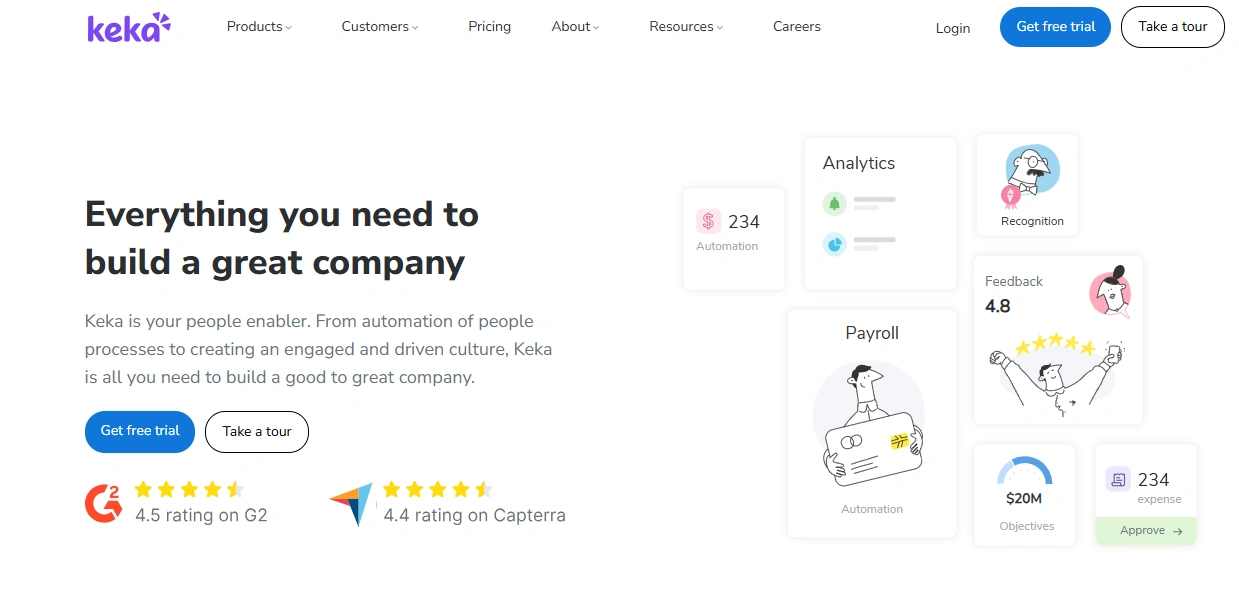
Keka is popular with Indian IT companies for a reason: the payroll review screen shows every variance before the bank file is cut, flexible benefits and tax regimes are handled per employee, and performance, OKRs and engagement live on the same platform. Hybrid attendance with geo-fencing and WFH requests is solid. It suits a product or services firm that wants employees to actually use the app.
Key features:
- Payroll review with variance highlights and approval flow
- Flexible benefits, regime selection and investment proofs
- Multi-state PT, PF, ESI, TDS and Form 138
- Hybrid attendance, WFH and comp-off policies
- Performance, OKR and engagement modules
- Expense and reimbursement processing
Best suited for: product and services firms with 100 to 2,000 employees that value usability.
Watch-out: pricing steps in blocks of 100 employees.
Pricing: plans start around Rs 6,999 a month for up to 100 employees.
3. HROne
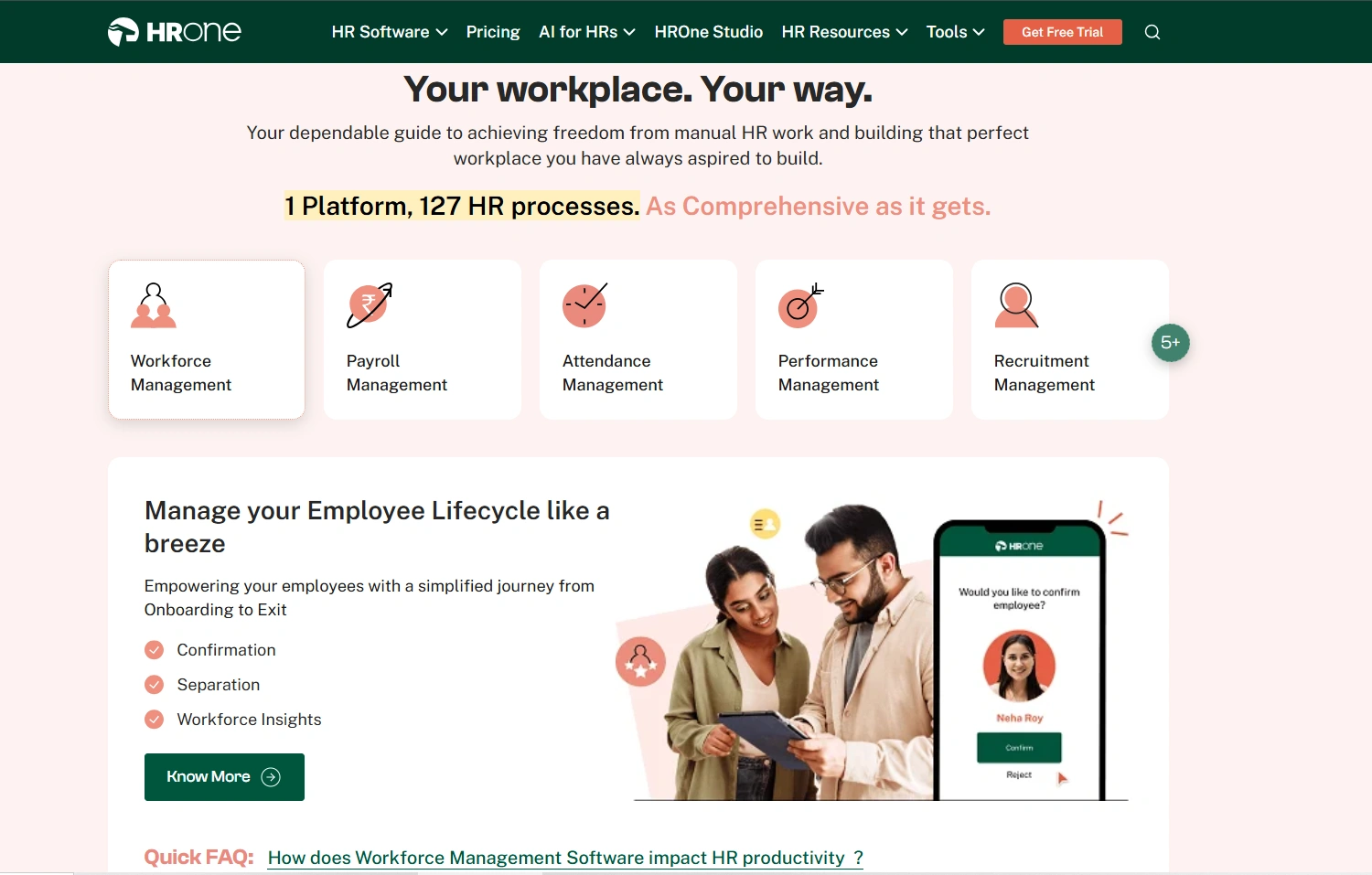
HROne is a hire-to-retire suite with multi-entity payroll and reporting that services firms appreciate: project-wise and bench-wise cost views, multi-state statutory, and audit trails on every change. Workflows handle variable pay approvals and exits cleanly. It fits a mid to large IT services company with multiple legal entities or delivery centres.
Key features:
- Multi-entity, multi-state payroll with consolidated reports
- Project, bench and cost-centre payroll reporting
- Variable pay, arrears and exit workflows
- PF, PT, LWF, TDS and Form 138 automation
- Audit logs and role-based access
- Integrations with accounting and HR tools
Best suited for: IT services firms with 500-plus employees across entities.
Watch-out: the enterprise tier is quote-based.
Pricing: roughly Rs 85 to Rs 130 per employee per month by tier.
4. Darwinbox
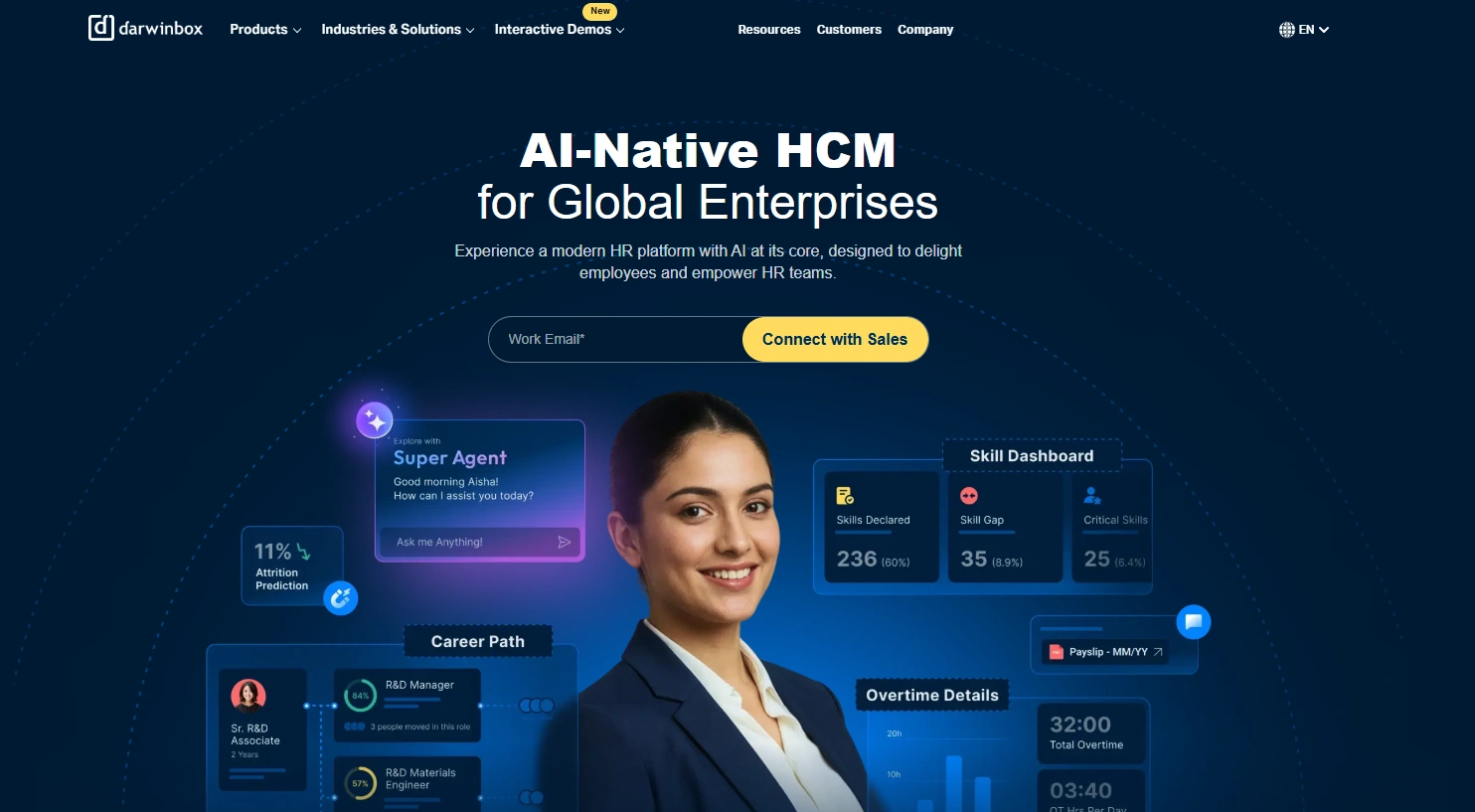
Darwinbox is an enterprise HCM with payroll depth to match, used by large Indian IT and ITES groups for global and multi-entity workforces. Analytics, talent and payroll share one data model, and security certifications satisfy enterprise client audits. It is the choice when scale and analytics matter more than entry price.
Key features:
- Enterprise payroll across entities and countries
- Talent, performance and workforce analytics
- Regime-aware tax engine and flexible benefits
- Security certifications and granular access control
- Integration with ERPs and identity providers
Best suited for: IT enterprises with 2,000-plus employees.
Watch-out: costly and heavy for a small firm.
Pricing: custom quote based on headcount and modules.
5. greytHR
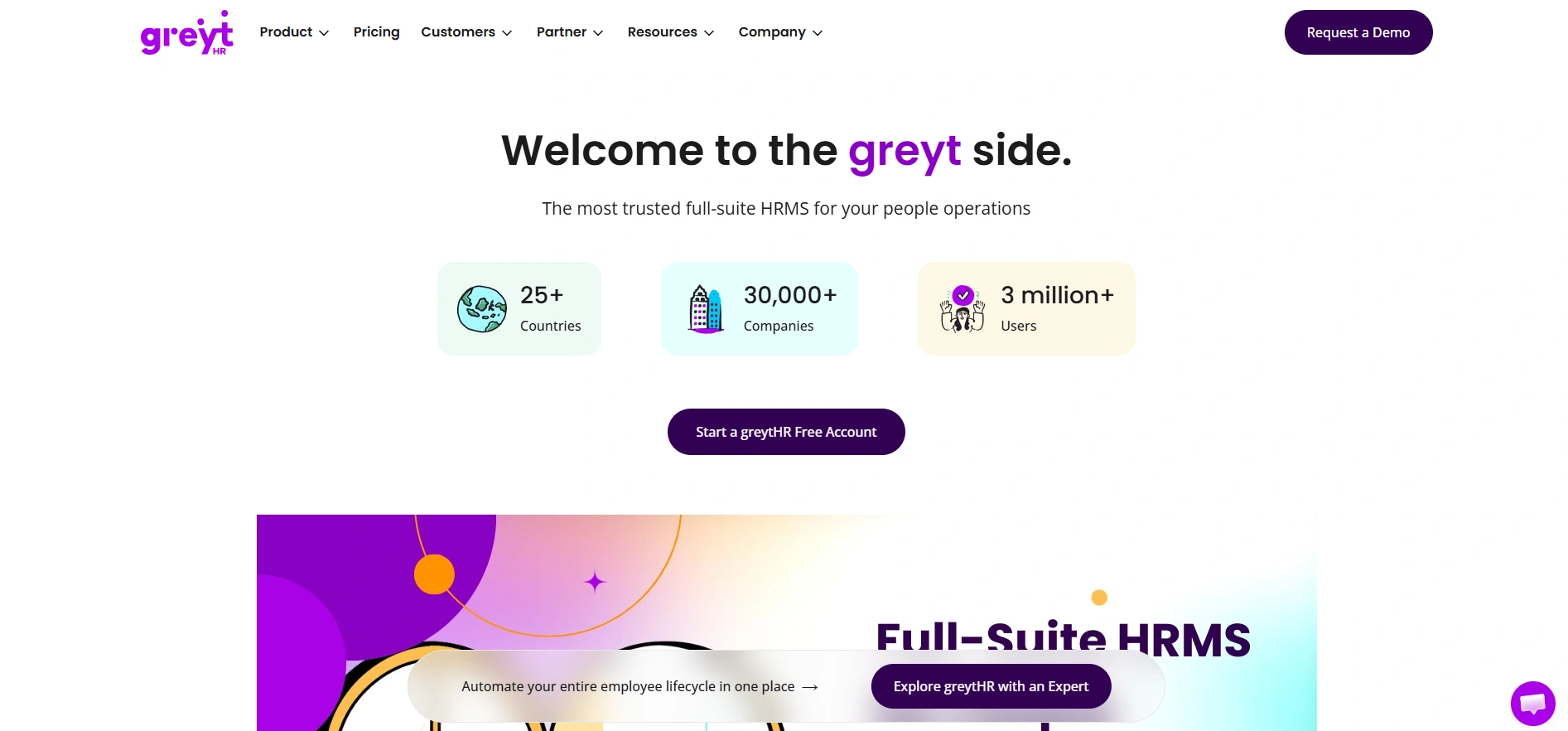
greytHR is the statutory workhorse: state-wise professional tax, PF, TDS, Form 138 and Form 16 are handled with the accuracy of two decades in Indian payroll. Flexible benefits and regime choice are supported, and the employee portal covers declarations and payslips. It suits a finance-led IT company that wants compliance first and HR features second.
Key features:
- State-wise PT, PF, LWF and TDS with automatic rate updates
- Investment declarations, proofs and regime-wise projection
- Form 138, Form 16 and challan-ready reports
- Leave, attendance and full-and-final computation
- Employee portal and mobile app
Best suited for: IT firms whose finance team runs payroll and wants statutory accuracy.
Watch-out: lighter on performance and engagement.
Pricing: free for up to 25 employees; paid plans from about Rs 1,495 a month.
6. Zoho People
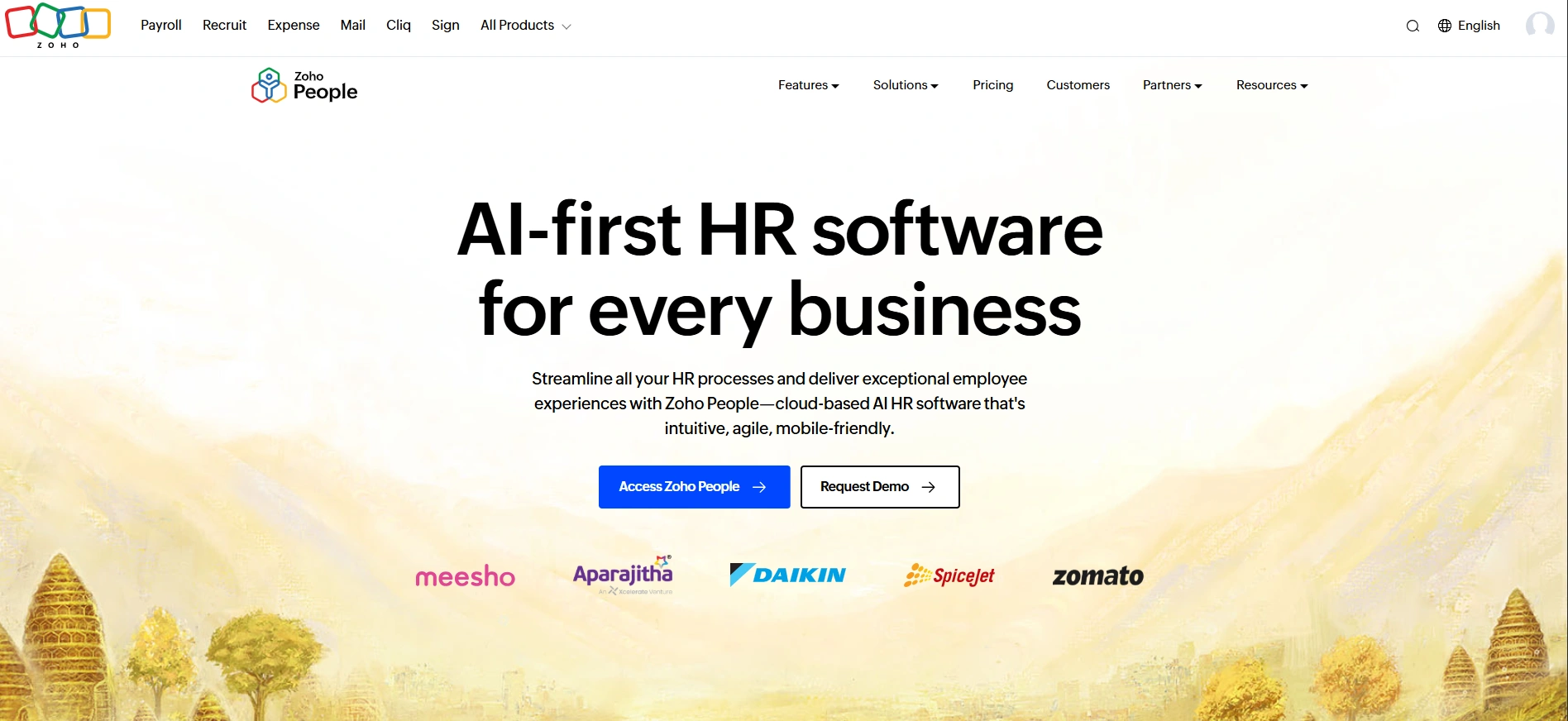
Zoho People with the Zoho Payroll add-on is the low-cost route for a small IT firm already on Zoho Books, Zoho CRM or Zoho Projects. Payroll handles PF, PT, TDS and Form 138, and the HR side covers attendance, leave and onboarding. Integration with the Zoho stack is the main reason to choose it.
Key features:
- Low per-employee pricing with a free tier for tiny teams
- Zoho Payroll add-on with PF, PT, TDS and Form 138
- Native sync with Zoho Books for salary journals
- Attendance, leave and onboarding workflows
- Employee self-service and mobile app
Best suited for: small IT firms under 100 employees on the Zoho ecosystem.
Watch-out: payroll is a separate add-on and multi-state depth is lighter.
Pricing: free up to 10 employees; around Rs 48 to Rs 230 per employee per month after, payroll add-on extra.
7. RazorpayX Payroll
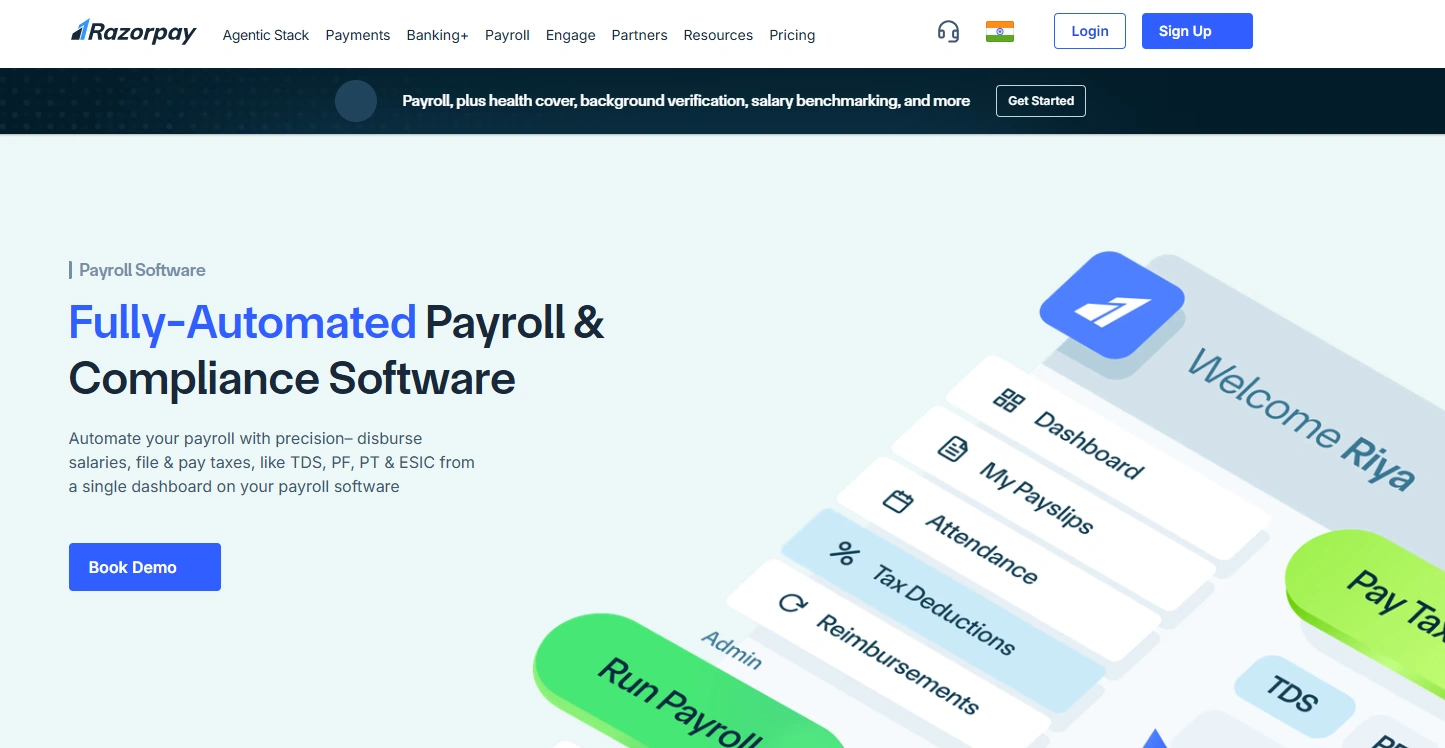
RazorpayX Payroll automates the whole payout chain for a small IT firm: salary computation, TDS, PF and ESI deposits and returns, and the bank transfer itself. Founders like it because compliance filing is included and the free core plan covers the basics. It is a payroll engine rather than an HR suite, so leave, performance and attendance need other tools.
Key features:
- Salary computation with one-click bank payouts
- TDS, PF, ESI and PT deposits and returns handled
- Form 16 and payslips for employees
- Contractor payouts with TDS
- Free core plan
Best suited for: small IT firms and startups under 100 employees that want payouts and filings automated.
Watch-out: thin HR features beyond payroll.
Pricing: free core plan; paid plans priced per employee.
8. PeopleStrong
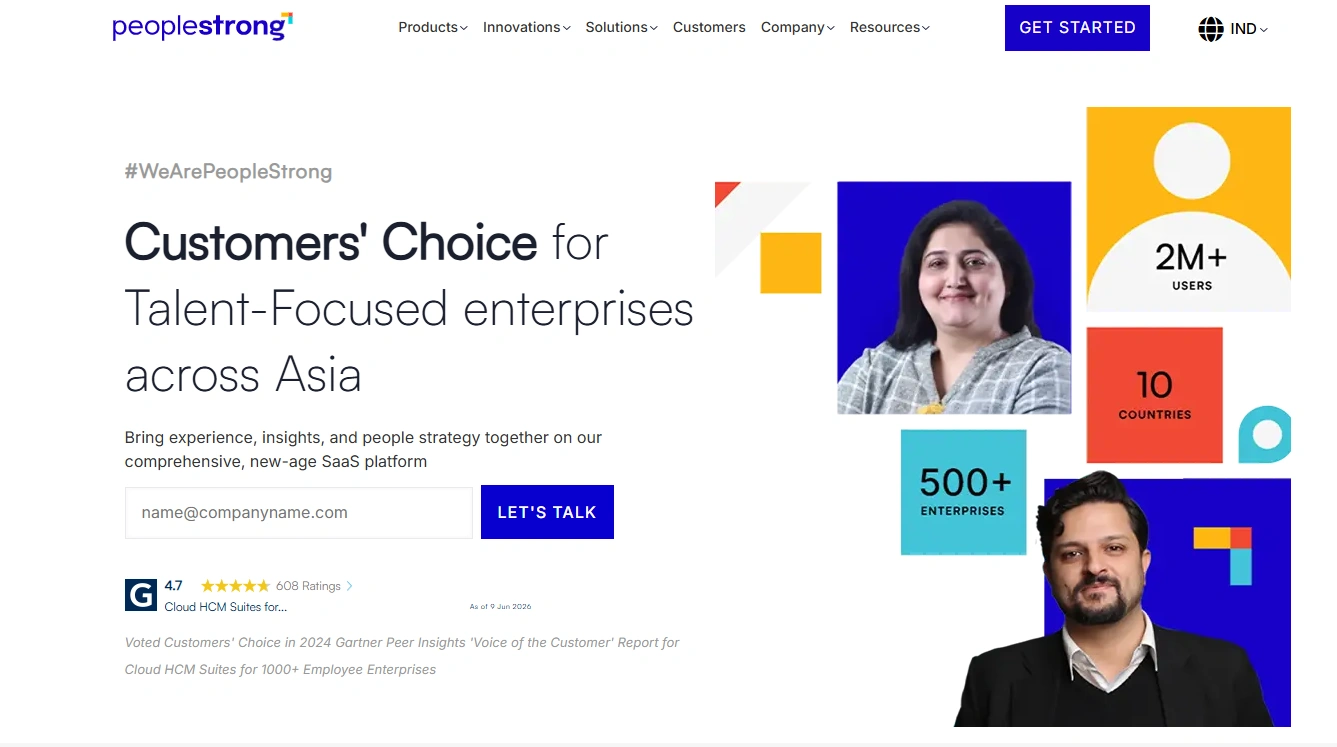
PeopleStrong is an India-built enterprise HCM used by large IT and ITES employers for payroll, talent and workforce analytics at scale. Multi-entity statutory, enterprise security and deep reporting are its strengths. It belongs on the shortlist for an enterprise, not for a 200-person firm.
Key features:
- Enterprise payroll with multi-entity statutory
- Workforce analytics and talent management
- Enterprise security and access control
- ERP and identity integrations
Best suited for: IT and ITES enterprises with thousands of employees.
Watch-out: quote-based and enterprise-focused.
Pricing: custom quote based on headcount and modules.
9. sumHR
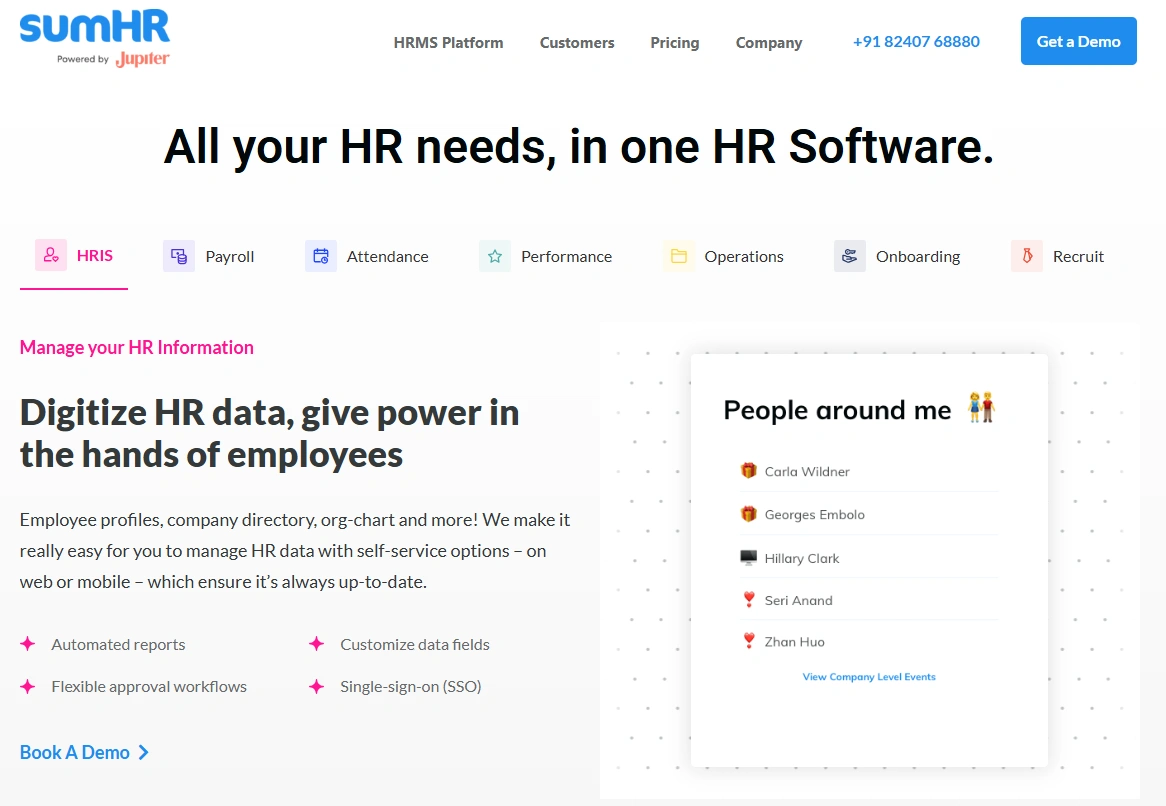
sumHR gives a lean IT team HR and payroll together at a low per-employee price, with quick setup and a clean employee app. Statutory basics, leave and attendance are covered. It is a sensible choice for a 20 to 150 person firm that wants more than a payroll engine without paying enterprise prices.
Key features:
- Payroll with PF, PT, TDS and Form 138
- Leave, attendance and onboarding
- Employee app with payslips and declarations
- Low per-employee pricing
Best suited for: lean IT teams of 20 to 150 employees.
Watch-out: smaller ecosystem and integrations.
Pricing: low per-employee pricing; confirm current plans with the vendor.
10. Qandle
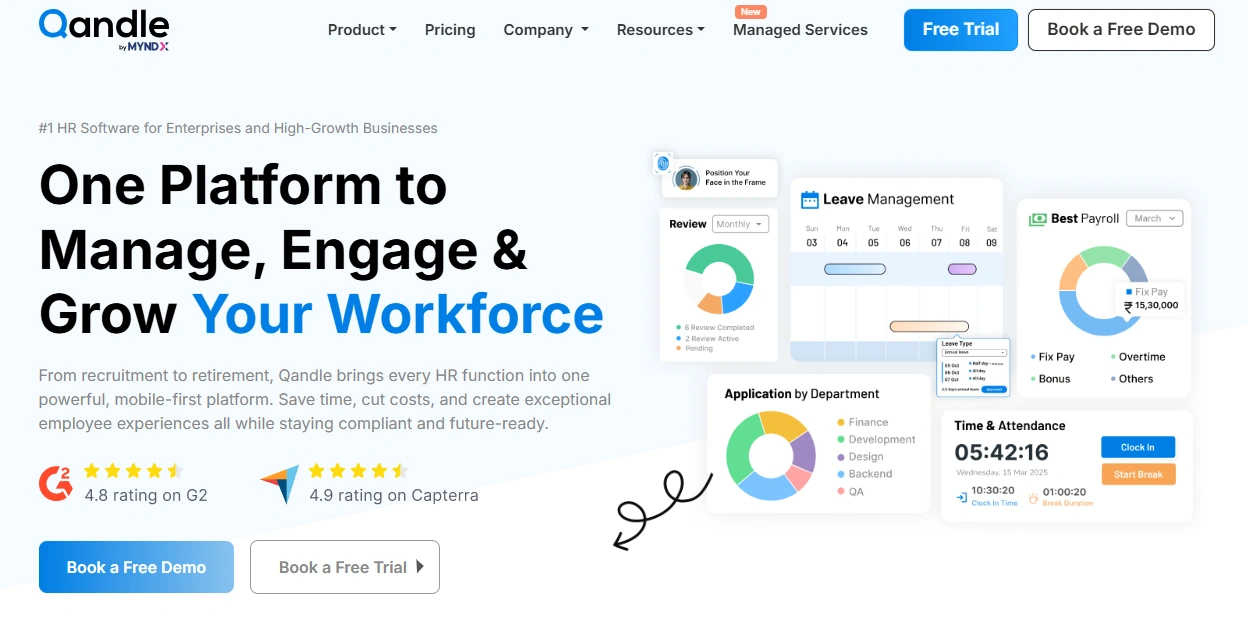
Qandle is a modular HR and payroll platform that lets a growing IT firm start with payroll and add attendance, performance and recruitment as needed. The employee app is polished and payroll handles Indian statutory needs. Modular pricing keeps the entry cost low but adds up as modules are switched on.
Key features:
- Modular payroll, attendance, leave and performance
- PF, PT, TDS, Form 138 and Form 16
- Flexible benefits and declarations
- Polished employee app
Best suited for: growing IT firms that want to add modules over time.
Watch-out: advanced modules add up.
Pricing: around Rs 49 to Rs 100 per employee per month by plan.
What IT Payroll Really Costs in 2026
Almost every IT employee sits above the Rs 21,000 ESI ceiling, so ESI applies only to support staff. PF is the big line, and the EPF wage ceiling of Rs 25,000 decides it: a company that restricts PF to the ceiling pays 12 percent of Rs 25,000, while one that contributes on full basic pays more. Here is a worked example for a software engineer earning Rs 80,000 gross a month with a basic of Rs 40,000, where the employer restricts PF to the ceiling:
| Item (per engineer) | Rate | Monthly |
|---|---|---|
| Employer EPF plus EPS | 12% of Rs 25,000 ceiling | Rs 3,000 |
| Employer ESI | Not applicable above Rs 21,000 | Rs 0 |
| EDLI plus admin | ~1% of PF wages | Rs 250 |
| Professional Tax | State slab | Rs 200 |
| Employer statutory outgo | Total of the above | Rs 3,450 |
| For 200 such engineers | Total x 200 | Rs 6,90,000 a month |
Gratuity accrues on top at roughly 4.81 percent of basic, and variable pay, retention bonuses and ESOP exercises add TDS spikes in the month they land. If the company contributes PF on full basic instead of the ceiling, the PF line on this engineer rises to Rs 4,800. Model the structures on our CTC calculator and review the components in our guide to salary structure in India.
How to Choose by Company Size
- Small firm, under 100 employees: prioritise statutory accuracy and low cost. greytHR, Zoho People, RazorpayX Payroll, sumHR or factoHR India on the starter tier fit well.
- Growing firm, 100 to 1,000 employees: you need multi-state PT, flexible benefits, variable pay and fast final settlement. factoHR India, Keka, Qandle or HROne are the sweet spot.
- Enterprise, 1,000-plus employees: you need multi-entity payroll, analytics and enterprise security. Darwinbox, PeopleStrong or HROne are built for this.
Whatever the size, the right payroll software for IT companies is decided by multi-state statutory, tax-engine accuracy and security evidence, not app polish. The buyer checklist is on our HR software for IT companies page, and the broader HR shortlist is in our guide to the best HR software for IT companies.
Implementation: What to Expect
- Salary-structure review: check that wages meet the Labour Codes 50 percent test and decide the PF policy, restricted to the ceiling or on full basic, before import.
- Location and PT mapping: load every employee's work state so professional tax applies correctly from month one; add a relocation workflow.
- Tax engine setup: configure flexible benefits, regime defaults, declaration windows and perquisite rules for ESOPs.
- Security and SSO: connect your identity provider, set role-based access and confirm audit logs meet your client-audit requirements.
- Parallel run: one month in parallel with the old process, reconcile TDS and PT state by state, then cut over. Expect three to five weeks for a mid-size firm.
Frequently Asked Questions
Which Payroll Software Is Best for IT Companies in India?
For most Indian IT and ITES companies, factoHR India and Keka are the strongest all-round choices because they handle multi-state professional tax, flexible benefits, variable pay and fast final settlement in one run. HROne and Darwinbox fit mid to large services firms, greytHR fits statutory-first teams, Zoho People and RazorpayX Payroll fit small firms, PeopleStrong fits enterprise, and sumHR and Qandle fit lean teams.
How Does Professional Tax Work for Remote IT Employees?
Professional tax is levied by the state where the employee works, not where the company is registered. A remote engineer in Maharashtra attracts Maharashtra slabs even if the company sits in Karnataka. Payroll software should hold the work state per employee and apply that state's slab and filing calendar. Our professional tax guide lists the slabs by state.
How Are ESOPs Taxed in Payroll?
At exercise, the difference between fair market value and exercise price is a perquisite taxed as salary, with TDS deducted by the employer. DPIIT-recognised eligible startups can defer the TDS under section 80-IAC rules, but most IT companies cannot. The payroll tool needs the exercise date and valuation to recompute the month's TDS.
Does the Two-Day Final Settlement Rule Apply to IT Companies?
Yes. The Code on Wages requires wages due at exit to be paid within two working days of resignation, removal or retrenchment, and state rules follow the Code. That is only achievable when leave balances, expense claims and notice-pay recovery live in the same system as payroll.
How Much Does IT Payroll Software Cost?
Budget roughly Rs 50 to Rs 200 per employee per month depending on modules. Entry plans start free or around Rs 1,495 to Rs 6,999 a month for small firms; enterprise tiers are quote-based.
Can It Handle Flexible Benefit Plans and Tax Regimes?
The tools on this list support employee-level regime selection and flexible benefit declarations with proof upload. Confirm during the demo that the TDS projection recomputes when a one-off component is added, because that is where under-deduction happens.
What Security Evidence Should I Ask For?
Ask for ISO 27001 or SOC 2 reports, data-residency confirmation for India, single sign-on support, role-based access and exportable audit logs. Enterprise clients increasingly include vendor HR systems in their security questionnaires.
How Long Does Implementation Take?
Three to five weeks for a mid-size firm with clean data; two to three months for an enterprise with multiple entities and SSO integration. One parallel payroll month before cutover is the safest approach.
Final Word
IT payroll is decided by the tax engine and the state map, not by the payslip template. factoHR India and Keka lead for all-round fit, HROne and Darwinbox for mid to large services firms, greytHR for statutory accuracy, Zoho People and RazorpayX Payroll for small firms, PeopleStrong for enterprise, and sumHR and Qandle for lean teams. Shortlist two or three, run one month in parallel, and cut over once TDS and professional tax reconcile state by state. Want to see multi-state payroll and a two-day final settlement on your own data? Book a free factoHR India demo.