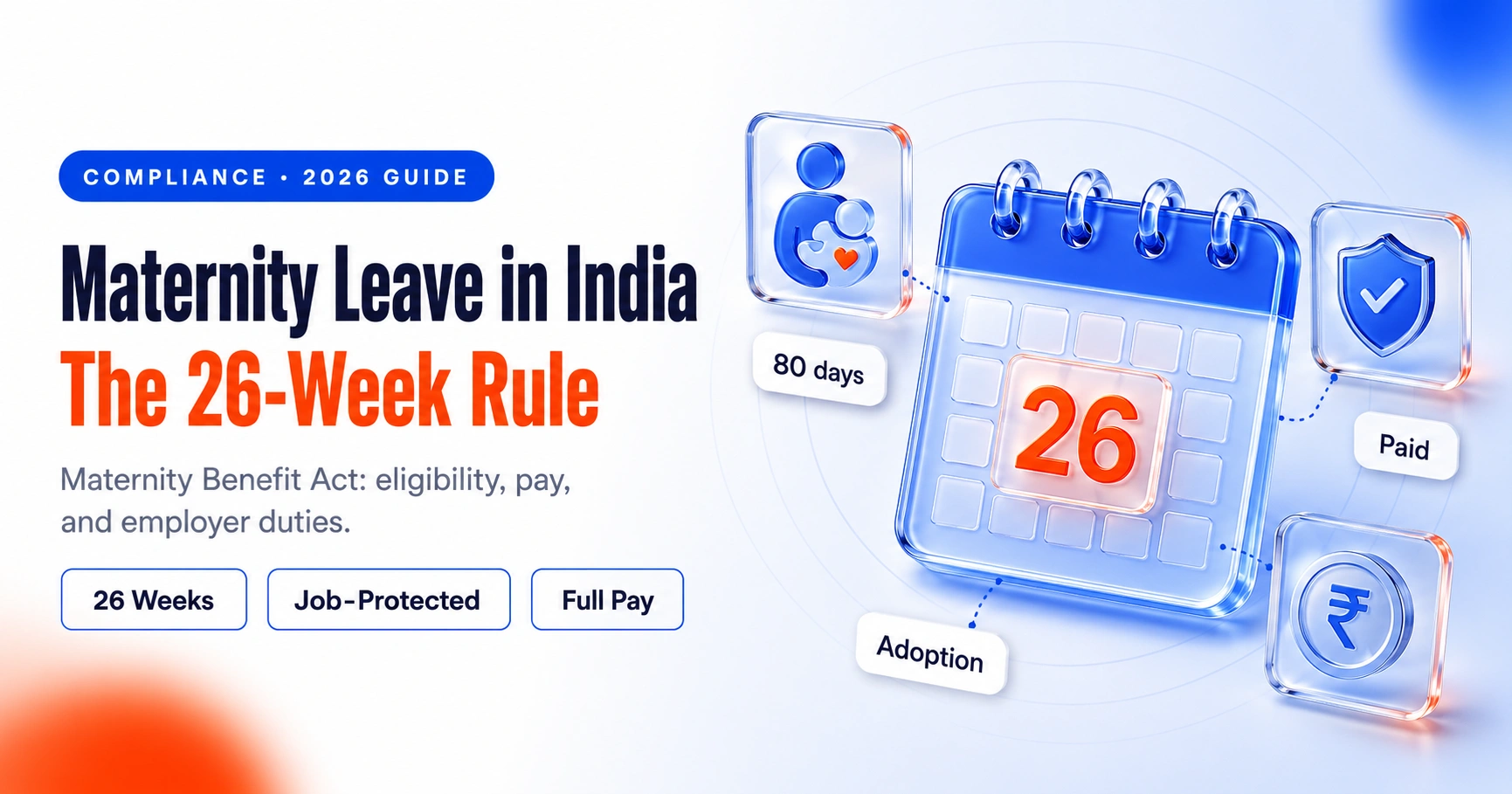
Maternity leave in India gives eligible women 26 weeks of paid, job-protected leave for their first two children, and 12 weeks for the third child onwards, under the Maternity Benefit Act, 1961 as amended in 2017. To qualify, a woman must have worked at least 80 days for the employer in the 12 months before her expected delivery date.
For HR and payroll teams, maternity leave is not just a policy line. Get the weeks, the pay calculation, or the ESI interplay wrong, and you face arrears, penalties, and a compliance problem. This guide covers the full rules, who is eligible, how pay works, and how employers stay compliant.
Key Takeaways
- Maternity leave is 26 weeks paid for the first two children and 12 weeks from the third child onwards, under the Maternity Benefit Act, 1961 (amended 2017).
- A woman qualifies if she has worked at least 80 days in the 12 months before her expected delivery. The Act applies to establishments with 10 or more employees.
- Adopting and commissioning mothers get 12 weeks; miscarriage gives 6 weeks, and a pregnancy-related illness gives an extra month.
- Leave is fully paid at the average daily wage, and the employer cannot dismiss or demote a woman during her maternity leave.
- If a woman is covered under ESI, her maternity benefit comes from ESIC, not the employer under this Act, so the two do not stack.
- Non-compliance carries a fine and imprisonment under Section 21, plus arrears, so payroll must track every case accurately.
What is maternity leave in India?
Maternity leave is a paid, protected break from work for a woman around childbirth. In India it is a legal right, not a company perk, governed by the Maternity Benefit Act, 1961. The 2017 amendment raised paid leave from 12 to 26 weeks, added cover for adopting and commissioning mothers, and made a crèche facility mandatory for larger establishments.
The Act applies to factories, mines, plantations, shops, and commercial establishments that employ 10 or more people. Women covered under the Employee State Insurance (ESI) scheme receive the benefit through ESIC instead, which we explain below.
Who is eligible for maternity leave?
A woman is entitled to maternity benefit if she meets two conditions:
- Service condition. She has actually worked for the employer for at least 80 days in the 12 months immediately before her expected date of delivery.
- Covered establishment. Her workplace employs 10 or more people and falls under the Act.
The 80-day rule counts days actually worked, and it covers permanent, temporary, contractual, and daily-wage women alike. There is no minimum salary bar for eligibility.
How many weeks of maternity leave apply?
The entitlement changes with the situation. This is the part employers most often get wrong.
| Situation | Paid leave |
|---|---|
| First and second child | 26 weeks |
| Third child onwards | 12 weeks |
| Adopting a child below 3 months | 12 weeks from the date the child is handed over |
| Commissioning mother (surrogacy) | 12 weeks from the date the child is handed over |
| Miscarriage or medical termination | 6 weeks from the date it occurs |
| Tubectomy operation | 2 weeks from the date of operation |
| Illness from pregnancy, delivery, or miscarriage | Extra 1 month of paid leave |
For the 26-week entitlement, a woman may take up to 8 weeks before her expected delivery, with the rest after. For the 12-week entitlement, up to 6 weeks may be taken before delivery.
Notice and documentation
To claim the benefit, the woman gives written notice to her employer stating that she will be absent and, if she wishes, that the benefit be paid to a nominated person. She states the date from which she will be absent, which cannot be earlier than the permitted pre-delivery window. A medical certificate or proof of delivery supports the claim. Employers should log this in the leave system so the dates and pay are correct.
How maternity pay is calculated
Maternity benefit is paid at the rate of the average daily wage for the period of actual absence. The average daily wage means the average of the wages payable to her for the days she worked during the three calendar months before she goes on leave. In practice this keeps her salary running as normal through the leave, so a correctly notified maternity leave does not reduce her pay. Clean payroll processing is what keeps this accurate across the leave period.
Job protection during maternity leave
The Act protects the woman's job. An employer cannot dismiss or discharge her during her maternity leave, and cannot change her conditions of service to her disadvantage because of the leave. Any dismissal during this period that would deprive her of maternity benefit is unlawful. This is one of the strongest protections in Indian labour law and applies regardless of company policy.
Crèche and work-from-home rules
Two more duties came in with the 2017 amendment:
- Crèche facility. Every establishment with 50 or more employees must provide a crèche, and the mother is allowed four visits a day to it, including her rest intervals.
- Work from home. If the nature of the work allows, an employer and employee may agree to a work-from-home arrangement after the maternity leave ends, on mutually agreed terms.
Maternity leave and ESI: the part most guides miss
This is where employers slip. If a woman is covered under the Employee State Insurance scheme, her maternity benefit is paid by ESIC, not by the employer under the Maternity Benefit Act. The two do not stack. So an employer must know which employees are ESI-covered and which fall under the Act, and pay through the right route. Mixing this up leads to either underpayment or paying twice. Keeping this straight is part of wider statutory compliance for any Indian employer.
Employer obligations checklist
- Grant the correct number of weeks based on the situation.
- Pay the benefit at the average daily wage and keep salary running.
- Do not dismiss, demote, or reduce the pay of a woman on maternity leave.
- Provide a crèche if you employ 50 or more people.
- Route ESI-covered employees through ESIC.
- Display an abstract of the Act at the workplace and keep the required records.
Penalties for non-compliance
Denying maternity benefit or dismissing a woman during maternity leave is an offence under Section 21 of the Act. It can attract imprisonment of three months up to one year, along with a fine, besides the arrears the employer must still pay. For a growing company, one mishandled case is enough to trigger a labour inspection, so the rules are worth getting right the first time.
How HR software handles maternity leave
Manually tracking 26-week entitlements, pre and post-delivery splits, ESI routing, and job-protection flags is where errors creep in. An HRMS platform applies the correct leave type, keeps pay running through the leave, and connects it to leave management and payroll so nothing falls through the cracks. That keeps both the employee and the business protected.
Key takeaways
- Maternity leave is a legal right of 26 weeks (first two children) or 12 weeks (third onwards), fully paid and job-protected.
- Eligibility needs 80 days of work in the prior 12 months, in an establishment with 10 or more employees.
- Adoption, surrogacy, miscarriage, tubectomy, and pregnancy illness each have their own entitlement.
- ESI-covered women are paid by ESIC, not the employer, so route the benefit correctly.
Frequently asked questions
How many months is maternity leave in India?
Maternity leave is 26 weeks, which is about six months, for the first two children. From the third child onwards it is 12 weeks, about three months. Adopting and commissioning mothers also get 12 weeks.
Is maternity leave paid in India?
Yes. Maternity leave is fully paid at the average daily wage for the whole period of leave. A correctly notified maternity leave does not reduce the woman's salary, and the employer cannot cut her pay because of it.
What is the eligibility for maternity leave in India?
A woman must have worked for the employer for at least 80 days in the 12 months before her expected delivery date, and her establishment must employ 10 or more people. There is no minimum salary requirement.
Can a company deny maternity leave?
No. If a woman meets the eligibility conditions, maternity leave is a legal right, not a discretionary benefit. Denying it or dismissing her during the leave is an offence under Section 21 of the Maternity Benefit Act, with a fine and possible imprisonment.
Is maternity leave available for a third child?
Yes, but the entitlement is 12 weeks for the third child onwards, instead of the 26 weeks available for the first two children. All other protections, such as full pay and job security, still apply.
Do ESI-covered employees get maternity leave too?
Yes. Women covered under the Employee State Insurance scheme receive maternity benefit through ESIC rather than from the employer under the Maternity Benefit Act. The benefit does not come from both sources, so the employer routes it through ESI for those employees.
Is there paid leave for a miscarriage in India?
Yes. In the case of a miscarriage or medical termination of pregnancy, a woman is entitled to 6 weeks of paid leave from the date it occurs, on production of the required medical proof.